Annual Leave, Sick Leave & Public Holidays in NZ

Ever wondered how much time off you're really entitled to in Aotearoa? Whether you're planning a summer getaway or need to know your rights when flu season hits, understanding annual leave, sick leave...
Priya writes about immigration pathways, job searching, and building a career in New Zealand. She covers visa options, CV writing, interview preparation, and workplace culture for newcomers and locals alike.
Ever wondered how much time off you're really entitled to in Aotearoa? Whether you're planning a summer getaway or need to know your rights when flu season hits, understanding annual leave, sick leave, and public holidays is essential for every Kiwi worker. With big changes on the horizon for 2026, here's everything you need to know to make the most of your entitlements.
Annual Leave Entitlements in New Zealand
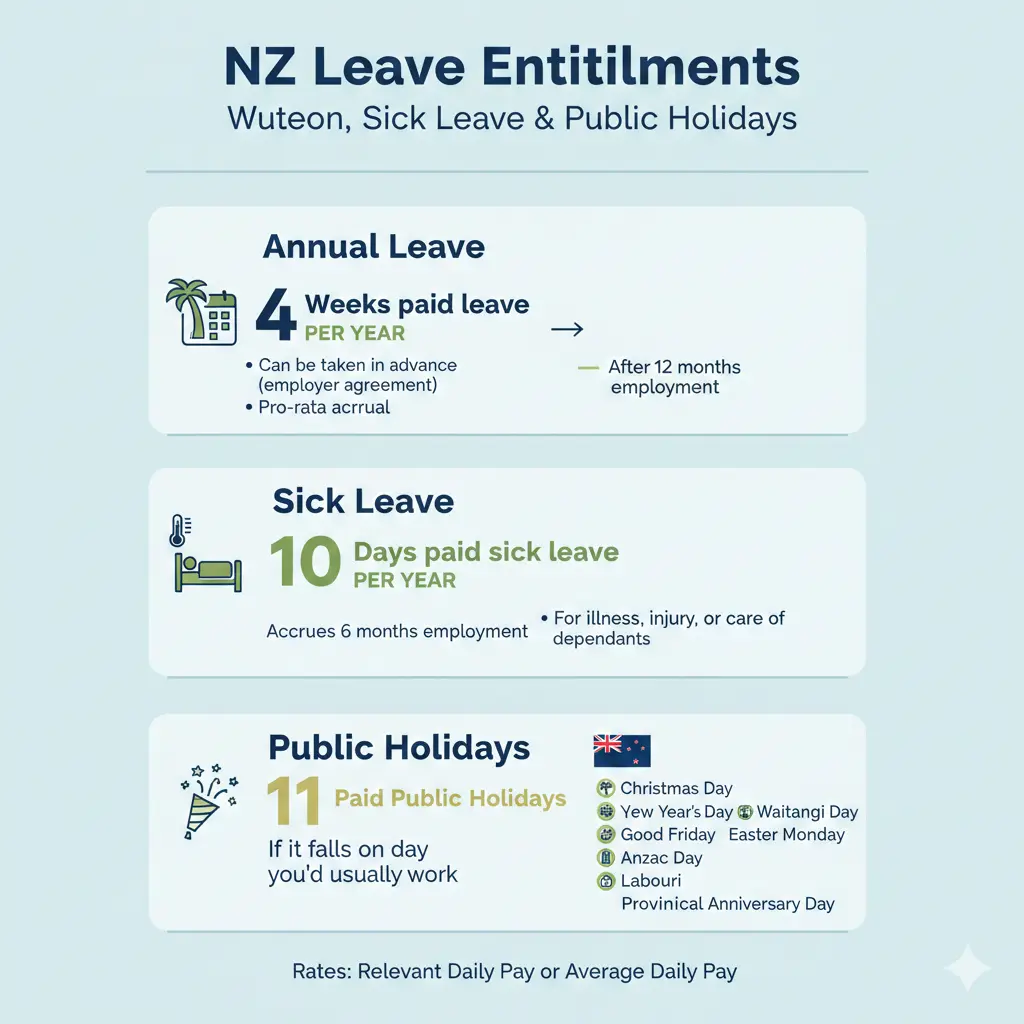
Right now, if you're working full-time or part-time with regular hours, you're entitled to at least four weeks' paid annual leave after 12 months of continuous employment with your employer. This kicks in on the anniversary of your start date, unless your workplace has an annual closedown or you've taken more than a week of unpaid leave, which can shift it.
Many employers offer leave in advance, letting you dip into your entitlement before that first year is up—just check your employment agreement. Your balance can either drop in a lump sum on your anniversary or accrue gradually as you work, adding up to those four weeks by year's end.
What's Changing in 2026?
Exciting reforms are coming with the replacement of the Holidays Act 2003. The new legislation, set for introduction in early 2026 with a two-year transition period, will see annual leave accrue from day one at a rate of 0.0769 hours per hour worked—still equating to four weeks annually for consistent hours.
This hourly system means greater flexibility: you can take leave in chunks as small as an hour, perfect for half-day appointments or school pick-ups. You'll also be able to cash up 25% of your balance every 12 months, up from the current one-week limit, which is a win if you've built up extra leave.
For casuals and those working extra hours, a 12.5% leave compensation payment on base hourly rates will replace accruing leave, paid per pay period. Payment simplifies too—all leave types will use a single hourly rate based on your base wage.
Sick Leave Rights for Kiwis
Currently, after six months with your employer, full-time workers get 10 days' paid sick leave per year, resetting annually. This covers illness, injury, or caring for dependants like kids or whānau. Part-timers get a pro-rated amount based on hours worked.
Upcoming Sick Leave Reforms
Under the new system, sick leave will also accrue from day one, moving to an hourly basis rather than lump sums. The rate ties into the 12.5% compensation for casuals (3.85% portion for sick leave).
This shift aims to fix the "complex and confusing" current setup, letting you take just the hours you need without burning a full day. Note: part-time workers might see adjusted entitlements under the hour-based model, so keep an eye on updates.
Public Holidays in New Zealand
We Kiwis enjoy 12 public holidays a year, like Waitangi Day, Easter, and Christmas. If they fall on a workday and you don't work, you're paid as usual. Work on one? You get time-and-a-half plus a day off later, or 200% pay.
When a holiday lands on a weekend, it's often "Mondayised"—pushed to the next working day. Your employment agreement might offer more, but the minimums are law.
Maximising Public Holidays with Annual Leave in 2026
2026 offers prime opportunities to stretch your leave. Here's how to book smartly for epic breaks:
- Waitangi Day (Fri 6 Feb): Take 9-12 Feb (4 days) for 6 Feb-14 Feb off—9 days total.
- Easter (Good Fri 3 Apr, Easter Mon 6 Apr): Book 7-10 Apr for 3-12 Apr (10 days).
- ANZAC Day (Mon 27 Apr observed): 28 Apr-1 May for 25 Apr-3 May (9 days).
- King's Birthday (Mon 1 Jun): 2-5 Jun for 30 May-7 Jun (9 days).
- Matariki (Fri 10 Jul): 13-16 Jul for 10-18 Jul (9 days).
- Labour Day (Mon 26 Oct): 27-30 Oct for 24 Oct-1 Nov (9 days).
- Christmas/NY (25 Dec, 1 Jan, plus 29 Dec?): 29-31 Dec + 4 Jan for 25 Dec-4 Jan (11 days).
Pro tip: Chat with your boss early—workplaces often slow down end-of-year anyway.
Practical Tips for Managing Your Leave
Keep records of your entitlements and usage—employers must too. For annual closedowns, you might have to use leave, but get paid for public holidays within it.
Actionable advice:
- Review your employment agreement for extras beyond minimums.
- Use apps or calendars to track accrual, especially with 2026 changes.
- If casual, confirm your 12.5% payments are itemised on payslips.
- Plan around public holidays—book leave flanking them for max R&R.
- Got questions? Contact Employment NZ's helpline or use their online tools.
Next Steps for Kiwi Workers
Stay ahead by bookmarking Employment NZ and MBIE sites for 2026 updates. Talk to your employer about your balances, plan those long weekends, and know your rights—you've earned that time off. If disputes arise, free advice is available via Employment NZ. Here's to more beach days and less worry!
Frequently Asked Questions
Sources & References
-
1
New holiday leave legislation: what you need to know - Lane Neave — www.laneneave.co.nz
-
2
Maximise your annual leave in 2026 - 1Cover Travel Insurance — www.1cover.co.nz
-
3
Understanding the Employment Leave Act | Three60 Consult — three60consult.co.nz
- 4
- 5
-
6
Holidays Act to be replaced | MBIE — www.mbie.govt.nz
-
7
Annual holidays | Employment New Zealand — www.employment.govt.nz
-
8
New Zealand PTO: A Comprehensive Guide to Paid Time Off — trackingtime.co
-
9
Public Holiday Entitlements NZ: Employer Factsheet — employmenthero.com