Chicken Keeping NZ: Beginner's Guide

Keeping chickens in your backyard is one of the most rewarding ways to get started with urban farming in New Zealand. Whether you're after fresh eggs, natural pest control, or just some feathery compa...
The Lifetimes NZ editorial team curates, fact-checks, and updates guides on personal finance, property, health, immigration, legal, business, and lifestyle topics relevant to Lifetimes NZ readers. Articles are produced with AI assistance and reviewed by the editorial team before publication.
Keeping chickens in your backyard is one of the most rewarding ways to get started with urban farming in New Zealand. Whether you're after fresh eggs, natural pest control, or just some feathery companions, raising a small flock is easier than you might think. This guide walks you through everything you need to know to get your first chickens up and running, from understanding local council rules to building the perfect coop.
Check Your Local Council Rules First
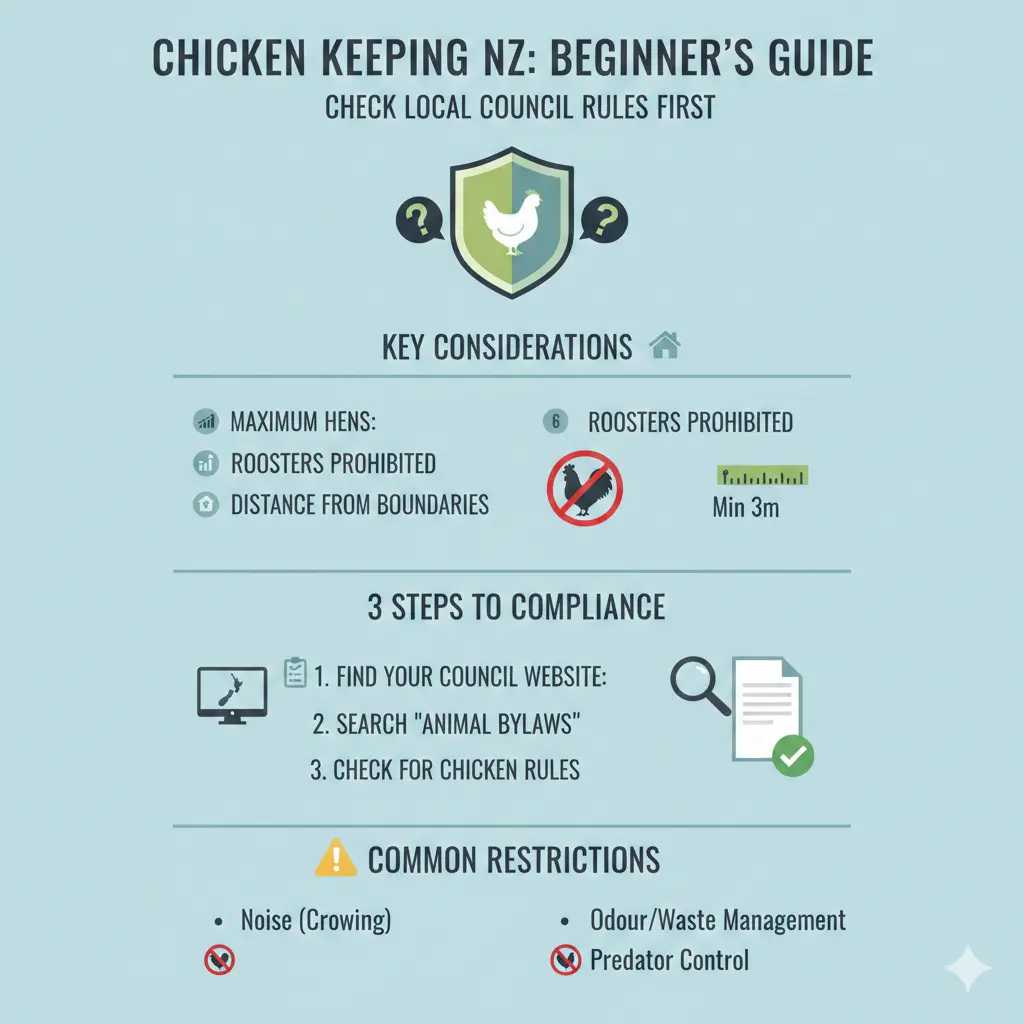
Before you buy a single chicken, you'll need to check what your local council allows. Each council in New Zealand has its own rules about chicken keeping, and they vary significantly depending on where you live. This is the most important first step, so don't skip it.
Some councils, like Christchurch, don't require any permission to keep chickens in your backyard, with no limits on numbers. However, others have strict requirements. For example, Auckland Council requires that chickens have access to at least three square metres of land per chicken if they're kept in an enclosure.
You'll also want to check if your property has a covenant that might exclude poultry keeping. Some residential developments enforce their own restrictions, separate from council rules, so it's worth checking your property documents or asking your developer.
Understanding New Zealand's Free-Range Standards
If you're planning to keep your chickens as "free range," it's helpful to understand what that means in New Zealand. Under New Zealand law, layer hens are considered free range as long as they have access to the outdoors and meet the stocking densities set by the Code of Welfare.
For your backyard flock, here are the key space requirements:
- Indoor coop space: 9 chickens per square metre (or 0.6 square metres for 6 chickens)
- Outdoor roaming space: 1 hen per 4 square metres maximum
- For Auckland specifically: At least 3 square metres of land access per chicken
The SPCA goes further, advocating that all laying hens should have unrestricted access to an outdoor area for at least 8 hours per day with appropriate ground cover and natural shelters. This is a good standard to aim for if you want genuinely happy, healthy birds.
Building Your Chicken Coop
Your chicken coop is the foundation of your operation. The good news? Most councils in New Zealand view chicken coops as low-risk construction work, so you can build your own or buy a ready-made one without needing council approval.
Essential Coop Features
Your coop needs to include:
- An enclosed, rainproof shelter for sleeping and laying eggs
- At least 30 cm of roosting or perching space per chicken
- A surface for pecking and scratching (grass or dirt, not concrete)
- A secluded nesting area where hens feel safe laying eggs
- Pop-holes (access doors) at least 35 cm high and 40 cm wide, evenly spaced along the building
Location Matters
Where you place your coop is just as important as how you build it. Set it up in a spot that's least likely to cause a nuisance to neighbours. Consider these practical tips:
- Keep the coop away from your fence if your neighbours have dogs, as chickens can encourage barking
- Avoid placing it too close to the street where it might be visible to roaming dogs
- Choose a location that isn't too sunny or too exposed to the wind
- Keep it at least 1 metre from the boundary fence
Space Requirements for Different Setups
The amount of space you need depends on how many chickens you're keeping and whether they'll be fully free-range or confined to a run.
For a Small Backyard Flock
If you're keeping 6 chickens, you'll need at least 0.6 square metres of space inside the coop and at least 24 square metres of space in your chicken run. However, if you have the ability to give them access to larger space while keeping them safe from predators and the elements, they'll be happier and healthier.
Balancing Free-Range and Confinement
Many Kiwi backyard farmers find that a balance of both free-ranging and confined space works best: allow them to roam in a fenced area during the day and keep them safe in the coop at night. This approach protects them from predators while still giving them room to express natural behaviours like scratching and dust bathing.
What About Roosters?
If you're thinking about adding a rooster to your flock, be prepared for extra paperwork. Most councils ban roosters because of the likelihood of offensive noise, but some will allow them with a permit.
If your council permits roosters, you'll typically need to apply for a permit and meet specific requirements, such as:
- Keeping the rooster effectively confined in an appropriate enclosure
- Soundproofing the enclosure to reduce noise
- Placing the enclosure at least 1 metre from the boundary fence and 5 metres from roads
- Regularly cleaning and maintaining the enclosure to prevent vermin and odour
Check with your local council before you commit to keeping a rooster.
Essential Chicken-Keeping Equipment
Beyond the coop itself, you'll need some basic equipment to keep your flock healthy and happy:
- Feeders and drinkers to provide fresh food and water daily
- A dust bath (a sand or dirt area where chickens can self-clean)
- Predator-proof fencing to protect your run from foxes, stoats, and other threats
- Bedding material for the coop (straw or wood shavings)
- Layer feed specifically formulated for egg-laying hens
- A basic first aid kit with electrolytes and healing ointment
Being a Good Neighbour
Even if your council allows chickens, most councils state that chickens must not cause a nuisance. This means keeping noise levels down and maintaining your coop properly.
Chickens will cluck and make noise throughout the day, which most neighbours won't mind. However, having enough space for each chicken can help reduce noise and fights, as feeling confined can result in squabbles that annoy neighbours.
Keep your coop clean and well-maintained to prevent vermin, odour, and fly problems. Excess food and bedding waste can attract mice, rats, and flies to your property.
Frequently Asked Questions
Do I need council permission to keep chickens in New Zealand?
It depends on your local council. Yes, raising chickens in most cities and suburbs around New Zealand is legal, but each city has its own rules on how many chickens you can own and whether you need a license. Always check with your local council first.
How many chickens can I keep?
This varies by council. Some councils have no limit, while others restrict numbers based on property size. Check your local council's requirements, and remember that more space means healthier, happier birds.
Can I keep chickens on a small urban section?
Yes, but you'll need to meet your council's minimum space requirements. Auckland Council, for example, requires at least three square metres of land access per chicken. Many other councils have similar or less stringent requirements.
What's the difference between a coop and a run?
The coop is the enclosed shelter where your chickens sleep and lay eggs. The run is the outdoor fenced area where they can roam during the day. Both are important for your birds' safety and wellbeing.
How often do I need to clean the coop?
You should clean out bedding regularly to prevent vermin, odour, and flies. Most backyard farmers do a full clean weekly and remove soiled bedding as needed throughout the week.
Will my chickens lay eggs year-round?
Most hens lay well during spring and summer, with production dropping in autumn and winter as daylight hours decrease. You can extend laying with supplementary lighting in the coop, but this isn't necessary for a backyard flock.
Getting Started: Your Next Steps
Ready to join the growing number of Kiwis keeping backyard chickens? Here's what to do:
- Visit your local council's website and check their specific requirements for keeping chickens
- Check your property documents for any covenants that might restrict poultry
- Talk to your neighbours about your plans—being upfront builds goodwill
- Decide how many chickens you want and ensure you have adequate space
- Build or purchase a suitable coop with all the essential features
- Set up your run with predator-proof fencing and a dust bath area
- Get your chickens and enjoy fresh eggs!
Starting with chickens doesn't need to be complicated. By understanding your local rules, building a proper coop, and giving your birds enough space, you'll be well on your way to a thriving backyard flock. The reward? Fresh eggs, natural pest control, and some genuinely entertaining feathery friends.