NZ Minimum Wage 2025: What You Need to Know

As we navigate 2026, knowing your rights under New Zealand's employment laws is crucial—especially if you're earning the minimum wage NZ 2025 or supporting someone who is. The adult minimum wage sits...
Priya writes about immigration pathways, job searching, and building a career in New Zealand. She covers visa options, CV writing, interview preparation, and workplace culture for newcomers and locals alike.
As we navigate 2026, knowing your rights under New Zealand's employment laws is crucial—especially if you're earning the minimum wage NZ 2025 or supporting someone who is. The adult minimum wage sits at $23.50 per hour since 1 April 2025, affecting around 142,000 Kiwis with a welcome pay boost.
This change means an extra $14 a week before tax for a standard 40-hour week, helping stretch the household budget amid rising living costs. Whether you're a teen starting out, an apprentice in training, or a full-time worker in hospitality or retail, this guide breaks down everything you need to know about the minimum wage NZ 2025, from rates and who qualifies to how to check your pay and what employers must do.
What is the Minimum Wage in New Zealand?
The minimum wage is the lowest hourly rate most employees can legally be paid in Aotearoa. It's set annually by the government and applies to all covered workers, regardless of industry, from cafes in Christchurch to farms in Waikato. Governed by the Minimum Wage Act 1983 and updated via Employment New Zealand, it ensures fair pay for basic work.
From 1 April 2025, rates rose in line with inflation and wage growth, but they're reviewed yearly—keep an eye on announcements from the Ministry of Business, Innovation and Employment (MBIE) for 2026 updates.
Current Minimum Wage Rates (as of 2026)
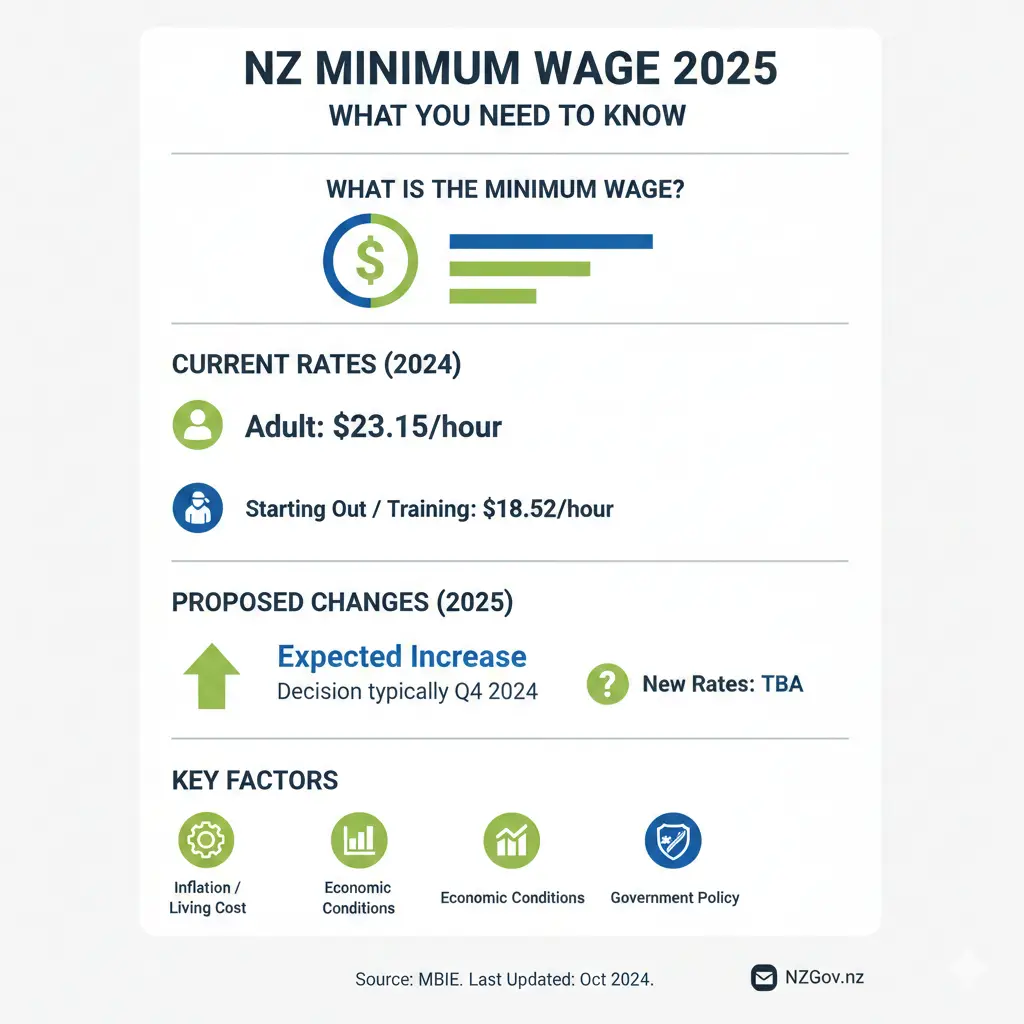
- Adult minimum wage (16 years and older): $23.50 per hour (up from $23.15).
- Starting-out minimum wage: $18.80 per hour (80% of adult rate, up from $18.52)—for 16-17 year olds in their first 6 months or up to 12 months with the same employer.
- Training minimum wage: $18.80 per hour (also 80% of adult rate)—for workers 20+ doing at least 60 credits of industry training yearly.
These are gross rates (before tax). For a full-time worker (40 hours/week, 52 weeks/year), the adult rate equates to about $48,960 annually before deductions.
Who Qualifies for Minimum Wage?
Most employees aged 16+ qualify, but exemptions apply. You're covered if you're:
- Employed under an individual or collective employment agreement.
- Working in any sector, including casual jobs like waiting tables in Auckland bars or picking fruit in Hawke's Bay.
Who Doesn't Qualify?
- Workers under 16.
- Residents in care homes or supported accommodation doing flat-rate tasks.
- Certain family members on family businesses (check Employment NZ for details).
Self-employed contractors, volunteers, and some interns aren't entitled—always clarify your status with your employer or Employment NZ.
Minimum Wage vs Living Wage: What's the Difference?
Don't confuse the legal minimum with the New Zealand Living Wage, which is higher at $28.95 per hour from 1 September 2025 (up $1.15, a 4.2% rise tracking average wages). Calculated by the Family Centre Social Policy Research Unit, it covers basics like housing, food, and transport for a dignified life—not just survival.
That's $5.45 more per hour than the minimum, or over $11,000 extra yearly for full-timers. Over 342 accredited employers (in hospitality, finance, retail) pay it voluntarily. If your employer is accredited, you might already earn it—check Living Wage Aotearoa NZ.
"The Living Wage has made a real difference to workers for over a decade now," says Gina Lockyer, Executive Director of Living Wage Aotearoa NZ.
How the 2025 Increase Affects You
The jump from $23.15 to $23.50 added 35 cents/hour, benefiting 141,900 workers. For part-timers, that's real money: a 20-hour week gains $7 weekly.
Real-Life Examples for Kiwis
- Hospitality worker in Wellington: Serving coffees 30 hours/week? Your pay rises $280/year before tax.
- Teen in retail, Hamilton: At starting-out rate, $18.80/hour means safer entry to work.
- Apprentice plumber, Dunedin: Training rate supports skill-building without exploitation.
Employers must update payslips by 1 April 2025—no phasing in allowed. If you're underpaid, you're owed backpay.
Employers' Responsibilities
Kiwi bosses must pay at least the minimum from day one, record hours accurately, and provide itemised payslips showing the rate. Penalties for non-compliance include fines up to $10,000 for individuals or $50,000 for businesses via the Labour Inspectorate.
Practical tips for employers:
- Review payroll software now—many like iPayroll auto-update rates.
- Train managers on exemptions to avoid mistakes.
- Communicate changes to staff via meetings or emails.
- If offering above-minimum, note it in contracts for clarity.
How to Check if You're Paid Correctly
Grab your payslip and calculator:
- Multiply hours worked by the applicable rate (adult, starting-out, or training).
- Subtract pre-tax deductions (KiwiSaver, tax)—use IRD's tax calculator.
- Compare take-home pay. Tools like MoneyHub's wage checker help verify.
Suspect underpayment? Contact Employment NZ's helpline (0800 20 90 20) or use their online form. They investigate free, and you can remain anonymous. In 2024, they recovered millions for underpaid workers.
What About Overtime, Holidays, and Other Pay?
Minimum wage applies to ordinary hours only. Overtime, public holidays, and annual leave have separate rules under the Holidays Act 2003:
- Public holidays: Time-and-a-half if worked, or 8 hours' pay if not.
- Annual leave: 4 weeks paid (or 5 for new starters post-2024 changes).
- Alternative holidays: Paid at your average wage.
Meal and rest breaks are mandatory—4 hours max without a 10-minute paid break. For full details, visit Employment NZ.
Future Outlook: Minimum Wage NZ 2026 and Beyond
Models predict $24.00/hour by end-2026, rising to $24.50 in 2027, based on economic forecasts. With unemployment at 5.3% and wages growing 2.1% yearly, pressures like inflation could push faster hikes. Watch MBIE announcements around December for confirmation.
Next Steps for You
Review your latest payslip today against the $23.50 rate. If it's short, reach out to Employment NZ or a union like FIRST Union. Employers, audit your payroll and chat with staff. Stay informed via employment.govt.nz or MBIE updates. Earning minimum wage? Budget tools from Sorted.org.nz can help maximise it—knowledge is your best tool for fair pay.
Frequently Asked Questions
Sources & References
-
1
Minimum wage set for 2025 — www.mbie.govt.nz
-
2
New Zealand Minimum Wage 2025 & 2026 — www.moneyhub.co.nz
-
3
Minimum Wage Rates in New Zealand — www.employers.co.nz
-
4
New Zealand Living Wage for 2025/26 is $28.95 per hour — www.livingwage.org.nz
-
5
New Zealand Gross Minimum Hourly Wage — tradingeconomics.com
-
6
Highest & Lowest Minimum Wage by Country in 2025 — velocityglobal.com
-
7
What is the minimum wage? — support.ipayroll.co.nz
-
8
Minimum wage and fair pay — www.business.govt.nz
Useful Tools
Related Articles

Employment Law 101: Annual Leave; Sick Pay; and Your Rights
Ever wondered if you're getting the annual leave or sick pay you're entitled to? As Kiwis, we all deserve fair treatment at work, but navigating employment law can feel like a maze—especially with big...
Minimum Wage 2026: Your Rights and What You Should Be Paid
Imagine clocking in for your shift at the local café in Auckland, only to realise your pay slip doesn't match what the law says you should be earning. For around 122,500 Kiwis living on or near the mi...
Public Holidays NZ 2025: Your Rights and Pay
If you're working in New Zealand, understanding your public holiday rights is crucial—it affects your pay, your time off, and your work-life balance. Whether you're an employee wondering how much you'...

Minimum Wage NZ 2025: Current Rates and Your Rights
Imagine clocking in for your shift, working hard all day, only to realise your pay slip doesn't add up. For Kiwis relying on the minimum wage NZ 2025, knowing your rights isn't just smart—it's essenti...