Prescription Costs & Subsidies in New Zealand 2025

If you're managing a long-term health condition in Aotearoa, understanding how much you'll pay for prescriptions can help you budget better and plan your healthcare. New Zealand's prescription system...
Emma writes about health, wellbeing, and ACC topics for Lifetimes NZ. She translates complex health information into clear, actionable advice for New Zealand readers.
If you're managing a long-term health condition in Aotearoa, understanding how much you'll pay for prescriptions can help you budget better and plan your healthcare. New Zealand's prescription system has changed significantly, and there are genuine ways to reduce what you're spending on medicines. Let's walk through how it works, what you'll actually pay, and the new changes coming into effect this month that could save you money.
How Much You'll Pay for Prescriptions
The cost of your prescription depends on a few key factors: your age, who prescribed the medicine, and whether it's fully subsidised by the government.
Standard Prescription Charges
For most adults aged 18 to 64, you'll pay $5 per medicine on a prescription written by your GP or a healthcare provider in a public hospital. This is the standard charge for fully subsidised medicines. If you're 65 years or older, or under 14, you don't pay anything for prescriptions from your GP or public hospital.
Things change if your prescription comes from a private specialist or dentist. In that case, you'll pay $15 per medicine as an adult aged 18 and over. If you have a Community Services Card or High Use Health Card, this reduces to $5 per medicine. Children aged 14 to 17 from private specialists pay $10 per medicine, unless they have a CSC or HUHC.
Partially Subsidised and Unsubsidised Medicines
Not every medicine gets the same level of government support. Some medicines are only partially subsidised, meaning you'll pay the standard prescription charge plus an additional cost for the medicine itself. Others aren't subsidised at all, and you'll cover the full cost. PHARMAC, the government agency responsible for funding medicines, decides which medicines are subsidised and by how much.
If your medicine needs a Special Authority (approval from PHARMAC based on specific health criteria), your GP or specialist will apply for this. Without approval, you'll pay the full unsubsidised cost.
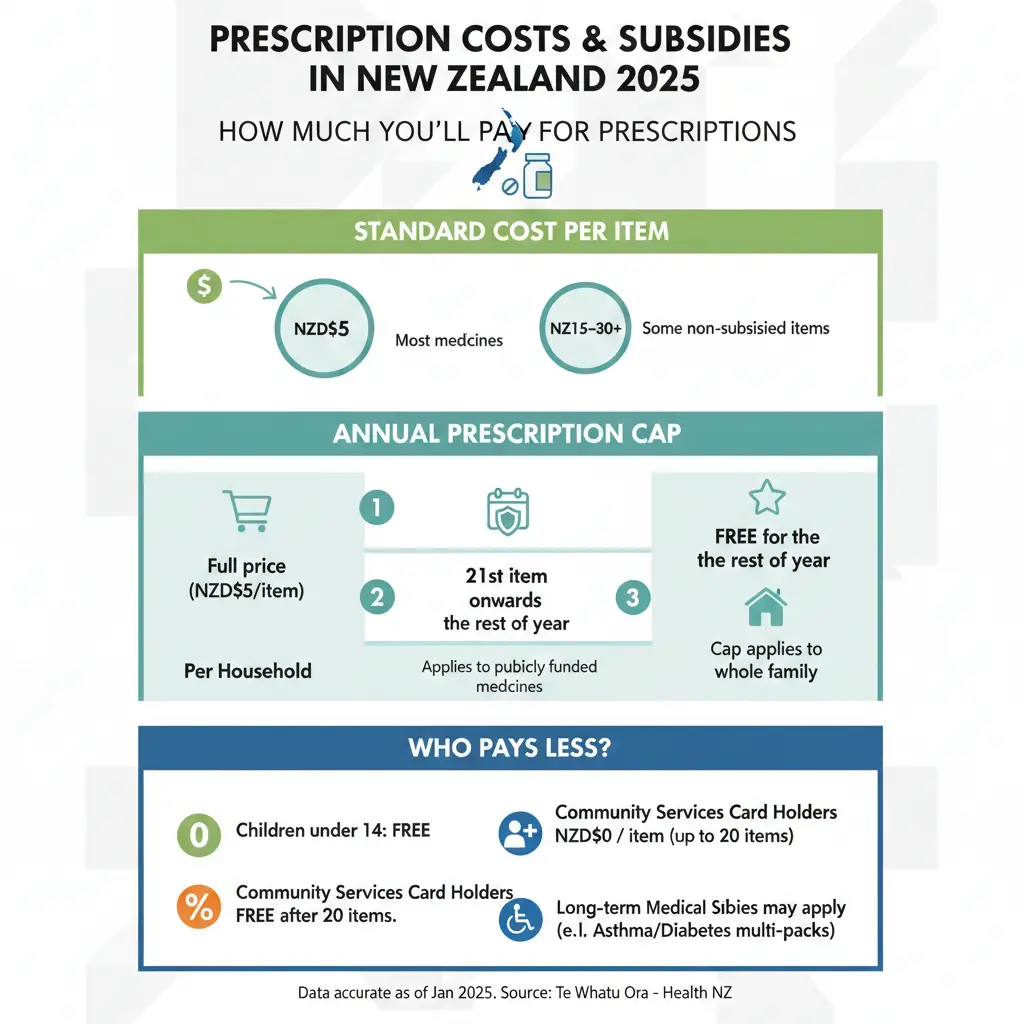
The Prescription Subsidy Card: Your Path to Free Medicines
Here's where things get really helpful. Once you or your whānau have collected 20 subsidised or partially subsidised prescription items between 1 February and 31 January each year, you're eligible for a Prescription Subsidy Card. With this card, all subsidised medicines become free when prescribed by your GP or a public hospital healthcare provider for the rest of that year.
To reach the 20-item threshold, you can include medicines for your partner and dependent children aged 14 to 18. Free or unsubsidised medicines don't count towards the total. Once you hit 20, you won't pay another prescription charge until 1 February the following year—that's potentially significant savings if you're managing multiple conditions or medications.
What's Changed: 12-Month Prescriptions from 1 February 2026
From 1 February 2026, a major change comes into effect that could transform how you manage long-term prescriptions. You can now receive prescriptions lasting up to 12 months for stable, long-term conditions like asthma, diabetes, epilepsy, and high blood pressure.
How 12-Month Prescriptions Work
Instead of collecting a new three-month prescription every quarter, you'll collect your repeats from the pharmacy as usual, but you won't need to go back to your doctor each time. This means fewer GP appointments and potentially significant savings on GP fees—up to $105 per year.
Here's the crucial part about costs: you'll pay the $5 co-payment only once when you collect your initial three-month supply. No further co-payments are charged for the remaining repeats over the 12-month period. This could save you up to $15 over the course of a 12-month prescription compared to the previous arrangement.
Who's Eligible?
You'll need to have a stable condition and be on a medicine that's suitable for longer-term prescribing. Talk to your GP or healthcare provider about whether your medicines can be prescribed under this new 12-month arrangement. Not every medicine is suitable, but many common long-term treatments are.
Practical Examples: What You'll Actually Pay
Let's make this concrete with some real-world scenarios:
Scenario 1: Sarah, 45, with asthma and high blood pressure
Sarah gets a 12-month prescription from her GP for two medicines. She pays $5 when she collects her first three-month supply. When she collects her next repeats at three months, six months, and nine months, she pays nothing. Total cost over the year: $5. Previously, she'd have paid $5 four times = $20. Savings: $15, plus she saves on four GP visits to renew scripts.
Scenario 2: Michael, 52, collecting medicines regularly
Michael has diabetes, high cholesterol, and arthritis—three medicines. By February, he's collected 20 prescription items with his wife's medications included. He gets a Prescription Subsidy Card and pays nothing for prescriptions for the rest of the year.
Scenario 3: Emma, 68, collecting prescriptions from her GP
Emma is over 65, so she pays nothing for prescriptions from her GP or public hospital anyway. The 12-month prescription change means she makes fewer trips to her doctor and gets more convenience without any extra cost.
Tips to Reduce Your Prescription Costs
- Ask your GP about 12-month prescriptions — If you're on long-term, stable medicines, this is now available and could save you money and time.
- Track your prescription count — Keep a mental note of how many items you've collected each year. Once you hit 20, you're eligible for the Prescription Subsidy Card.
- Include family medicines in your count — Your partner and children aged 14–18 count towards your 20-item threshold.
- Check if you qualify for a subsidy card — Community Services Card, High Use Health Card, or Prescription Subsidy Card holders get reduced or free prescriptions.
- Use GPs and public hospitals for prescriptions — Prescriptions from private specialists cost more ($15 vs $5).
- Ask about generic medicines — These are often cheaper and equally effective as branded versions.
- Discuss Special Authority requirements with your GP — If a medicine needs approval, your GP can apply, and you might avoid paying the full unsubsidised cost.
Getting Help with Prescription Costs
If you're struggling with prescription costs, here are some resources:
- Talk to your GP about generic alternatives or medicines on the subsidised list
- Check if you qualify for a Community Services Card at govt.nz
- Contact Health New Zealand or your local pharmacy for help understanding your costs
- Ask about Special Authority requirements if your medicine needs approval
The changes coming into effect from 1 February 2026 are genuinely designed to make prescriptions easier and more affordable. Whether you're managing asthma, diabetes, high blood pressure, or other long-term conditions, take time to understand what you're eligible for and talk to your GP or pharmacist about how these changes apply to you. Small savings add up, and fewer GP visits mean more time for what matters.
Frequently Asked Questions
Sources & References
-
1
Prescription charges | Healthify — healthify.nz
-
2
Government u-turns on prescription co-payment fees | RNZ News — www.rnz.co.nz
-
3
Easier and cheaper prescriptions for Kiwis | Beehive.govt.nz — www.beehive.govt.nz
-
4
Prescription charges | New Zealand Government — www.govt.nz
-
5
Increasing prescribing lengths | Ministry of Health NZ — www.health.govt.nz
Related Articles

The NZ Healthcare System: How Private Health Insurance Works
Imagine facing a diagnosis that requires surgery, only to learn you'll wait months in the public system. For many Kiwis, private health insurance turns that worry into swift action, offering faster ac...

Dental Costs in NZ: Why They are High and How to Save Money
Ever stared at a dentist's quote and felt your wallet recoil? You're not alone—dental costs in New Zealand have skyrocketed, leaving many Kiwis skipping check-ups or delaying essential treatments. Wit...

How Much Does a GP Visit Cost in NZ?
Ever wondered why that nagging cough or unexpected rash sends you scrambling for your wallet before even booking a GP appointment? You're not alone—figuring out how much a GP visit costs in NZ is a co...

Emergency Department or Urgent Care: Where Should You Go?
Picture this: it's 2am, your child's fever is spiking, or you've twisted an ankle playing weekend footy. Do you race to the nearest **Emergency Department** or hunt for an **Urgent Care** clinic? Maki...