Remote Work in New Zealand: Jobs, Taxes & Rights

Imagine ditching the daily commute, swapping office chatter for beach views, and still earning a solid income—all from your home in Aotearoa. Remote work in New Zealand has evolved from a pandemic nec...
Priya writes about immigration pathways, job searching, and building a career in New Zealand. She covers visa options, CV writing, interview preparation, and workplace culture for newcomers and locals alike.
Imagine ditching the daily commute, swapping office chatter for beach views, and still earning a solid income—all from your home in Aotearoa. Remote work in New Zealand has evolved from a pandemic necessity into a lifestyle choice that's reshaping how we balance careers and life. With 34% of Kiwi workers doing some or all of their jobs from home as of June 2025, it's clear this isn't just a trend; it's our new normal. Whether you're eyeing fully remote roles, hybrid setups, or even attracting international talent, this guide covers everything you need to know about remote work NZ opportunities, tax rules, and your rights under Kiwi law.
What Remote Work Looks Like in New Zealand Today
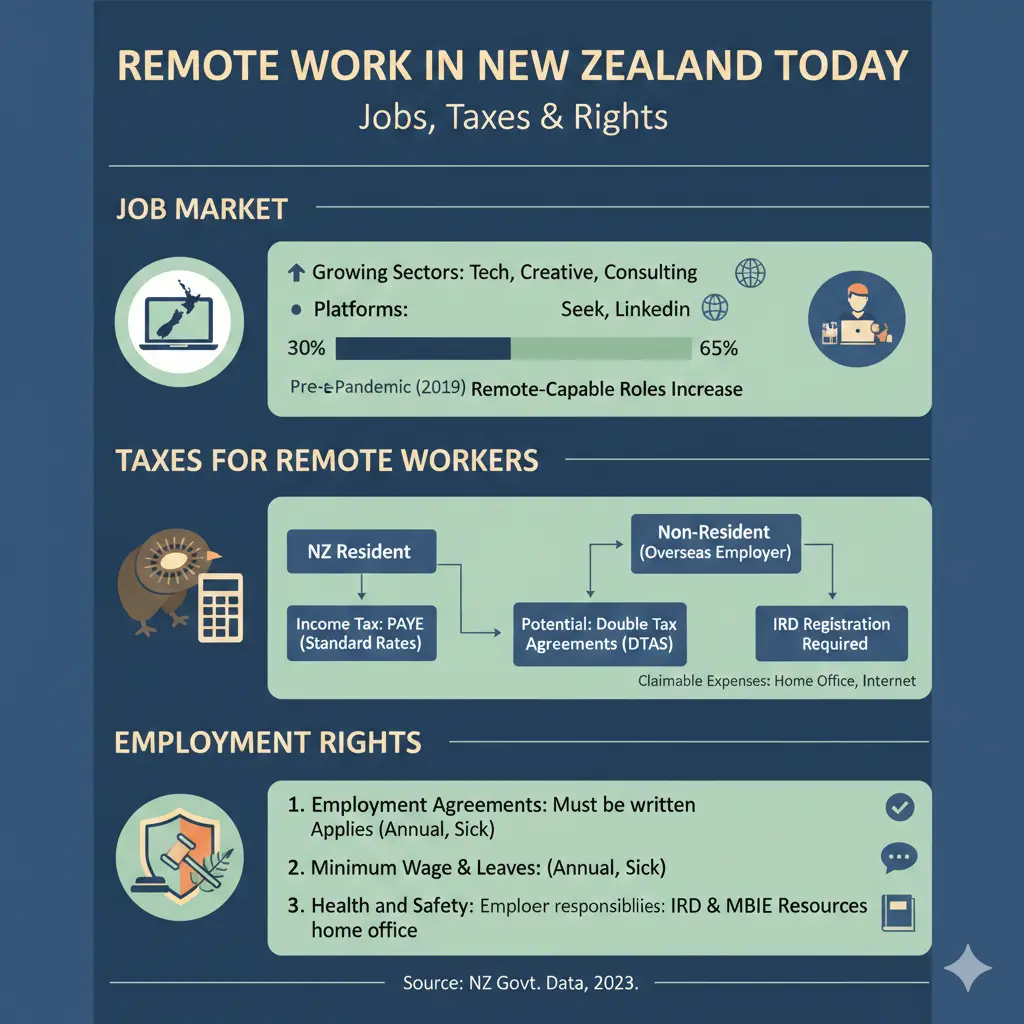
Remote work has stabilised at impressive levels across the ditch. Stats NZ data shows 34% of workers were remote at least part-time in the June 2025 quarter, a figure that's held steady after pandemic peaks. Pre-COVID, that number hovered around 10-15%, but lockdowns pushed over 40% of us online temporarily, with 20-30% sticking around long-term.
We're part of a global shift, but Kiwis punch above our weight. English-speaking economies like ours average 1.5-2 work-from-home days per week—far higher than the global drop to 1.27 days. Hybrid models dominate, slashing quit rates by 30% and keeping around 100 million workers worldwide in flexible patterns. In NZ, tech and professional sectors lead, though marketing and creative fields lag with only 14% fully remote postings.
Key Stats on Remote Work NZ
- 34% of NZ workers remote (some/all) in Q2 2025.
- 20-30% expected to stay remote post-pandemic.
- 41% of IT pros considered leaving NZ in 2024, down to 26% in 2025—signalling stabilisation.
- Hybrid work boosts retention; new fully on-site postings fell from 83% to 66% globally.
Our tech sector faces AI jitters—workers adopt tools but fear replacement—yet work-life balance is improving slightly, with only 33% reporting worse conditions in 2025.
Finding Remote Work Opportunities in NZ
Job hunting for remote work NZ? Focus on high-demand fields like IT, marketing, and professional services. Sites like Seek.co.nz, Trade Me Jobs, and LinkedIn filter for "remote" or "work from home"—add "NZ" to narrow it. Randstad's Workmonitor 2025 highlights a "new baseline" where purpose-driven roles with flexibility win talent.
Top Remote-Friendly Industries
| Industry | Remote Share | NZ Examples |
|---|---|---|
| Technology/IT | High (hybrid common) | Software devs, AI specialists; 26% considering offshore moves. |
| Marketing/Creative | 14% fully remote | Digital marketers, content creators for Kiwi brands like Air NZ. |
| Professional Services | Hybrid dominant | Accountants, consultants via firms like Deloitte NZ. |
Practical tip: Tailor your CV with keywords like "remote work NZ," "hybrid Auckland," or "WFH Wellington." Network on Kiwi Reddit subs like r/newzealand or r/WFH. For internationals, NZ ranks well in global remote readiness thanks to solid internet and lifestyle.
Actionable Job Search Tips
- Update LinkedIn: List remote skills (Zoom fluency, Asana proficiency) and NZ timezone availability.
- Target SMEs: Smaller Kiwi firms offer more flexibility than corporates.
- Leverage government resources: Check Careers.govt.nz for remote listings and skills training.
- Freelance start: Platforms like Upwork suit NZ contractors, but watch tax (more below).
Navigating Taxes for Remote Workers in NZ
Taxes can trip up remote setups, but 2026 brings clarity—especially for digital nomads. From 1 April 2026, proposed changes align tax rules with visitor visas, letting non-residents work remotely for overseas employers without NZ tax on short stays (up to visa limits, exceeding old 183-day thresholds). No more surprise tax residency from beachside Zoom calls!
For Kiwi residents: Income is taxed progressively (10.5% to 39%), regardless of location. IRD requires PAYE for employees; contractors use provisional tax. Remote perks like home office setups may qualify for deductions—claim $5/week cleaning or actual costs if audited.
Digital Nomad Tax Breaks (From April 2026)
- Non-resident visitors ignore 183-day test for tax residency.
- Foreign employer presence doesn't trigger NZ corporate/employment tax risks.
- Transitional residency exemption still applies if you later become resident.
- Stays over visa limits? Income may still be taxable—check IRD.govt.nz.
Employers: Use IRD's payroll tools for remote PAYE. Contractors, register for GST if over $60k turnover. Pro tip: Track days in NZ via apps like Nomad List to stay compliant.
Your Rights as a Remote Worker in NZ
Employment law applies fully to remote roles—no exceptions. Under the Employment Relations Act 2000, you're entitled to a written agreement detailing remote terms (hours, tech support, health checks). Minimum wage sits at $23.15/hour (2026 rate); claim it regardless of location.
Key Rights and Protections
- Health & Safety: Employers must assess remote risks (ergonomics, mental health). Request a home workstation audit via Employment NZ.
- Breaks: 10-min paid per 2 hours; 30-min unpaid lunch after 4 hours.
- Parental Leave: 26 weeks paid (2026), applicable remotely.
- Disputes: Free mediation via MBIE; no cost for most cases.
- KIWISAVER: Auto-enrolled; employer matches 3% minimum.
Hybrid? Right to request flexibility post-6 months (90% approval rate). Discrimination-free: Remote status can't factor in pay or promo decisions. Tip: Document everything—emails on expectations prevent "always-on" burnout.
Challenges and Tips for Thriving in Remote Work NZ
Isolation hits hard—33% report worse work-life balance. Combat with co-working spots like Bizdojo in Auckland or Wellington's The Sevens. Tech woes? Spark or Vodafone fibre handles most, but rural? Starlink's booming.
Practical Tips
- Set boundaries: No emails post-5pm.
- Ergonomics: $300 IRD-deductible standing desk.
- Connect: Join Remote Workers NZ Facebook group.
- Power costs: Claim business portion via meter reads.
Next Steps for Your Remote Journey
Ready to go remote? Audit your skills on Careers.govt.nz, update your CV, and chat with Employment NZ (0800 20 90 20) for free advice. For taxes, hit IRD.govt.nz or call 0800 227 774. Track jobs daily—flexible roles fill fast. Whether you're in Christchurch eyeing remote tech gigs or a nomad plotting Kiwi shores, remote work NZ offers freedom without sacrificing security. Start small: Request hybrid today.
Frequently Asked Questions
Sources & References
- 1
-
2
20 Remote Work Statistics & Trends for 2026 — Emapta — emapta.com
-
3
Hybrid Working in New Zealand | What 2025 Data Shows — ZEIL — www.zeil.com
-
4
Remote work statistics and trends for 2026 — Robert Half — www.roberthalf.com
-
5
NZ Tech Workers Adopt AI While Fearing Replacement — Younity — www.younity.co.nz
-
6
Workmonitor | Randstad New Zealand — Randstad — www.randstad.co.nz
-
7
Remote Work Statistics in Australia and New Zealand — Zoe Talent Solutions — zoetalentsolutions.com
-
8
Global Remote Work Readiness Index 2026 — EOR Quotes — eorquotes.com
-
9
Employment NZ — employment.govt.nz — www.employment.govt.nz
-
10
Minimum Wage Rates 2026 — employment.govt.nz — www.employment.govt.nz