Writing a Winning CV for New Zealand Employers

Landing your dream job in New Zealand starts with a standout CV that speaks directly to Kiwi employers. In a competitive 2026 job market, where applicant tracking systems (ATS) scan thousands of appli...
Priya writes about immigration pathways, job searching, and building a career in New Zealand. She covers visa options, CV writing, interview preparation, and workplace culture for newcomers and locals alike.
Landing your dream job in New Zealand starts with a standout CV that speaks directly to Kiwi employers. In a competitive 2026 job market, where applicant tracking systems (ATS) scan thousands of applications and recruiters spend just seconds on each, mastering CV writing NZ is your first step to getting noticed.
Whether you're a recent graduate eyeing entry-level roles, a mid-career professional switching industries, or an executive aiming for leadership positions, this guide equips you with practical, NZ-specific tips to craft a winning CV. We'll cover structure, tailoring, common pitfalls, and 2026 trends like AI literacy and sustainability focus, all backed by expert advice from local sources.
Why NZ CVs Differ from International Standards
New Zealand employers value brevity, relevance, and cultural fit over flashy designs. Unlike longer US resumes or photo-heavy European formats, Kiwi CVs are typically 1-2 pages (up to 3 for executives), focusing on clear, achievement-driven content without personal details like age, gender, or photos—unless specifically requested. This reflects our no-nonsense approach: recruiters want to see how you'll add value quickly.
In 2026, with remote work entrenched and a push for diverse, inclusive hiring, highlight transferable skills, teamwork, and any experience supporting Māori and Pacific communities if relevant. Always tailor your CV to the job ad, incorporating keywords to pass ATS filters used by many NZ firms.
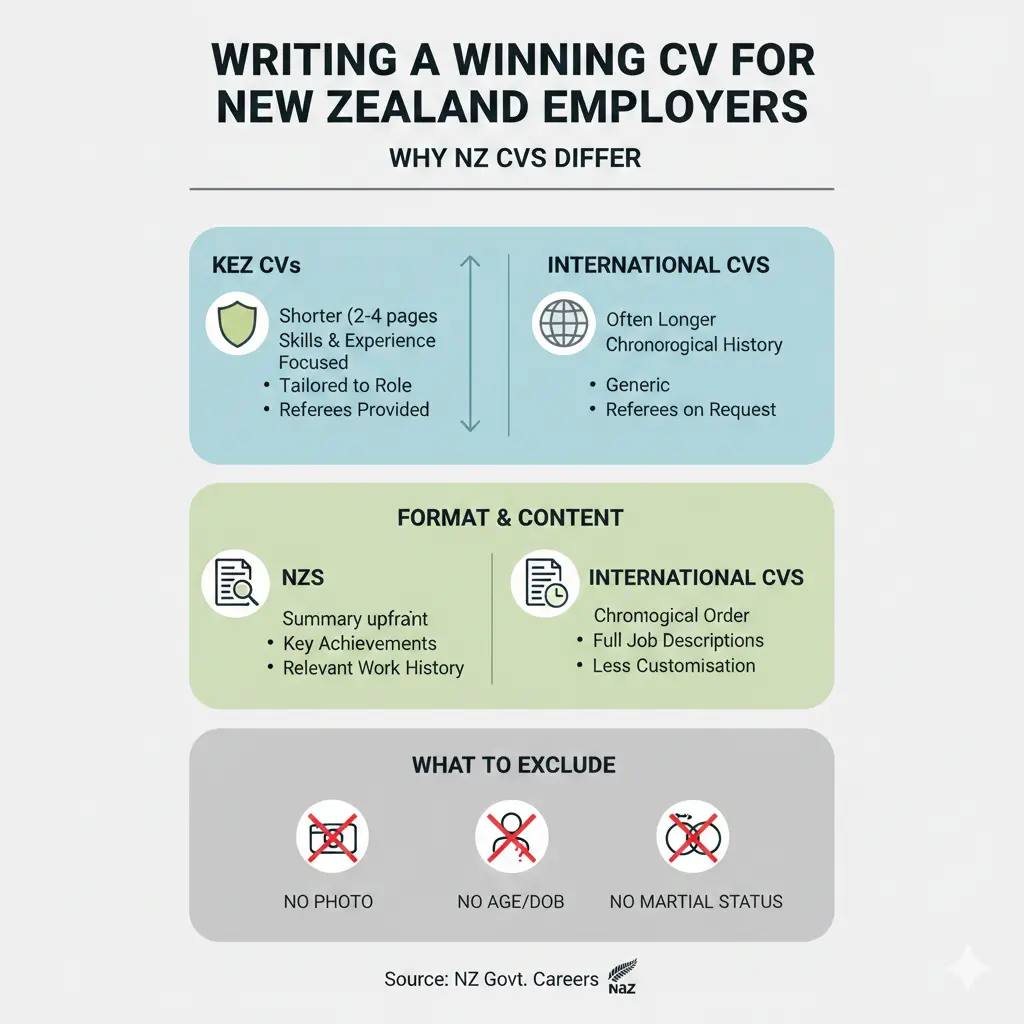
Essential Sections for a Winning NZ CV
Structure your CV logically, starting with the most impactful info. Use a clean, ATS-friendly format: Calibri or Arial font (11pt), bold headings, bullet points, short sentences, and plenty of white space. Avoid images, tables, or fancy graphics.
Contact Details
Keep it simple at the top: full name, phone, professional email (no "[email protected]"), and LinkedIn profile or portfolio link if relevant. Include your location (e.g., "Auckland-based") but not a full address for privacy.
Professional Summary or Profile
This 3-5 sentence opener hooks the reader. Summarise your experience, key skills, and the role you're targeting. Make it job-specific.
"Reliable hospitality manager with 5+ years in fast-paced Kiwi cafés. Skilled in team leadership, customer service, and inventory management. Seeking supervisor role in Wellington to drive operational excellence."
Adapt this for each application, mirroring job ad language.
Key Skills Summary
List 6-10 skills in a bulleted or categorised section, prioritising those from the job description. Back them with evidence elsewhere.
- Technical: Microsoft Office, Xero, Adobe Suite, AI tools like ChatGPT for data analysis
- Soft: Communication, problem-solving, cultural competence (e.g., tikanga Māori awareness)
- Industry-specific: Agile methodologies, cloud computing (for tech roles)
In 2026, emphasise emerging skills like data analysis, sustainability practices, and remote collaboration tools.
Work Experience
List in reverse chronological order (newest first). For each role, include job title, employer, location, dates (month/year), and 4-6 bullet points of achievements, not duties.
Use action verbs: achieved, led, optimised, developed. Quantify where possible—e.g., "Managed a team of 10, boosting sales by 20% in Q4 2025." Include volunteer or freelance work if it shows transferable skills. Limit to 10-15 years unless early roles are highly relevant.
Example for a retail role:
- Led stocktakes for 50+ SKUs, reducing discrepancies by 15% at Countdown, Auckland
- Trained 5 new staff on POS systems and customer service standards
- Handled peak-hour rushes, maintaining 95% satisfaction scores
Education and Qualifications
Reverse chronological order: highest first. Include qualification name, provider, location, and dates. NZ employers rate NZQA-accredited courses highly.
- Diploma in Business (Level 5), Ara Institute of Canterbury, Christchurch, 2024-2025
- NCEA Level 3 (Endorsed with Merit), Wellington High School, 2023
- Micro-credential: Sustainable Business Practices, Te Herenga Waka—Victoria University of Wellington, 2026
For career changers, add relevant short courses or online learning from platforms like Coursera.
Referees (References)
Common in NZ: list 2-3 with name, role, relationship, and contact (with permission). Or simply state "Referees available on request."
Tailoring Your CV: The Key to Interviews
One-size-fits-all CVs rarely win in NZ. Analyse the job ad on sites like Seek.co.nz or Trade Me Jobs, then weave in keywords (e.g., "stakeholder engagement" for public sector roles). Customise your summary, reorder skills, and prioritise matching experience.
For ATS success, use standard headings like "Work Experience" and avoid headers/footers. Tools like Jobscan can check keyword matches, but always ensure it reads naturally for humans.
NZ-Specific Tips and 2026 Trends
- Cultural Fit: Show humility and collaboration—e.g., "Teamed up with iwi partners to deliver community projects."
- Sustainability: Highlight eco-initiatives, as NZ employers prioritise this in 2026.
- Remote/Hybrid: Note experience with tools like Zoom, Slack, or Microsoft Teams.
- No Experience? Focus on education, volunteering (e.g., City Mission), transferable skills from uni projects, or hobbies like sports coaching showing leadership.
- Interests: Include only if relevant, e.g., "Captain of local marae netball team—builds teamwork."
Proofread ruthlessly—typos kill applications. Use Grammarly, then get a mate to review. Save as PDF to preserve formatting.
Common Mistakes to Avoid in CV Writing NZ
- Too Long: Stick to 2 pages max.
- Generic Content: No tailored keywords or achievements.
- Irrelevant Info: Skip high school if you have a degree; omit personal photos.
- Poor Formatting: Inconsistent bullets or fancy fonts trip ATS.
- No Quantifiables: "Handled customers" vs. "Served 100+ customers daily."
CV Writing NZ for Different Career Stages
Entry-Level/Graduates
Lead with education, skills, and extracurriculars. Example: Include barista volunteering or student union roles.
Mid-Career
Emphasise progression and achievements. Brief education section.
Executives
Up to 3 pages: Focus on leadership metrics, board experience. Use executive summary.
Next Steps to Polish Your CV
Grab a free NZ CV template from Tahatū or LSNZ, input your details, and tailor for your top 3 dream jobs. Join a Job Club via Careerforce or your local library for feedback. Upload to Seek.co.nz, then follow up applications with a polite email. With these CV writing NZ strategies, you're set to impress employers and land interviews in 2026. You've got this, Kiwis—go get that role!
Frequently Asked Questions
Sources & References
-
1
How to Write a New Zealand CV/Resume (with a Template) - LSNZ — www.lsnz.co.nz
-
2
How to write a CV - Tahatū Career Navigator — tahatu.govt.nz
-
3
How to Write a CV That Gets Interviews in 2026 | NZ Job Markets — www.cvexperts.co.nz
-
4
How to write a CV in NZ - Robert Half — www.roberthalf.com
-
5
How to write a CV - template and tips New Zealand - Hays — www.hays.net.nz
-
6
Top Tips for a Standout Executive CV in 2026 | Career Solutions NZ — www.careersolutions.co.nz