First-Home Buyer's Complete Guide to Buying in NZ (2025)
Buying your first home in Aotearoa is one of life's biggest milestones – and it doesn't have to feel like navigating a maze of jargon and paperwork. Whether you're saving your deposit, exploring gover...
James writes about the New Zealand property market, renting, home ownership, and housing costs. He breaks down complex property topics into practical advice for renters and buyers.
Buying your first home in Aotearoa is one of life's biggest milestones – and it doesn't have to feel like navigating a maze of jargon and paperwork. Whether you're saving your deposit, exploring government support, or preparing to make an offer, this guide will walk you through every step of the journey with practical, actionable advice tailored to the 2025 New Zealand housing market.
Getting Your Finances in Order
Before you start scrolling through property listings, you need to understand what you can realistically afford. This is the foundation of your entire home-buying journey.
Work Out Your Budget
Start by calculating the maximum purchase price you can afford. Lenders will examine your income, existing debts, and spending habits carefully. Use an online mortgage calculator to estimate repayments at different interest rates, and don't forget to factor in ongoing costs like rates, insurance, and maintenance. Crucially, stress-test your repayments at higher interest rates – banks often use "test rates" to ensure you can handle payments if rates rise.
Beyond your deposit, you'll need to budget for upfront costs including legal and conveyancing fees, LIM and building reports, valuation fees, mortgage establishment fees, insurance, moving costs, and any body corporate levies if you're buying an apartment.
Save Your Deposit
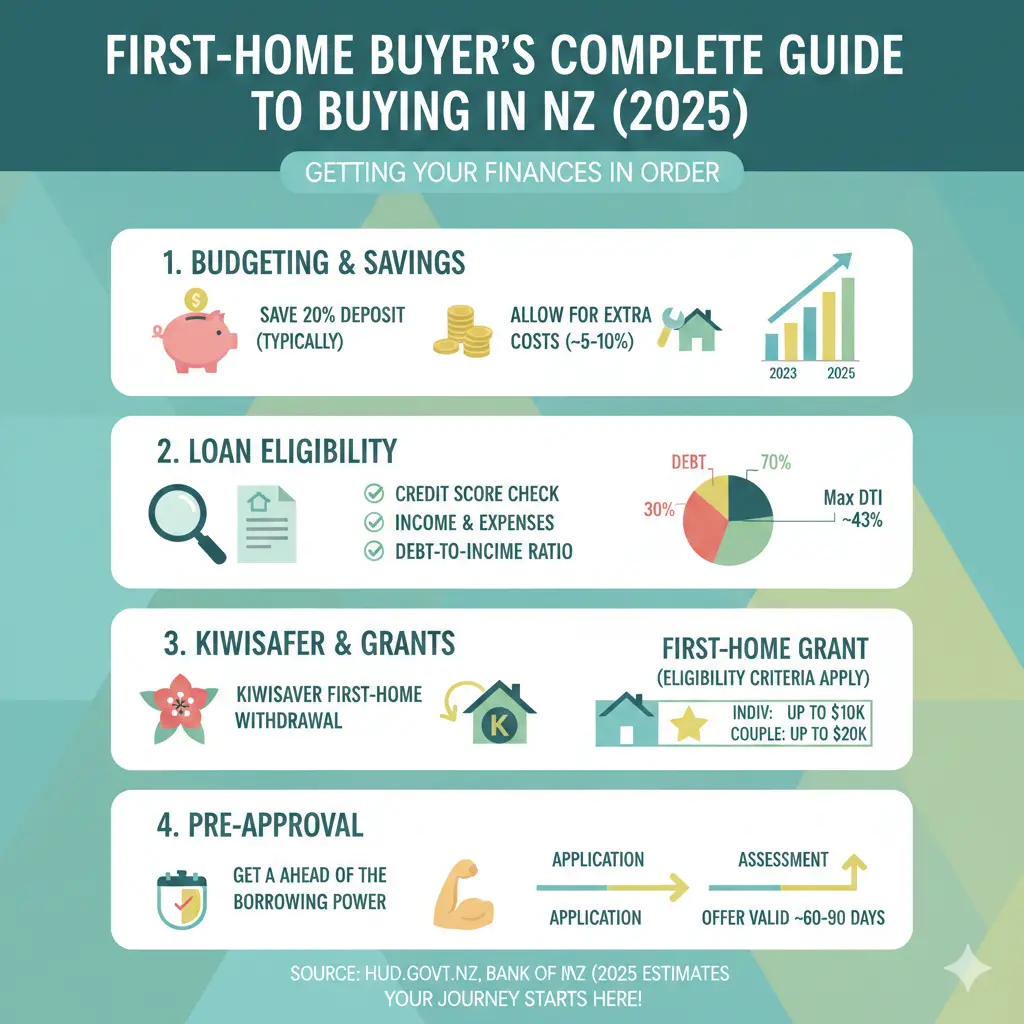
Most banks traditionally require a 20% deposit, but you have options as a first-home buyer. You might qualify for a deposit as low as 5–10% through the First Home Loan scheme (Kainga Ora), or 10% for certain new builds.
If you've been in KiwiSaver for at least three years, you can withdraw most of your balance to boost your deposit. Many first-home buyers also receive help from family – either as a gift, a loan, or by using them as guarantors.
Understanding Government Support
The New Zealand government offers several schemes designed to help first-home buyers get on the property ladder.
First Home Loan (Kainga Ora)
This scheme allows eligible first-time buyers to purchase with a deposit as low as 5%. To qualify, you must be a first-time property owner, the property must be in New Zealand, and you must be building or buying a home to be your family home.
First Home Grant
You may be eligible for a First Home Grant of up to $10,000 for new builds. This can significantly ease the financial burden of your purchase.
KiwiSaver Withdrawal
If you've been a KiwiSaver member for at least three years, you're eligible to withdraw your savings for your first home. Gather your KiwiSaver statements and proof of membership before applying for a mortgage – lenders will want to see this documentation.
Getting Mortgage Pre-Approval
Before you start house hunting seriously, get pre-approval from a lender. This shows sellers you're a serious buyer and gives you a clear budget to work with.
When applying, you'll need to provide identification (passport or driver's licence), your last three payslips, 3–6 months of bank statements, proof of savings or gifts, and KiwiSaver statements. Your lender will assess how much you can borrow based on your income and expenses.
House Hunting and Due Diligence
Once you know your budget and have pre-approval in place, it's time to find your home. But don't rush – thorough research now can save you thousands later.
Visit Properties Multiple Times
Visit potential homes during the day and at night. Check the neighbours, noise levels, access, and local amenities. It really is true that it's better to buy the worst house in a good street – location and community have a huge impact on your quality of life and future resale value. Pay attention to the aspect of the house too; check where it gets the sun and which rooms will be warmest.
Do Your Research
Talk to neighbours, run Google searches on the house, street, and area. Check street lighting and noise levels at night. Research school zones and commute times if these matter to you.
Order a LIM Report
A Land Information Memorandum (LIM) from your local council summarises records on consents, hazards, drainage, rates, and bylaws. LIMs can reveal issues that affect property value – and skipping this step could cost you thousands in repairs or legal headaches later.
Get a Building Inspection
Before making an offer, arrange a pre-purchase building report. For high-risk homes, consider an engineer's report as well. Building.govt.nz recommends an inspection for all properties. Also check for Code Compliance Certificates (CCCs) on any recent work – missing CCCs can be a red flag and may affect bank lending.
Unit Title Properties
If you're buying an apartment or unit, request the unit title pre-contract disclosure, body corporate minutes, budgets, and insurance information. The Unit Titles disclosure regime has strict timing rules for sellers.
Making an Offer
When you find the right home, it's time to make your move. You have two main options: negotiation or auction.
Private Treaty (Negotiation)
You'll submit a conditional or unconditional offer. Most first-time buyers use conditions to protect themselves – typically including finance approval, satisfactory LIM and building reports, and your lawyer's approval clause.
Auction
At auction, you'll need to be fully prepared with your deposit and finance in place before bidding. Make sure you understand the auction process and have your finances confirmed beforehand.
Going Unconditional and Settlement
Once your offer is accepted and all conditions are met (such as finance approval and satisfactory building report), the purchase becomes unconditional. This is the point of no return, so make sure everything is in order.
Before settlement day, confirm your finance is approved and have your mortgage documents signed. Organise house insurance before this date – most banks require it. Your lawyer will handle title registration and mortgage registration through LINZ (Land Information New Zealand).
Settlement day is when the property officially transfers to you, and you can pick up the keys. After settlement, notify your council and utilities, and keep a file of all documents for future reference.
Common Questions First-Home Buyers Ask
How much deposit do I need?
Most banks require 20%, but first-home buyers can qualify with as little as 5–10% through schemes like the First Home Loan. The lower your deposit, the higher your interest rate may be.
Can I use my KiwiSaver for my deposit?
Yes – if you've been in KiwiSaver for at least three years, you can withdraw most of your balance for your first home. This is one of the most popular ways first-home buyers boost their deposits.
What if I can't afford a 20% deposit?
You have options. The First Home Loan scheme allows 5% deposits for eligible buyers, and certain new builds may allow 10% deposits. You might also qualify for the First Home Grant (up to $10,000 for new builds), or receive help from family members.
What's a LIM report and do I really need one?
A LIM report is a council document that summarises important information about the property, including consents, hazards, drainage, and rates. It's essential – LIMs can reveal issues that affect value and should always be ordered before making an offer.
What happens if the building inspection finds problems?
This is why you include a building report condition in your offer. If significant issues are found, you can negotiate a lower price, ask the seller to fix them, or walk away from the purchase.
How long does the whole process take?
From pre-approval to settlement typically takes 6–12 weeks, depending on how quickly you find a property, get inspections done, and secure finance. Building reports usually take around 15 working days.
Your Next Steps
Buying your first home in New Zealand doesn't have to be overwhelming when you break it down into clear steps. Start by assessing your finances and understanding what you can afford. Gather the documentation you'll need for a mortgage application. Explore government support options like KiwiSaver withdrawals and First Home Grants. Then, when you're ready, begin house hunting with confidence, knowing you've done your homework.
Remember: take your time, do your due diligence, and don't skip the important checks like LIM reports and building inspections. Each stage brings you closer to your goal of home ownership. If you're ready to start, talk to a mortgage broker or lender about pre-approval – it's the first real step on your journey to owning your own home.
Sources & References
-
1
First Home Buyers NZ: The Complete Step-by-Step Guide for 2025 — www.lookahead.co.nz
-
2
First Home Buyer's Guide (NZ) — bmlegal.co.nz
-
3
First‑Home Buyer Checklist for 2025 – Everything Kiwis Need to Know — www.eurekafinancial.co.nz
-
4
A Proper First Home Buyers Guide — properli.co.nz
-
5
The ultimate guide to buying your first house in NZ — www.squirrel.co.nz
Related Articles
First Home Grant NZ: How to Get Up to $10000
Buying your first home is one of the biggest financial decisions you'll make, and the New Zealand government wants to help. The First Home Grant puts up to $10,000 directly towards your deposit, makin...

Why 2026 is the Hardest Year to Buy a Home (and How to Beat the Odds)
Imagine standing at the edge of the property ladder in 2026, eyeing your dream home while prices hover stubbornly high, listings pile up, and buyer confidence wavers. For Kiwis, this year feels toughe...

Buying Your First Home in 2026: A Step-by-Step NZ Checklist
Imagine standing in your own Kiwi bach or cosy family home, keys in hand, after years of renting. In 2026, with interest rates stabilising and first-home schemes still strong, buying your first home i...

Selling Your Home? 10 Low-Cost Renovations That Add $50k in Value
If you're planning to sell your home in New Zealand, you don't need to break the bank with a complete renovation to attract buyers and boost your sale price. The good news? Some of the most effective...