Kainga Ora First Home Loan: Eligibility & How to Apply

Dreaming of your first home but struggling to save that big deposit? The Kāinga Ora First Home Loan could be the key to unlocking home ownership in New Zealand, letting you buy with just a 5% deposit...
The Lifetimes NZ editorial team curates, fact-checks, and updates guides on personal finance, property, health, immigration, legal, business, and lifestyle topics relevant to Lifetimes NZ readers. Articles are produced with AI assistance and reviewed by the editorial team before publication.
Dreaming of your first home but struggling to save that big deposit? The Kāinga Ora First Home Loan could be the key to unlocking home ownership in New Zealand, letting you buy with just a 5% deposit instead of the usual 20%. Backed by Kāinga Ora and offered through participating banks, this scheme helps thousands of Kiwis get on the property ladder without needing massive savings upfront.
Whether you're a solo buyer in Auckland eyeing a unit or a couple in Christchurch saving for a family home, understanding the Kainga Ora first home loan eligibility and application process is your first step. In this guide, we'll break it down with the latest 2026 details, real NZ examples, and practical tips to boost your chances.
What is the Kāinga Ora First Home Loan?
The Kāinga Ora First Home Loan is a government-backed mortgage scheme designed to make home ownership accessible for first-home buyers who can't meet standard bank deposit requirements. Kāinga Ora underwrites up to 15% of the loan, allowing participating lenders to offer loans with only a 5% deposit from you. This means no need for lenders mortgage insurance (LMI), saving you thousands.
Launched to tackle New Zealand's housing challenges, the scheme removes previous house price caps, so you can target properties anywhere – from a $500,000 townhouse in Wellington to a $900,000 home in Auckland – as long as you meet income limits and other criteria. It's not a grant; it's a loan you'll repay, but the low-deposit entry point makes it a game-changer for many.
How it Differs from Standard Home Loans
- Deposit: 5% vs. typical 20%.
- Underwriting: Kāinga Ora guarantees part of the risk, enabling banks to lend beyond their usual rules.
- Restrictions: Must be your primary home; no investors allowed.
- Interest Rates: Same as the bank's standard rates – shop around for the best deal.
For example, on a $800,000 Auckland home, you'd need just $40,000 deposit instead of $160,000, freeing up cash for moving costs or renovations.
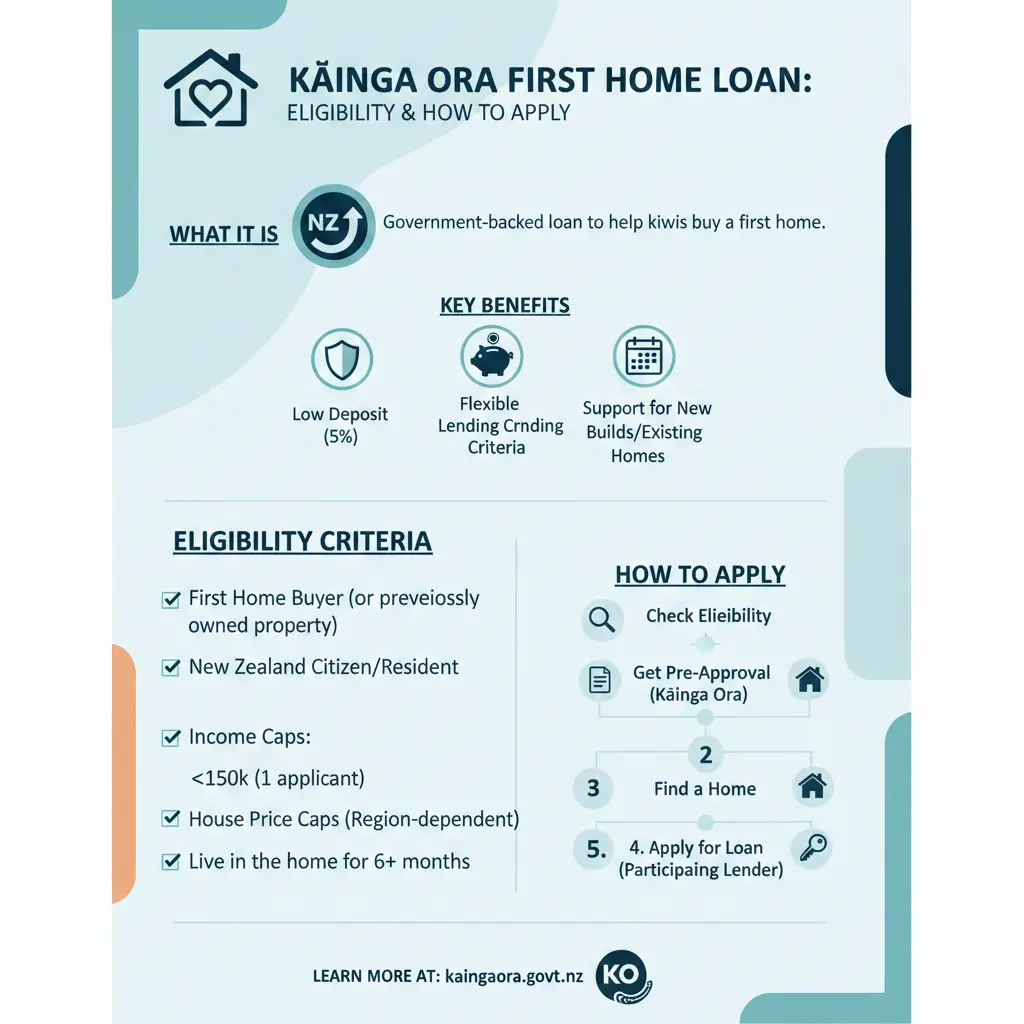
Kainga Ora First Home Loan Eligibility Criteria
To qualify, you must tick all the boxes set by Kāinga Ora. These are strict but fair, focusing on genuine first-home buyers in genuine need.
Basic Requirements
- Be over 18 years old.
- Be a New Zealand citizen, permanent resident, or resident visa holder ordinarily resident in NZ.
- Not own any other property or land (Māori land excluded).
- Commit to living in the home as your primary residence for at least 6-12 months (lender-specific).
Income Limits (Before Tax, Last 12 Months)
Household income caps ensure the scheme targets middle-income earners. Here's the breakdown:
| Situation | Maximum Annual Income |
|---|---|
| One buyer, no dependants | $95,000 |
| One buyer, 1+ dependants | $150,000 |
| Two or more buyers (combined) | $150,000 |
Note: No minimum income, but you must prove you can service the loan via bank checks. If you're a previous homeowner but in a similar financial spot to a first-timer (e.g., after a separation), you may still qualify.
Deposit Requirements
Minimum 5% of purchase price, which can include:
- KiwiSaver first-home withdrawal.
- Cash savings.
- Gifts from family (no repayment needed).
- First Home Grant if eligible (up to $10,000, but check separately as it's means-tested).
Tip: Combine with KiwiSaver – many first-home buyers use both to hit the 5% mark quickly.
Bank Lending Criteria
Beyond Kāinga Ora rules, lenders assess:
- Credit history.
- Debt-to-income ratio (aim for under 6x income).
- Ability to repay (stress-tested at higher rates).
- Stable employment.
Not all banks have identical extras; Westpac and Kiwibank are popular choices.
How to Apply for a Kainga Ora First Home Loan
Applying is straightforward but requires preparation. Start early – pre-approval can take 2-4 weeks.
Step-by-Step Application Process
- Check Eligibility: Use Kāinga Ora's online tool or chat with a broker.
- Gather Deposit: Calculate 5% and source funds. Get gift letters if needed.
- Choose a Lender: Participating banks include Westpac, Kiwibank, BNZ, ASB, ANZ, and Co-operative Bank. Compare rates via sites like Canstar.
- Apply for Pre-Approval: Submit online or call. Provide ID, income proof (payslips, tax returns), expenses, and deposit evidence. Get a letter valid for 90 days.
- House Hunt: Find a property in your pre-approved range.
- Final Approval: Return to lender with sale agreement for full loan sign-off.
- Settle: Complete purchase like any home loan.
Pro Tip: Use a mortgage broker – they're free and access multiple lenders. In NZ, brokers like NZ Mortgage Solutions can match you perfectly.
Documents You'll Need
- Proof of identity (passport/driver's licence).
- Income verification (last 12 months' payslips, IRD summary).
- Bank statements (3 months).
- Expense breakdown (rent, bills, debts).
- Deposit proof (KiwiSaver balance, gift affidavits).
Benefits and Potential Drawbacks
Key Benefits
- Enter the market sooner with less saved.
- No LMI fees.
- Flexible on property type (existing, new build – check lender).
- Combine with First Home Grant for up to 10% deposit boost.
Drawbacks to Consider
- Higher loan amount means more interest over time.
- Limited lender choice (only participants).
- Strict owner-occupier rules – sell early? Repay Kāinga Ora portion first.
- If income rises above caps later, refinancing needed.
Example: Sarah, a 28-year-old teacher in Hamilton earning $85,000, used the scheme for a $650,000 home with $32,500 deposit (KiwiSaver + gift). She's now building equity without years of renting.
Practical Tips to Boost Your Application
- Pay Down Debt: Lower credit card balances improve debt ratios.
- Save Extra: Aim for 10% deposit to reduce loan size.
- Boost Credit Score: Check via Equifax; fix errors free.
- Get Pre-Approval Early: Strengthens offers in competitive markets like Auckland.
- Consider New Builds: Some lenders allow; qualify for fewer consents under RMA changes.
- Team Up: Buying with a partner shares income cap but boosts buying power.
Under NZ's Credit Contracts and Consumer Finance Act, lenders must ensure loans are affordable – transparency is key.
Next Steps to Your First Home
Ready to apply? Head to Kāinga Ora's site for the full lender list and eligibility checker. Chat with a broker today, crunch your numbers using online calculators, and picture your keys in hand. With house prices stabilising in 2026, now's a great time for first-home buyers. You've got this, Kiwi!
Frequently Asked Questions
Sources & References
-
1
Kāinga Ora's First Home Loan Scheme - Global Finance — www.globalfinance.co.nz
-
2
First Home Loan - Kainga Ora — kaingaora.govt.nz
-
3
Kāinga Ora First Home Loan - The Co-operative Bank — www.co-operativebank.co.nz
-
4
First Home Loan Brochure [PDF] - Kainga Ora — kaingaora.govt.nz
-
5
First Home Loan | Westpac NZ — www.westpac.co.nz
-
6
First Home Loan - Kiwibank — www.kiwibank.co.nz
- 7
-
8
First Home Loans - 5% Deposit Mortgages Underwritten by Kāinga Ora — www.moneyhub.co.nz
-
9
Is the Kāinga Ora First Home Grant Still Available in New Zealand? — www.canterburylegal.co.nz
Useful Tools
Related Articles

First Home Grant NZ: How to Get Up to $10000
Buying your first home is one of the biggest financial decisions you'll make, and the New Zealand government wants to help. The First Home Grant puts up to $10,000 directly towards your deposit, makin...

Why 2026 is the Hardest Year to Buy a Home (and How to Beat the Odds)
Imagine standing at the edge of the property ladder in 2026, eyeing your dream home while prices hover stubbornly high, listings pile up, and buyer confidence wavers. For Kiwis, this year feels toughe...

Buying Your First Home in 2026: A Step-by-Step NZ Checklist
Imagine standing in your own Kiwi bach or cosy family home, keys in hand, after years of renting. In 2026, with interest rates stabilising and first-home schemes still strong, buying your first home i...

Selling Your Home? 10 Low-Cost Renovations That Add $50k in Value
If you're planning to sell your home in New Zealand, you don't need to break the bank with a complete renovation to attract buyers and boost your sale price. The good news? Some of the most effective...