Healthcare for Migrants: What's Covered?

If you're planning to move to New Zealand, understanding how healthcare works here is crucial—and it's likely quite different from what you're used to. The good news? New Zealand has a well-regarded p...
Priya writes about immigration pathways, job searching, and building a career in New Zealand. She covers visa options, CV writing, interview preparation, and workplace culture for newcomers and locals alike.
If you're planning to move to New Zealand, understanding how healthcare works here is crucial—and it's likely quite different from what you're used to. The good news? New Zealand has a well-regarded public healthcare system that's either free or heavily subsidised for those who qualify. The catch? Not everyone gets immediate access, and knowing where you stand can save you money, stress, and potentially your health.
How New Zealand's Healthcare System Works
New Zealand operates a tax-funded public healthcare system that's administered regionally through Health New Zealand Te Whatu Ora. The government funds the majority of healthcare costs using public tax money—up to 9% of New Zealand's GDP. This means that if you're eligible, you'll get access to the same publicly-funded medical treatment as Kiwis, with hospital and specialist care covered when referred by a general practitioner (GP).
The publicly funded system covers quite a lot:
- Preventive care and health screenings
- Inpatient and outpatient hospital services
- Primary care through GP visits
- Maternity services
- Mental health care
- Prescription medications on the national formulary
- Dental care for schoolchildren
- Long-term care and disability support services
- Hospice care and home help
However, there's an important caveat: the public system has waiting lists for non-urgent services. That's why many New Zealanders and eligible migrants opt for private health insurance to bypass queues and access private hospitals faster.
Who's Eligible for Public Healthcare?
This is the million-dollar question, because eligibility depends entirely on your visa status.
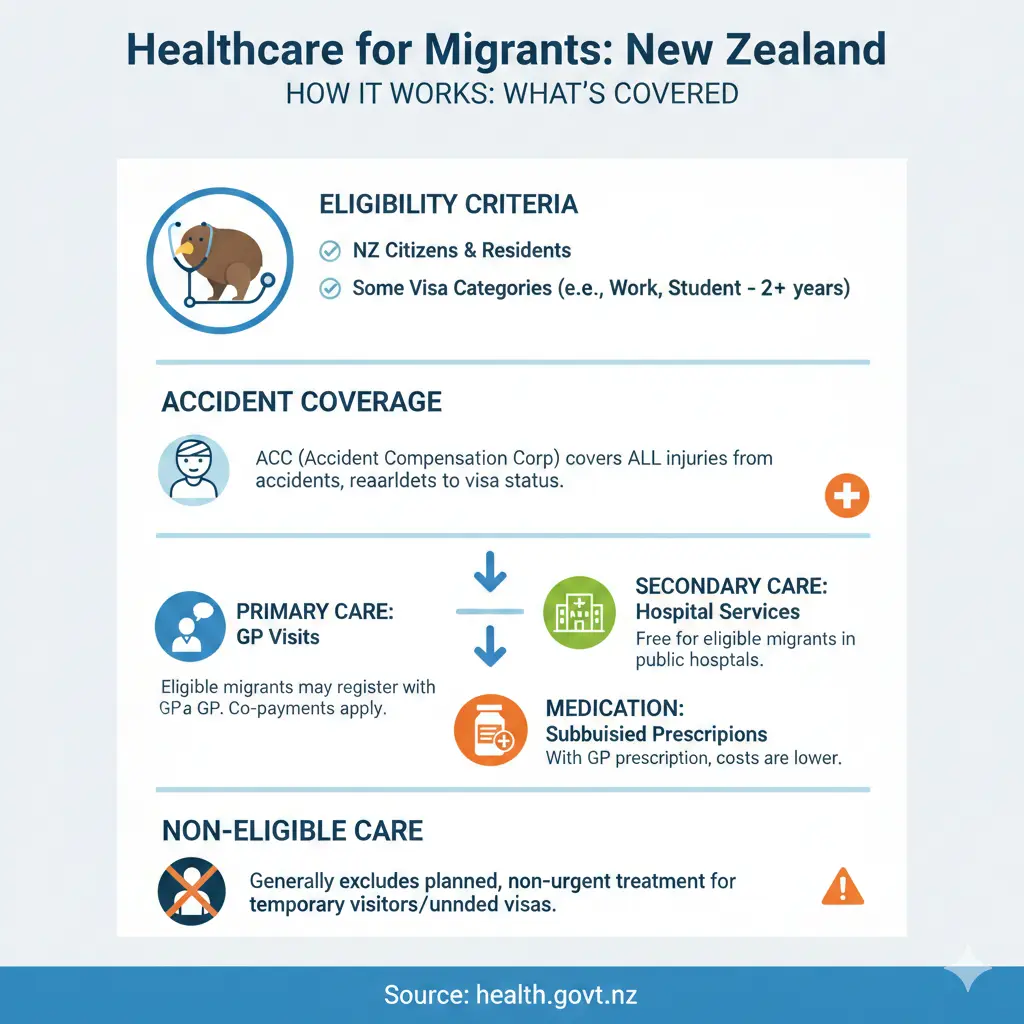
You'll Get Free Public Healthcare If You're:
- A New Zealand citizen or permanent resident – automatically eligible
- On a work visa valid for 2 years or more – your eligibility starts from your first day in New Zealand
- An Australian citizen or permanent resident who has lived or intends to live in NZ for 2 years or more – covered under reciprocal healthcare agreements
- A UK citizen – covered under reciprocal healthcare agreements, though with some restrictions and limitations
If you qualify, your partner and any children under 20 years of age are also eligible for public healthcare services.
You'll Need to Pay If You're:
- On a temporary visa (visitor, tourist, or student visa)
- On a work visa valid for less than 2 years
- On a working holiday visa
- A digital nomad on a tourist or visitor visa of 6 months or less
If you don't qualify for publicly funded healthcare, you'll need to pay for all your medical care out of pocket. The government strongly recommends that people travelling to New Zealand who aren't eligible for public healthcare have comprehensive travel insurance, including full health insurance.
What About ACC Coverage?
Here's something that applies to everyone, regardless of visa status: if you're in an accident, your treatment is covered by ACC (Accident Compensation Corporation). This is comprehensive, no-fault personal injury cover available to all NZ residents and visitors. So if you're injured in a car accident, workplace incident, or sports injury, you won't be left with a massive bill.
Private Health Insurance in New Zealand
Health insurance isn't compulsory in New Zealand, unlike some other countries. However, many migrants choose private cover for faster access to specialists and procedures—especially if they're not eligible for public healthcare or want to avoid public system waiting lists.
What Private Health Insurance Covers
Private health insurance typically covers:
- Surgical and specialist treatment – operations and procedures in private hospitals (this is the main reason people get private cover)
- Diagnostic tests and scans – MRIs, CT scans, ultrasounds that might have long waits in the public system
- Specialist consultations – appointments without GP referrals in some cases, with shorter waiting times
- Cancer treatment – some policies cover specialised cancer treatments and drugs not funded publicly
What Private Health Insurance Typically Doesn't Cover
- GP visits (you pay out of pocket)
- Prescription medications (covered separately by the public pharmaceutical schedule)
- Pre-existing conditions (usually excluded for a period)
- Cosmetic procedures
- Dental care (requires separate dental insurance)
- ACC-covered injuries
Smart Insurance Strategies for Migrants
If you're considering private health insurance, here are some practical approaches:
- Start with surgical-only cover – the most cost-effective option covering major procedures where public waits are longest. You can upgrade later if needed.
- Consider employer insurance – many professional employers offer subsidised health insurance, which can be significantly cheaper than individual policies.
- Get travel insurance before you arrive – it's best to purchase travel insurance before leaving your home country, especially if you won't qualify for public healthcare immediately.
Important note: if you're not eligible for public healthcare, you won't qualify for private health insurance in New Zealand either. Insurance companies rely on the public system to function, so they only insure people who have access to it. If you fall into this category, travel insurance is your best option.
Proof of Eligibility
When you visit a healthcare provider in New Zealand, you'll need to show proof of eligibility for public healthcare. This might be your e-Visa letter or other documentation from Immigration New Zealand. If you don't have proof, you may have to pay for services. Check the Health New Zealand Te Whatu Ora website for specific requirements based on your visa type.
Special Circumstances
International Students
If you're applying for a Fee-paying Student Visa, you must provide evidence of health insurance when applying. Some health insurance plans are specifically available for international students, and it's worth checking what's available before you arrive.
Seasonal Workers
Seasonal workers may have specific health insurance requirements depending on their visa type. Check the conditions of your specific visa to understand what you need to arrange.
People Living with HIV
If you're living with HIV, treatment is available at no cost in New Zealand, irrespective of your immigration status. The Burnett Foundation Aotearoa provides services and support for people living with HIV.
Getting Started: Your Next Steps
Before you move to New Zealand, take these steps to ensure you're covered:
- Check your visa eligibility – confirm whether your visa type qualifies you for public healthcare by checking Immigration New Zealand's website or the conditions of your specific visa.
- Arrange travel insurance if needed – if you won't qualify for public healthcare, purchase comprehensive travel insurance before leaving your home country.
- Register with a GP – once you arrive, register with a local general practitioner. They'll be your first point of contact for most health issues.
- Consider private insurance – if you're eligible for public healthcare but want faster access to specialists, explore private health insurance options and employer schemes.
- Gather proof of eligibility – keep your e-Visa letter and any other documents proving your eligibility for public healthcare handy for healthcare provider visits.
New Zealand's healthcare system is robust and well-regarded, but it works differently depending on your immigration status. By understanding your eligibility and planning ahead, you'll be able to access the care you need without unexpected costs or complications. Welcome to Aotearoa!
Frequently Asked Questions
Sources & References
-
1
Healthcare for Immigrants in New Zealand — www.new-zealand-immigration.com
-
2
The New Zealand Healthcare System - Are You Eligible? — www.internationalinsurance.com
-
3
Insurance in New Zealand: Complete Guide for Migrants (2026) — themigratehub.com
-
4
Who can get public health care - Immigration New Zealand — www.immigration.govt.nz
- 5
-
6
How the New Zealand Health System works? — www.workingin-newzealand.com
-
7
New Zealand | International Health Care System Profiles — www.commonwealthfund.org
Related Articles

Can i sponsor my brother / sister to New Zealand ?
Ever dreamed of having your brother or sister join you here in Aotearoa for good? Maybe you're a Kiwi who's made NZ home and now wants your sibes to share in the good life—barbies on the beach, trampi...

Moving to NZ from Overseas: Complete Checklist
Whether you're helping a family member, friend, or colleague settle into our beautiful country, knowing the ins and outs of moving to NZ from overseas makes all the difference. This complete checklist...

Registering for Tax in NZ: IRD & Work Income
Getting your IRD number is one of the first things you'll need to do when you start earning in New Zealand, whether you're a new arrival, a returning resident, or someone who's been here for years. It...

Skilled Migrant Category: Points, Eligibility & Process
If you're thinking about moving to New Zealand to work and eventually settle here permanently, understanding the Skilled Migrant Category (SMC) is essential. The SMC is your pathway to permanent resid...