Permanent Residency Pathways in New Zealand
Imagine building a life in New Zealand's stunning landscapes, from the beaches of Auckland to the fjords of Fiordland, without the uncertainty of temporary visas. Securing permanent residency NZ opens...
The Lifetimes NZ editorial team curates, fact-checks, and updates guides on personal finance, property, health, immigration, legal, business, and lifestyle topics relevant to Lifetimes NZ readers. Articles are produced with AI assistance and reviewed by the editorial team before publication.
Imagine building a life in New Zealand's stunning landscapes, from the beaches of Auckland to the fjords of Fiordland, without the uncertainty of temporary visas. Securing permanent residency NZ opens doors to indefinite stay, work, and access to our world-class healthcare and education. With changes rolling out in August 2026, now's the time to understand your pathways.
Understanding Permanent Residency in New Zealand
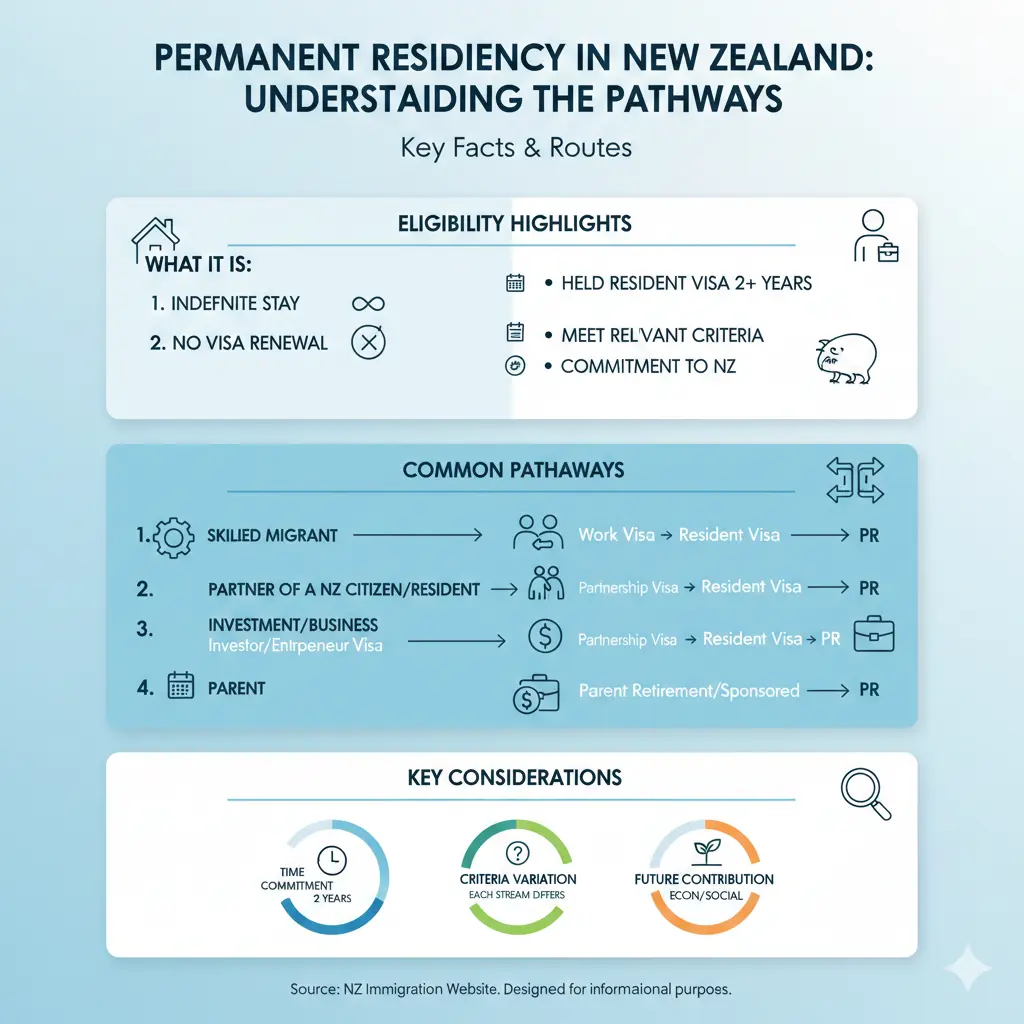
Permanent residency, or a resident visa, lets you live, work, and study in New Zealand indefinitely. It's not citizenship—you'll need that separately for voting or a passport—but it gives you most of the same rights, including bringing family and sponsoring relatives later. Most pathways target skilled workers under 55, recognising NZ's need for talent in health, construction, and tech.
Key requirements across pathways include good character, health checks, and English proficiency. Use Immigration New Zealand's online tools to check eligibility early—processing prioritises Straight to Residence, Skilled Migrant Category (SMC), and Work to Residence visas from 2026.
Why Pathways Are Changing in 2026
Our government's Going for Growth programme is refining rules to attract experienced migrants. From August 2026, expect reduced NZ work experience (e.g., from 3 to 2 years in some cases) and no need for a higher wage at application—just maintain your threshold during work experience. Red List occupations (high-risk) are excluded from new routes, while Amber List roles face extra checks.
Main Pathways to Permanent Residency NZ
Skilled Migrant Category (SMC) Resident Visa
The SMC is the cornerstone for permanent residency NZ, using a 6-points system based on skills, qualifications, income, and NZ work experience. Current rules apply until August 2026: you need skilled employment (30+ hours/week) at the median wage or higher, plus points from qualifications (e.g., PhD = 6 points outright) or experience.
2026 Updates: Two new pathways launch, easing access for experienced workers.
- Skilled Work Experience Pathway: For ANZSCO skill levels 1–3 roles. Need 5+ years relevant experience, including 2 years in NZ at 1.1× median wage. Keep payslips, IRD summaries, and job descriptions as evidence.
- Trades & Technician Pathway: For specified trades (list publishing soon). Requires Level 4+ qualification (120+ credits) and 4+ years post-qual experience, including 18 months in NZ at median wage.
Pro tip: If applying now, secure a job offer and hit 6 points. NZ Master's holders get boosted points from 2026.
Green List Pathways
Fast-track your permanent residency NZ if you're on the Green List of in-demand roles like nurses, engineers, or ICT specialists. Tier 1 jobs offer Straight to Residence; Tier 2 require 2 years' work here first.
Check the full list on Immigration NZ—prioritised processing means quicker approvals. Care workforce and transport roles have dedicated paths too.
Work to Residence Visas
Start with an Accredited Employer Work Visa (2 years max from 2025 updates), then transition. Ideal if under 55 with a full-time job paying enough to support your family. Pacific Access Category ballots for Samoans, Kiribati, Tuvalu, Tonga, and Fiji citizens offer another route (18–45 years old, English speakers).
Step-by-Step Guide to Applying
- Assess Eligibility: Use Immigration NZ's points indicator or visa finder. Match your job to ANZSCO codes.
- Gather Evidence: Passport, qualifications (assessed by NZQA if needed), job offer letter, payslips, police certificates, medicals.
- Secure a Visa: Apply for work visa first if needed. Maintain wages—track via IRD.
- Submit Residence Application: Online via RealMe. Fees around $4,000–$5,000 NZD (check current rates). Processing: 6–9 months prioritised.
- Post-Approval: Get your visa sticker/endorsement. Travel conditions apply for first year.
Practical Tips for Success
- Start in regional areas like Canterbury or Waikato for easier job finds and median wage roles.
- Network via Seek.co.nz, TradeMe Jobs, or LinkedIn NZ groups.
- Budget for costs: visas, assessments (~$750 NZQA), relocation.
- If over 55, explore family sponsorship or investor routes (separate categories).
- Watch for Red/Amber lists—avoid high-risk roles for new pathways.
For tradespeople, confirm your qualification meets Level 4+ (e.g., NZQA-equivalent certificates). Keep records meticulously—Immigration NZ audits wages via IRD.
Common Challenges and How to Overcome Them
Points shortfalls? Gain NZ experience or upskill locally. Wage issues? Target Green List for flexibility. Family inclusion needs proof of support—use our family calculator tools.
"These reforms introduce two new residence pathways designed to better recognise skilled workers, tradespeople, and technicians already contributing to the New Zealand workforce."
Next Steps to Secure Your Future
Visit Immigration.govt.nz today—create a RealMe account and run a visa check. Consult a licensed adviser via iaa.govt.nz if complex. With 2026 changes on the horizon, align your experience now: update your CV, secure skilled work, and gather evidence. Your Kiwi dream is closer than you think—start mapping your pathway to permanent residency NZ.
Frequently Asked Questions
Sources & References
-
1
SMC 2026: 2 New Skilled Migrant Residence Paths + Eased Rules — sharmalaw.co.nz
-
2
New Zealand Major Visa Changes 2026 - YouTube — www.youtube.com
-
3
New Zealand Green List 2026: Fast-Track Your PR Dream — aspireglobalpathways.com
-
4
Skilled residence pathways in New Zealand — www.immigration.govt.nz
-
5
Work that leads to residence | New Zealand Government — www.govt.nz
-
6
Changes to the Skilled Migrant Category Resident Visa announced — www.immigration.govt.nz
Related Articles

Can i sponsor my brother / sister to New Zealand ?
Ever dreamed of having your brother or sister join you here in Aotearoa for good? Maybe you're a Kiwi who's made NZ home and now wants your sibes to share in the good life—barbies on the beach, trampi...

Moving to NZ from Overseas: Complete Checklist
Whether you're helping a family member, friend, or colleague settle into our beautiful country, knowing the ins and outs of moving to NZ from overseas makes all the difference. This complete checklist...

Registering for Tax in NZ: IRD & Work Income
Getting your IRD number is one of the first things you'll need to do when you start earning in New Zealand, whether you're a new arrival, a returning resident, or someone who's been here for years. It...
Healthcare for Migrants: What's Covered?
If you're planning to move to New Zealand, understanding how healthcare works here is crucial—and it's likely quite different from what you're used to. The good news? New Zealand has a well-regarded p...