Minimum Wage NZ 2025: Current Rates and Your Rights

Imagine clocking in for your shift, working hard all day, only to realise your pay slip doesn't add up. For Kiwis relying on the minimum wage NZ 2025, knowing your rights isn't just smart—it's essenti...
The Lifetimes NZ editorial team curates, fact-checks, and updates guides on personal finance, property, health, immigration, legal, business, and lifestyle topics relevant to Lifetimes NZ readers. Articles are produced with AI assistance and reviewed by the editorial team before publication.
Imagine clocking in for your shift, working hard all day, only to realise your pay slip doesn't add up. For Kiwis relying on the minimum wage NZ 2025, knowing your rights isn't just smart—it's essential to ensure you're paid fairly under New Zealand law. From 1 April 2025, the adult minimum wage sits at $23.50 per hour, but there are nuances for starting-out workers, trainees, and more that every employee should understand.
This guide breaks down the current rates, who qualifies, and practical steps if you're underpaid, so you can protect your earnings and stand up for yourself confidently.
What is the Minimum Wage in New Zealand?
The minimum wage is the lowest hourly rate most employers in New Zealand must pay their workers, set annually by the government and effective from 1 April each year. It's designed to provide a basic safety net, factoring in inflation, cost of living, and average wages across the country.
Nearly all employees qualify, including part-time, casual, and temporary workers aged 16 and over (school-leaving age). However, self-employed people, company directors, and those under 16 don't count. Employers can't pay less than this rate, even if you agree to it—it's a legal requirement enforced by Employment New Zealand.
Minimum Wage NZ 2025: Current Rates
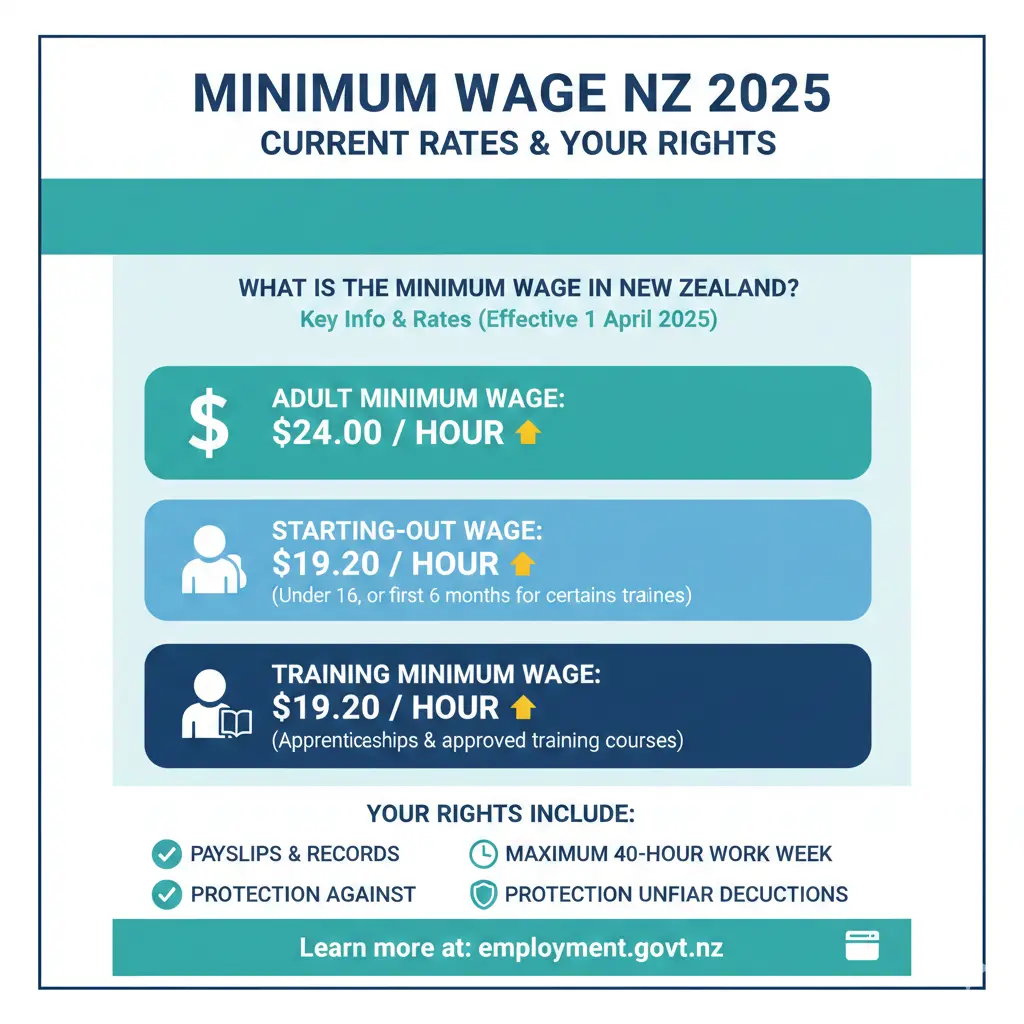
As of 1 April 2025, here's what you need to know:
| Type of Minimum Wage | Per Hour | 8-Hour Day | 40-Hour Week | 80-Hour Fortnight |
|---|---|---|---|---|
| Adult (16+ years, not starting-out or training) | $23.50 | $188 | $940 | $1,880 |
| Starting-Out | $18.80 | $150.40 | $752 | $1,504 |
| Training | $18.80 | $150.40 | $752 | $1,504 |
These starting-out and training rates are 80% of the adult minimum wage, per government guidance. For context, this is up from $23.15 (adult) in 2024, reflecting a steady rise over time—from $10.25 in 2006 to today's levels.
Who Qualifies for Each Minimum Wage Rate?
Not everyone gets the full adult rate right away. Here's a breakdown to help you check your status:
Adult Minimum Wage ($23.50/hour)
- Applies to all workers 16+ who aren't starting-out or trainees.
- Includes supervisors or those training others.
- Covers most Kiwis in full-time, part-time, or casual roles.
Starting-Out Minimum Wage ($18.80/hour)
This lower rate is temporary and targets young or new workers:
- 16-17-year-olds with less than 6 months continuous employment with their current employer.
- After 6 months with the same boss, you automatically move to the adult rate.
- Exceptions: If you're on a benefit or need training, other rules may apply.
Tip: Track your start date—it's your right to bump up after 6 months. Employers must update your pay without you asking.
Training Minimum Wage ($18.80/hour)
- For apprentices or trainees with a formal training agreement learning a trade.
- People with disabilities employed under Supported Living Payment.
Migrant workers on temporary visas have the same rights as Kiwis—no exceptions. If you're unsure, check your employment agreement or ask your employer for clarification.
How is Minimum Wage Calculated?
Minimum wage applies to all ordinary hours worked, before tax. It doesn't cover overtime, penalties, or allowances—these are extra on top.
- Piece rates or incentives: Your total pay must average at least minimum wage for hours worked.
- Commission-only jobs: Guarantee must meet or exceed minimum wage.
- Casual loading: Often 20-40% extra, but base still hits minimum.
Pro tip: Use the Employment NZ calculator online to verify your pay slip. For a 40-hour week at adult rate, that's $940 gross—know your numbers!
Minimum Wage vs Living Wage: What's the Difference?
Don't confuse minimum wage with the New Zealand Living Wage, which is higher at around $26 per hour (as of recent updates). The living wage, set by the Living Wage Organisation, covers basic needs like housing, food, and transport for a dignified life—it's voluntary, not law.
"The living wage is intended to provide a standard for employers to pay their workers a wage that allows them to live with dignity and meet their basic needs rather than just survive."
Over 100 NZ organisations endorse it, but minimum wage is the legal floor. Many employers aim higher, especially in tight labour markets.
What to Do If You're Underpaid Minimum Wage
Suspect your pay is short? Act fast—employers must fix it, and you have rights:
- Check your pay slip: Verify hours, rate, and totals against minimum wage tables.
- Talk to your employer: Politely raise it in writing—keep records.
- Report anonymously: Call Employment NZ at 0800 20 90 20. They'll investigate safely, no comeback on you.
- Seek free advice: Community Law Centres or your union.
Underpayment is illegal, even for small amounts. Between 80,000-145,000 Kiwis earn near minimum, so you're not alone. Recent cases show fines up to thousands for bosses who dodge it.
Real Kiwi Example
In Auckland, a café worker noticed her $22/hour pay after 7 months on the job. She qualified for adult rate ($23.50), back-paid $500 after Employment NZ stepped in. Don't let it happen to you—verify early.
Upcoming Changes: Minimum Wage NZ 2026
Looking ahead, the adult rate rises to $23.95/hour from 1 April 2026—a 2% increase (45 cents more). Starting-out and training will adjust to 80% of that. Stay tuned via govt.nz for confirmations.
Projections suggest $24/hour by end-2026, driven by economic models.
Practical Tips for Kiwis on Minimum Wage
- Track everything: Log hours, shifts, and payslips in an app like Hours Tracker.
- Know your breaks: Unpaid meal breaks don't count towards minimum wage hours.
- Union up: Join if in retail/hospo—free advice and bargaining power.
- Budget smart: Use KiwiSaver, WINZ supports, or StudyLink if studying.
- Job hunt wisely: Tight market means many pay above minimum—check Seek.co.nz rates.
Next Steps to Protect Your Pay
Download the Employment NZ app, bookmark minimum wage rates, and chat with mates about their pays. If underpaid, call 0800 20 90 20 today—it's free, confidential, and effective. You're entitled to fair pay; make sure you get it. For personalised advice, visit a Community Law Centre near you.
Frequently Asked Questions
Sources & References
-
1
New Zealand Minimum Wage 2025 & 2026 - MoneyHub NZ — www.moneyhub.co.nz
-
2
New Zealand Gross Minimum Hourly Wage - Trading Economics — tradingeconomics.com
-
3
NZ minimum wage increases to $23.15 per hour - SME Financial Ltd — smefinancial.co.nz
-
4
Minimum wage rates and types - Employment New Zealand — www.employment.govt.nz
-
5
Minimum Wage in New Zealand [2026 Guide] - Horizons — joinhorizons.com
-
6
Minimum wage increases from 1 April 2026 — www.nzimmigrationpartners.com
-
7
Minimum wage to rise 2% to $23.95 from April 2026 - Franklin Times — franklintimes.co.nz
Related Articles

Employment Law 101: Annual Leave; Sick Pay; and Your Rights
Ever wondered if you're getting the annual leave or sick pay you're entitled to? As Kiwis, we all deserve fair treatment at work, but navigating employment law can feel like a maze—especially with big...
Minimum Wage 2026: Your Rights and What You Should Be Paid
Imagine clocking in for your shift at the local café in Auckland, only to realise your pay slip doesn't match what the law says you should be earning. For around 122,500 Kiwis living on or near the mi...
Public Holidays NZ 2025: Your Rights and Pay
If you're working in New Zealand, understanding your public holiday rights is crucial—it affects your pay, your time off, and your work-life balance. Whether you're an employee wondering how much you'...

Disputes with Employers: How to Handle Workplace Issues
Imagine clocking in for your shift only to face unfair treatment, unpaid wages, or a boss who ignores your concerns. For Kiwis, workplace disputes with employers are more common than you might think,...