Minimum Wage 2026: Your Rights and What You Should Be Paid
Imagine clocking in for your shift at the local café in Auckland, only to realise your pay slip doesn't match what the law says you should be earning. For around 122,500 Kiwis living on or near the mi...
The Lifetimes NZ editorial team curates, fact-checks, and updates guides on personal finance, property, health, immigration, legal, business, and lifestyle topics relevant to Lifetimes NZ readers. Articles are produced with AI assistance and reviewed by the editorial team before publication.
Imagine clocking in for your shift at the local café in Auckland, only to realise your pay slip doesn't match what the law says you should be earning. For around 122,500 Kiwis living on or near the minimum wage, knowing your rights in 2026 could mean hundreds of extra dollars in your pocket each year.From 1 April 2026, New Zealand's adult minimum wage rises to $23.95 per hour, up 45 cents from the current $23.50. This article breaks down exactly what you'll be paid, who qualifies, and how to enforce your rights—keeping you informed and empowered in Aotearoa's job market.
What is the Minimum Wage in New Zealand?
The minimum wage is the lowest hourly rate most employers can legally pay workers in New Zealand. It's set annually by the government after reviewing factors like inflation, cost of living, and business pressures. For 2026, this balanced 2% increase helps workers keep pace with projected 2% inflation while easing wage compression—where pay bands bunch up due to big jumps.
Working a standard 40-hour week on the new adult rate? That's an extra $18 weekly or $936 annually before tax, making a real difference for families stretching their budget amid rising grocery and rent costs.
Key Minimum Wage Rates from 1 April 2026
Here's what you'll be entitled to, depending on your situation:
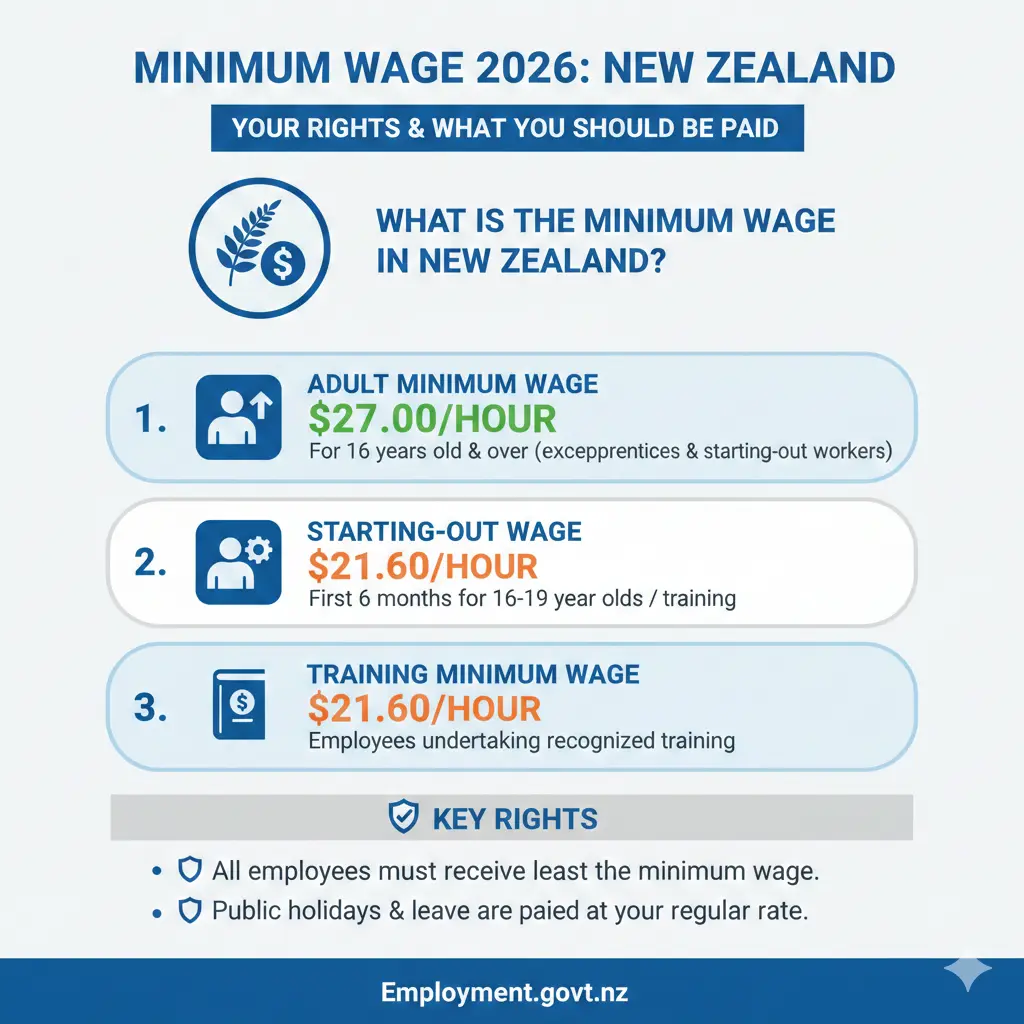
- Adult minimum wage (most workers 16+): $23.95 per hour
- Starting-out wage: $19.16 per hour (80% of adult rate)—for certain 16-19-year-olds in their first six months, or those transitioning from benefits
- Training wage: $19.16 per hour (80% of adult rate)—for workers 20+ on approved training programmes with at least 60 credits yearly
- No minimum for under 16s: But good employers often pay fairly; check your employment agreement
| Category | Who Qualifies | Rate from 1 April 2026 |
|---|---|---|
| Adult | 16+ years, not starting-out or training | $23.95/hour |
| Starting-out | 16-17 first 6 months; specific 16-19 on training/benefit paths | $19.16/hour |
| Training | 20+ on 60+ credit training programme | $19.16/hour |
| Children | 15 and under | No legal minimum |
These rates apply whether you're full-time, part-time, casual, salaried, on commission, or piece rates. No agreement with your boss can undercut them—it's illegal.
Who Qualifies for Minimum Wage Protections?
Most Kiwis in paid work are covered, but there are exceptions. You're entitled if you're an employee under the Employment Relations Act 2000—no matter your visa status or industry.
Common Eligible Workers
- Hospo staff in Wellington bars flipping burgers after school.
- Retail workers stocking shelves at Countdown in Christchurch.
- Cleaners in Auckland offices or care home support workers in Dunedin.
- Even apprentices after their training period ends.
Exemptions and Special Cases
Not everyone gets the full adult rate straight away:
- Starting-out: New 16-17-year-olds in their first 180 hours or six months with an employer. Also covers 16-19-year-olds on specific training or those off benefits for six months.
- Training: Adults on recognised programmes—must progress with at least 40-60 credits annually.
- Residents/special types: Supported employment for disabled workers or church workers might have tailored rates—check with Employment NZ.
- Independent contractors: Not employees, so no minimum wage (e.g., some gig drivers). Test your status via the online tool on employment.govt.nz.
Overseas? Visa holders on Accredited Employer Work Visas must still get at least minimum wage.
Your Rights: What Employers Must Do
Employers can't dodge minimum wage. Key rights include:
- Pay at least the rate for all hours worked—including training time or on-call shifts if you're required to be available.
- Record accurate hours and pay slips weekly or fortnightly—demand yours if missing.
- No deductions below minimum except approved ones like tax, KiwiSaver, ACC, or court-ordered (e.g., child support).
- Overtime or penalties? Minimum wage is the floor; awards or agreements often add more (e.g., Sunday rates in retail).
"This new rate will benefit around 122,500 working New Zealanders and strikes a balance between keeping up with the cost of living and not adding further pressure on the costs of running businesses."
Paid salary? Employers must ensure it equates to at least minimum for hours worked. Use Employment NZ's calculator to check.
How to Check if You're Paid Correctly
Grab your payslip and do the maths:
- Multiply hours worked by the applicable rate (e.g., 40 x $23.95 = $958 weekly).
- Subtract mandatory deductions only.
- Compare to what you received.
Tools to help:
- Employment NZ minimum wage calculator (employment.govt.nz).
- IRD myIR portal for tax checks.
- Timesheet apps like Clockify for tracking hours.
If underpaid, talk to your boss first—many fix it quickly. Still short? Contact Employment NZ's helpline (0800 20 90 20) for free advice.
What to Do if You're Underpaid
Underpayment happens—especially in casual hospo or seasonal fruit picking. Steps:
- Document everything: Payslips, rosters, texts about shifts.
- Raise it informally: "Kia ora, my pay seems short—can we check?"
- Lodge a claim: Free with Employment NZ up to three years backpay. They mediate or investigate.
- Escalate: Labour Inspectorate for deliberate breaches—fines up to $10,000 per worker.
- Support: Union like NZCTU, Community Law Centres, or WINZ if low-income.
Real Kiwi example: A Hamilton fast-food worker recovered $2,500 backpay after MBIE mediation in 2025.
Practical Tips for Kiwis on Minimum Wage
- Budget smart: Use sorted.org.nz tools; aim for KiwiSaver contributions for retirement boost.
- Upskill: Free apprenticeships via Competenz or study with StudyLink fees-free.
- Side hustles: Ensure they comply—don't let them drop you below minimum overall.
- Know Living Wage: $26/hour benchmark from Living Wage Movement—push employers adopting it (e.g., many councils).
- Tax credits: Check Working for Families via IRD if parenting.
Next Steps to Secure Your Pay
Don't leave money on the table—bookmark employment.govt.nz, snap photos of your next payslip, and chat with a mate or advisor today. If you're job hunting, target Living Wage employers via their site. For personalised help, ring Employment NZ or visit a Community Law Centre. You've got rights—use them to build a fairer future in New Zealand.
Frequently Asked Questions
Sources & References
-
1
New Zealand to raise minimum wage for workers from April 2026 — economictimes.com
-
2
Minimum wage set for 2026 - MBIE — www.mbie.govt.nz
-
3
Minimum wage increase balances business and worker needs — www.beehive.govt.nz
-
4
New Zealand Minimum Wage 2025 & 2026 - MoneyHub NZ — www.moneyhub.co.nz
-
5
Current Minimum Wage Rates NZ - Retail NZ — retail.kiwi
-
6
Minimum wage increases from 1 April 2026 — www.nzimmigrationpartners.com
Related Articles

Employment Law 101: Annual Leave; Sick Pay; and Your Rights
Ever wondered if you're getting the annual leave or sick pay you're entitled to? As Kiwis, we all deserve fair treatment at work, but navigating employment law can feel like a maze—especially with big...

Public Holidays NZ 2025: Your Rights and Pay
If you're working in New Zealand, understanding your public holiday rights is crucial—it affects your pay, your time off, and your work-life balance. Whether you're an employee wondering how much you'...

Minimum Wage NZ 2025: Current Rates and Your Rights
Imagine clocking in for your shift, working hard all day, only to realise your pay slip doesn't add up. For Kiwis relying on the minimum wage NZ 2025, knowing your rights isn't just smart—it's essenti...

Disputes with Employers: How to Handle Workplace Issues
Imagine clocking in for your shift only to face unfair treatment, unpaid wages, or a boss who ignores your concerns. For Kiwis, workplace disputes with employers are more common than you might think,...