Building Soft Skills for NZ's Automated Job Market: Empathy and Strategy Tips

As automation reshapes New Zealand's job market in 2026, Kiwis who master **soft skills** like empathy and strategic thinking will stand out. While AI handles routine tasks, employers increasingly val...
Priya writes about immigration pathways, job searching, and building a career in New Zealand. She covers visa options, CV writing, interview preparation, and workplace culture for newcomers and locals alike.
As automation reshapes New Zealand's job market in 2026, Kiwis who master **soft skills** like empathy and strategic thinking will stand out. While AI handles routine tasks, employers increasingly value human abilities that foster relationships and drive innovation—skills irreplaceable by machines.
In a tight labour market where 41% of workers are actively or passively job hunting, building these **soft skills for jobs in NZ** is your edge. With employment growth at a modest 0.3% and AI surging in job ads especially in IT, marketing, and strategy, here's how to prepare for the **automation job market**.
Why Soft Skills Matter More Than Ever in NZ's 2026 Job Landscape
New Zealand's workforce is evolving fast. AI and automation tools are embedded in hiring and daily workflows, streamlining admin but not replacing people. Instead, they're augmenting roles, elevating demand for **soft skills** that complement tech.
Employment Hero's 2026 report reveals 4 in 10 Kiwis want a new job, but frustration with vague ads and slow processes holds them back. Meanwhile, 73% prefer flexible, on-demand work—rising to 80% for under-35s. Employers who adopt AI for speed and clarity will win talent, but they need humans for the rest: empathy to build trust, strategy to navigate complexity.
Over 50% of employers are upskilling for AI-augmented roles like data analysis and stakeholder communications. In Auckland and Wellington, AI skill mentions in ads have surged, yet adoption lags, creating opportunities for those blending tech with people skills. South Island spots like Canterbury and Otago offer less competition in tourism and construction.
The Automation Shift: Tasks Change, Humans Stay Essential
AI won't wipe out jobs but reshape them. Only a small share of NZ roles can be fully automated; most see task-level changes. Neil Webster from Employment Hero notes: "AI is not replacing people. It's removing the admin burden that stops businesses from growing. When you combine smart tools with human capability, everything improves."
The NZ Workload Automation Market, valued at USD 140 million, drives efficiency in manufacturing, healthcare, and retail. Yet, gaps persist: only 47% of employers encourage AI use, while workers experiment independently. This divide favours those with **soft skills** to bridge it.
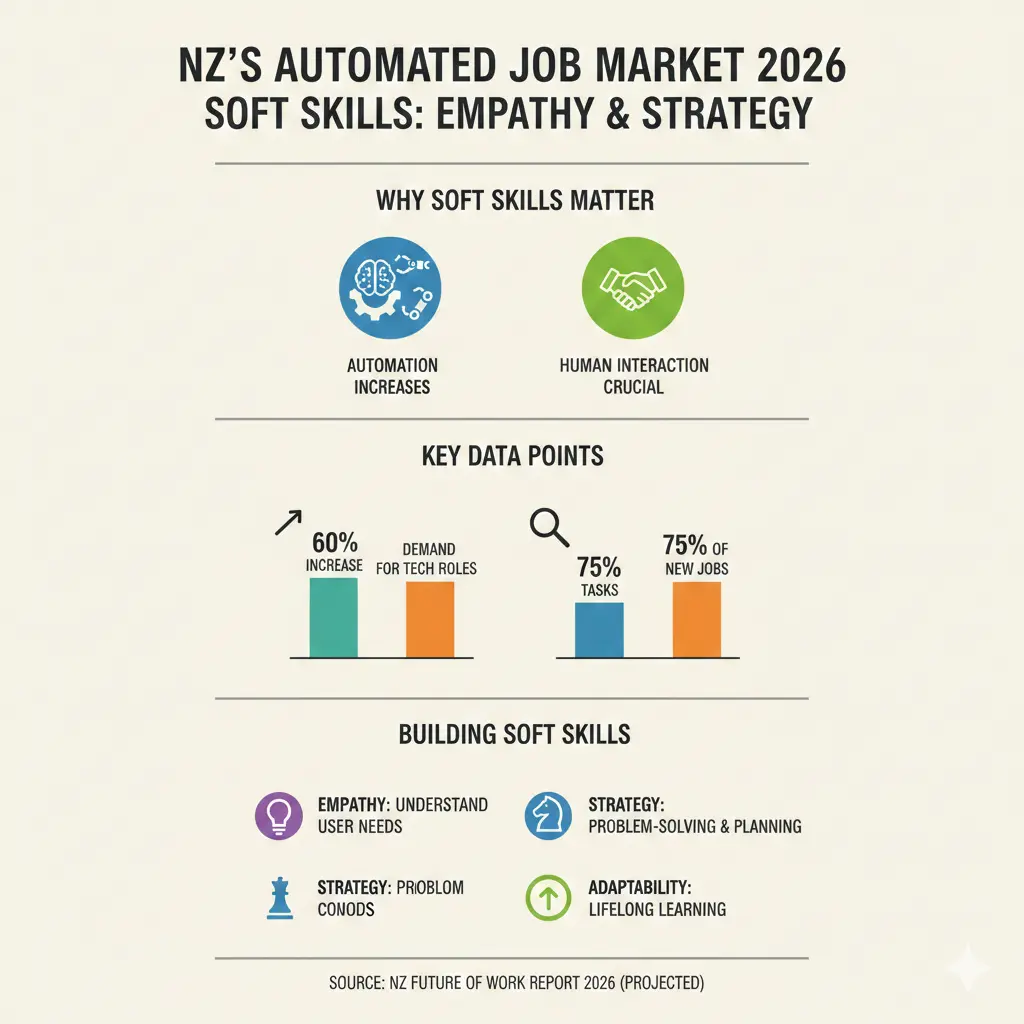
Top Soft Skills for Thriving in NZ's Automated Job Market
Focus on irreplaceable traits. Relationship building, valued by 68% of workers (per global trends adapted to NZ contexts), tops the list alongside adaptability and communication[rich_content reference, synthesized]. Here's what employers seek in 2026.
1. Empathy: The Human Edge AI Can't Replicate
Empathy builds trust in client-facing roles, from Auckland's logistics to Wellington's public sector. In AI-driven hiring, where tools like SmartMatch screen resumes, empathetic communicators shine in interviews and teams.
- Why it matters: 62% of Kiwis avoid jobs due to poor communication. Empathetic leaders retain talent amid flexibility demands.
- NZ example: In tourism hotspots like Queenstown, empathetic staff handle diverse visitors, boosting repeat business despite automation in booking systems.
2. Strategic Thinking: Navigate AI-Augmented Workflows
Strategy means seeing the big picture—redesigning roles around AI. With science and tech wages up 3.5% to $55.80/hour, strategists who upskill peers command premiums.
- Key application: In SMEs (covering 70,000+ employees), plan AI integration without fearing job loss—41% of IT pros considered leaving NZ over this.
- Regional tip: Auckland's recovery demands strategists in IT and construction.
3. Adaptability and Lifelong Learning
73% want on-demand work; adaptable Kiwis thrive. Upskilling in prompt engineering pairs with soft skills for AI roles.
4. Communication and Collaboration
Clear comms cut hiring friction. Over 50% of employers prioritise stakeholder skills.
5. Resilience and Emotional Intelligence
In a softening market with skill shortages, resilient teams weather public sector freezes in Wellington.
Practical Tips: Building Soft Skills for NZ Jobs
Don't just read—act. Tailor to Kiwi resources like Careers.govt.nz and regional networks.
Daily Habits to Boost Empathy
- Practice active listening: In meetings, paraphrase others' points.
- Volunteer: Join Community Waikato or local iwi initiatives for diverse interactions.
- Read Kiwi-authored books like "The Empathy Edge" adapted for NZ contexts.
Strategy-Building Exercises
- SWOT Analysis: Weekly review your career: Strengths (e.g., KiwiSaver planning), Weaknesses (AI gaps), Opportunities (Canterbury growth), Threats (automation).
- Mentor Up: Use LinkedIn to connect with Employment Hero experts or MBIE labour advisors.
- AI Pairing: Learn free tools via Te Pūkenga, then strategise their team impact.
NZ-Specific Resources for Upskilling
- Careers.govt.nz: Free soft skills courses aligned to 2026 forecasts.
- KiwiSaver Providers: Workshops on financial resilience as a soft skill.
- WINZ and StudyLink: Funding for short courses in regional hubs like Otago.
- SEEK and Trade Me Jobs: Target ads mentioning "AI readiness" and tailor CVs.
Incorporate these into your routine: dedicate 30 minutes daily. Track progress with a journal, aiming for one new connection weekly via NZ networks.
Job Search Strategies Tailored to Automation
With job ads rising but applications surging, stand out:
- Customise CVs highlighting soft skills with examples: "Led empathetic team through AI transition, retaining 90% staff."
- Leverage flexibility: Pitch hybrid models, valued by 80% of young Kiwis.
- Network regionally: Auckland for IT, South Island for tourism.
MBIE projects 1.4% annual growth to 2028, adding 39,400 workers yearly. Position yourself now.
Case Studies: Kiwis Winning with Soft Skills
Auckland Logistics Manager: Used empathy to upskill team on AI scheduling tools, boosting efficiency 20% amid USD 140m market growth.
Wellington Strategist: Navigated policy freezes by redesigning roles, securing promotion as AI ads surged.
Queenstown Tour Guide: Blended resilience with comms, thriving in +10% tourism growth.
Next Steps: Your Action Plan
Start today: Assess your soft skills via a free Careers.govt.nz quiz. Set goals—one empathy practice, one strategy exercise weekly. Update your SEEK profile with examples. Network on LinkedIn with #SoftSkillsJobsNZ. In 2026's **automation job market**, you're not just job hunting—you're future-proofing your career. Join progressive employers embracing AI and humans together.
Frequently Asked Questions
Sources & References
-
1
AI, flexibility & friction reshape New Zealand jobs in 2026 — ecommercenews.co.nz — ecommercenews.co.nz
-
2
New Zealand hiring market: Workforce outlook for 2026 — talentinternational.com — www.talentinternational.com
-
3
Job Search Strategies for 2026 | Career Solutions NZ — careersolutions.co.nz — www.careersolutions.co.nz
-
4
NZ Workload Automation Market | 2019 – 2030 - Ken Research — kenresearch.com — www.kenresearch.com
-
5
Medium to long-term employment outlook: Looking ahead to 2028 — mbie.govt.nz — www.mbie.govt.nz
-
6
NZ Tech Workers Adopt AI While Fearing Replacement - Younity — younity.co.nz — www.younity.co.nz
- 7
Useful Tools
Related Articles

Using Case Converters for Professional NZ Emails
This article references the following sources for accuracy and further reading:

Highest Paying Jobs in NZ 2026: Industries That are Desperate for Staff
If you're considering a career change or planning your next move in the New Zealand job market, you'll want to know where the money is—and more importantly, where employers are actively hiring. The go...

The Perfect NZ CV: A Free Template for 2026 Job Seekers
Your CV is your first chance to impress employers and land that job interview you're after. Whether you're a school leaver, career changer, or experienced professional, having a well-crafted CV tailor...
Best Recruitment Agencies for Tech Jobs in NZ
Searching for your next tech role in New Zealand's buzzing job market? With Kiwi tech hubs like Auckland, Wellington, and Christchurch leading the charge in cloud computing, cybersecurity, and softwar...