Disputes with Employers: How to Handle Workplace Issues

Imagine clocking in for your shift only to face unfair treatment, unpaid wages, or a boss who ignores your concerns. For Kiwis, workplace disputes with employers are more common than you might think,...
Priya writes about immigration pathways, job searching, and building a career in New Zealand. She covers visa options, CV writing, interview preparation, and workplace culture for newcomers and locals alike.
Imagine clocking in for your shift only to face unfair treatment, unpaid wages, or a boss who ignores your concerns. For Kiwis, workplace disputes with employers are more common than you might think, but knowing your rights under New Zealand law can turn the tide in your favour. This guide walks you through practical steps to handle disputes with employers, from internal chats to formal resolutions, using the latest 2026 employment rules.
Understanding Your Employment Rights in New Zealand
Every Kiwi worker is protected by the Employment Relations Act 2000, which sets the foundation for fair treatment, good faith dealings, and remedies for issues like unjustified dismissal or disadvantage. In 2026, recent changes strengthen these protections—wage theft is now a criminal offence under the Crimes (Theft by Employer) Amendment Act 2025, with penalties up to seven years' imprisonment for serious cases over $1,000. Pay secrecy clauses are invalid, letting you discuss wages openly to close gender and ethnic gaps.
Proposed 2026 reforms, like the Employment Relations Amendment Bill, introduce a $200,000 high-income threshold for unjustified dismissal claims (unless opted out), reform personal grievance remedies, and clarify contractor status with a 'gateway test'. A new Employment Leave Act is also on track, simplifying holidays and leave from early 2026. Always check your employment agreement—it's your first line of defence.
Common Types of Workplace Disputes
- Unpaid wages or entitlements: From overtime to holiday pay, intentional withholding is now theft.
- Unjustified actions: Dismissal, demotion, or disadvantage without fair process.
- Harassment or discrimination: Covered under the Human Rights Act 1993 alongside employment law.
- Health and safety breaches: Report to WorkSafe NZ if risks are ignored.
- Contract changes: Employers must bargain in good faith; unilateral shifts can trigger grievances.
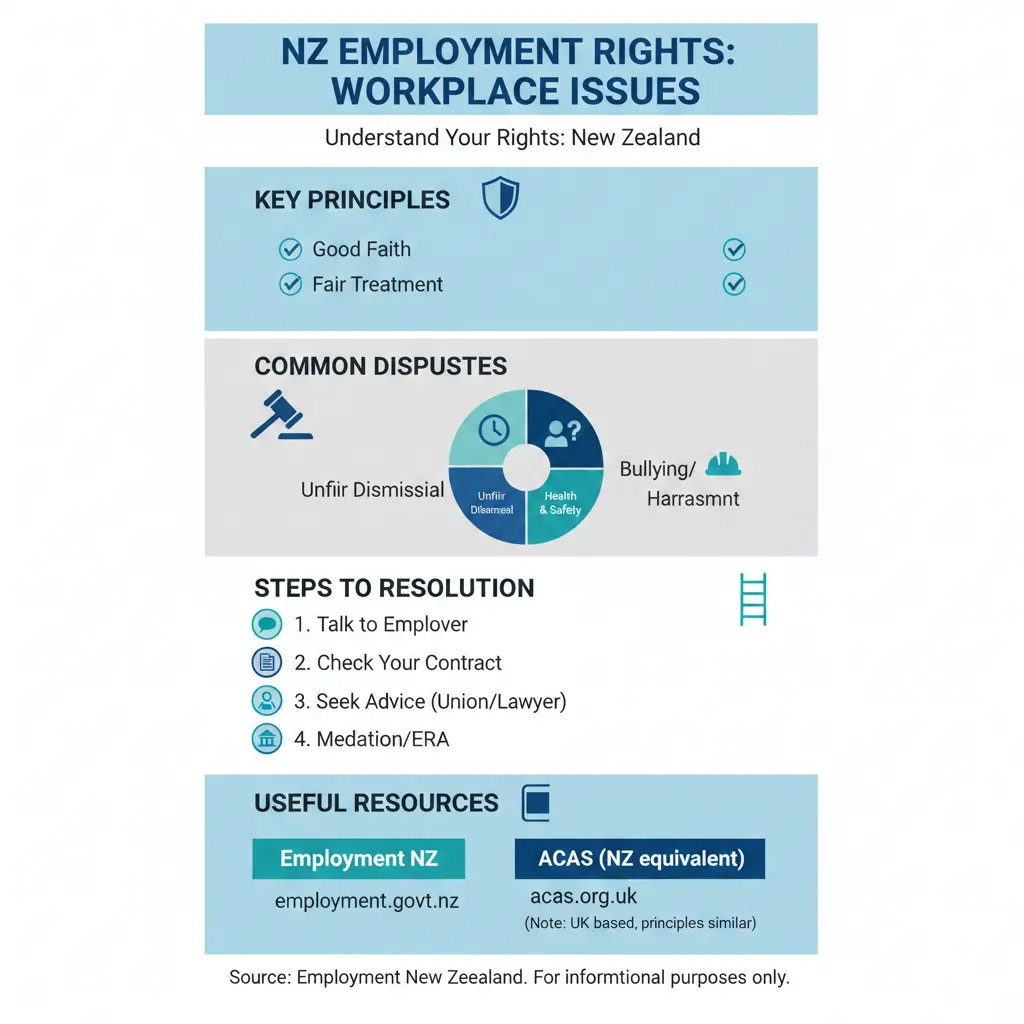
Step 1: Try Resolving It Internally
Most disputes start and end with a calm conversation. New Zealand law requires both parties to act in good faith, meaning open, honest communication without surprises. Document everything—emails, notes from meetings, and witnesses—to build your case.
Practical Tips for Internal Discussions
- Prepare your points: List facts, impacts on you, and desired outcomes, like backpay or a role adjustment.
- Request a meeting: Email your manager or HR: "I'd like to discuss [issue]—can we meet this week?"
- Stay professional: Use "I feel" statements, e.g., "I feel disadvantaged by the shift change without notice."
- Follow up in writing: Summarise agreements or next steps.
- Escalate if needed: Go to a senior manager or use your company's grievance policy, often in your employment agreement.
If internal efforts fail within 90 days, you're free to raise a personal grievance. For serious issues like wage theft, report to police alongside Employment NZ.
Step 2: Seek Free Mediation
When talks break down, mediation is your next free, confidential step through MBIE's (Ministry of Business, Innovation and Employment) service. A neutral mediator helps you and your employer negotiate a settlement—over 70% succeed without court.
How Mediation Works in 2026
- Apply online: Via employment.govt.nz—it's quick and no cost.
- Timeline: Mediation within weeks; you can request urgency.
- What to expect: Joint or separate sessions; outcomes are binding if agreed.
- New twists: With pending pre-termination negotiation rules, ensure any exit deal includes independent advice time and avoids penalties for breaches.
Mediation preserves relationships and avoids the stress of hearings. If no deal, proceed to formal investigation.
Step 3: Personal Grievances and Investigations
Raise a personal grievance (PG) if you've suffered unjustified disadvantage or dismissal. You have 90 days from the issue or discovery—don't delay. Send a formal letter to your employer outlining the grievance, facts, and remedy sought (e.g., compensation, reinstatement).
If unresolved in 90 days, apply to the Employment Relations Authority (ERA) for investigation. The ERA is an independent tribunal deciding on evidence, like a mini-court but less formal.
2026 Updates on Personal Grievances
Reforms limit remedies: high earners over $200,000 can't claim unjustified dismissal (opt-out possible); serious employee misconduct bars all remedies. Lesser misconduct cuts compensation up to 100%, excluding hurt feelings pay.
| Stage | Timeline | Key Action |
|---|---|---|
| Raise PG with employer | 90 days | Written notice |
| Employer response | 90 days | Investigate/resolve |
| Apply to ERA | After 90 days | Free application |
Step 4: Employment Relations Authority (ERA) Hearings
The ERA handles complex disputes, awarding remedies like lost wages (up to 12 months), humiliation compensation ($10,000–$30,000 typical), or reinstatement. Decisions are public and appealable to the Employment Court.
Preparing for an ERA Investigation
- Gather evidence: Payslips, emails, witness statements.
- Get support: Union reps, community law centres, or lawyers (check ACC levies or legal aid).
- Costs: Generally no filing fees; loser may pay some costs.
- 2026 note: Contractor disputes clarified—use the gateway test for status challenges.
For whistleblowers, the Protected Disclosures Act 2022 shields you from retaliation.
Getting Professional Help: Who to Contact
Don't go it alone—free resources abound for Kiwis:
- Employment NZ: Helpline 0800 20 90 20, advice on rights.
- Community Law Centres: Free legal help nationwide.
- Unions: If covered, strong advocates (e.g., NZCTU pushing right-to-disconnect).
- IRD: For tax/wage disputes tied to entitlements.
- WorkSafe: Health/safety issues.
- Lawyers: Specialist employment firms; initial consults often free.
In 2026, with KiwiSaver tweaks and minimum wage rises (1 April), check how disputes affect benefits.
Prevention: Building a Strong Workplace Relationship
Proactive steps reduce disputes:
- Review your employment agreement yearly.
- Join a union for collective bargaining power.
- Keep records of hours, pay, and feedback.
- Know family violence or bereavement leave rights under upcoming reforms.
Next Steps: Take Control Today
Start by documenting your issue and talking to your employer—most disputes resolve here. If not, hit mediation, then escalate confidently. Use Employment NZ's tools to stay empowered. You've got rights designed for Kiwis; use them to protect your livelihood. For personalised advice, call 0800 20 90 20 or visit a Community Law Centre today.
Frequently Asked Questions
Sources & References
-
1
An update on key employment law changes in 2026 - time to prepare! — www.humankind.nz
-
2
Significant changes in New Zealand employment law landscape — www.buddlefindlay.com
-
3
Employment Law Update: 2025 Review and 2026 Outlook for Schools — www.isnz.org.nz
-
4
NZ Employment Law 2026 Forecast - YouTube — www.youtube.com
-
5
2026 Employment Law Changes - Lawyers & Notary Public - Te Aroha — www.cwglaw.co.nz
-
6
What's on the Horizon – Time for Change — www.ammlaw.co.nz
-
7
Unions push for 'Right to Switch-Off' law - NZCTU — union.org.nz
-
8
Resolving problems | Employment New Zealand — www.employment.govt.nz
Related Articles

Employment Law 101: Annual Leave; Sick Pay; and Your Rights
Ever wondered if you're getting the annual leave or sick pay you're entitled to? As Kiwis, we all deserve fair treatment at work, but navigating employment law can feel like a maze—especially with big...
Minimum Wage 2026: Your Rights and What You Should Be Paid
Imagine clocking in for your shift at the local café in Auckland, only to realise your pay slip doesn't match what the law says you should be earning. For around 122,500 Kiwis living on or near the mi...

Public Holidays NZ 2025: Your Rights and Pay
If you're working in New Zealand, understanding your public holiday rights is crucial—it affects your pay, your time off, and your work-life balance. Whether you're an employee wondering how much you'...

Minimum Wage NZ 2025: Current Rates and Your Rights
Imagine clocking in for your shift, working hard all day, only to realise your pay slip doesn't add up. For Kiwis relying on the minimum wage NZ 2025, knowing your rights isn't just smart—it's essenti...