Immigration Advisor vs DIY: When You Need Professional Help

Navigating New Zealand's immigration system can feel like tackling a rugged tramping track—rewarding if you know the route, but risky if you go it alone without a map. For many Kiwis sponsoring family...
Sarah covers personal finance, tax, and KiwiSaver topics for Lifetimes NZ. She focuses on making money management straightforward and practical for everyday Kiwis.
Navigating New Zealand's immigration system can feel like tackling a rugged tramping track—rewarding if you know the route, but risky if you go it alone without a map. For many Kiwis sponsoring family, employers hiring skilled migrants, or individuals eyeing a visa switch, the choice between hiring a licensed immigration adviser or handling it yourself boils down to complexity, stakes, and your own expertise. This guide breaks down when Immigration Advisor vs DIY makes sense, helping you decide with confidence.
Understanding Immigration Advice in New Zealand
Immigration advice isn't just casual chit-chat—it's regulated under the Immigration Advisers Licensing Act 2007 to protect you from unqualified input that could derail your application. In New Zealand, anyone providing tailored guidance on visas, eligibility, or appeals must be a licensed immigration adviser (LIA) or exempt from licensing. Simply filling in forms with details you supply doesn't count as advice, but recommending the right visa pathway or interpreting policy does.
What Counts as Immigration Advice?
Advice becomes regulated when it's specific to your situation, such as:
- Assessing your eligibility for a Skilled Migrant Category Resident Visa.
- Advising on evidence needed for a Partner of a New Zealander Visa.
- Explaining impacts of 2026 policy shifts, like new wage thresholds or employer accreditation rules.
Immigration New Zealand (INZ) will decline applications if they include unregulated advice, and report unlicensed providers to the Immigration Advisers Authority (IAA). That's why checking the IAA register before engaging anyone is a must.
Licensed Immigration Advisers: Who They Are and Why They Matter
LIAs hold a Graduate Diploma in New Zealand Immigration Advice from Te Pūkenga, pass character checks, and commit to ongoing professional development. They're bound by a Code of Conduct covering ethics, competence, and client care, overseen by the IAA. Exempt providers include lawyers (via the New Zealand Law Society), Community Law Centres, Citizens Advice Bureau staff, and certain public servants—but always verify.
For Kiwis, this regulation ensures accountability. An LIA can liaise with INZ on your behalf, request your records, and represent you in disputes, saving you time and stress.
DIY Immigration: When It Works for Kiwis
Going solo suits straightforward cases where you're comfortable with online tools and have time to spare. INZ's Immigration Online portal lets you apply directly, with clear guides for common visas like visitor or student entries.
Ideal DIY Scenarios
- Simple Visitor Visas: If you're a Kiwi inviting overseas whānau for a short stay, provide basic docs like invitations and proof of funds—no complex eligibility tests.
- Student Visa Renewals: Current students extending enrolments often reuse existing info, especially if studying at a NZQA-approved provider.
- Straightforward Work Visa Extensions: For roles on the Green List with accredited employers, if your job matches ANZSCO levels 1-3 and meets median wage thresholds (updated for 2026).
Practical tip: Use INZ's Visa Finder tool and checklists. Budget 4-6 weeks for processing simple apps, and track via RealMe. Costs start low—e.g., $435 for a visitor visa in 2026 rates—but errors add up with refiling fees.
DIY Pros and Cons
| Pros | Cons |
|---|---|
| Save $1,500-$5,000 in adviser fees | Risk missing policy nuances, like 2026 Skilled Migrant changes requiring 5 years' experience (2 in NZ). |
| Full control and faster for basics | Time-intensive; appeals can take months |
| Free INZ resources and webinars | No expert review—INZ requests for info (RFIs) common, delaying outcomes |
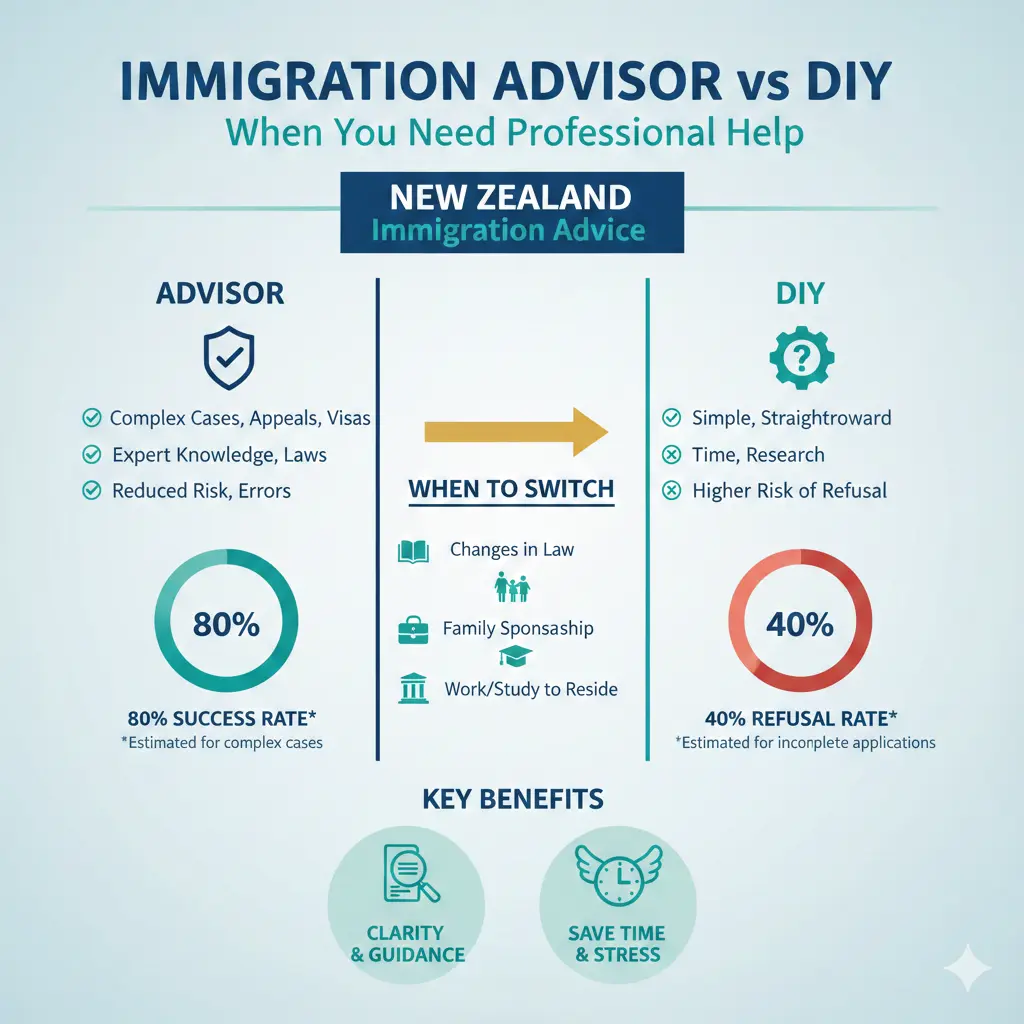
Many Kiwis succeed DIY for low-stakes visas, but stats show 20-30% of self-lodged complex apps face RFIs or declines versus under 10% with LIAs.
When You Need a Licensed Immigration Adviser
Opt for professional help when stakes are high—think residency pathways, family reunions, or business visas amid 2026 reforms like tightened employer checks. LIAs maximise success by tailoring apps to latest instructions.
Red Flags Signalling Professional Help
- Complex Eligibility: Skilled Migrant apps needing points for age, skills, or NZ work experience—2026 rules demand ANZSCO 1-3 jobs with 5 years' exp.
- Appeals or Declines: If INZ rejects your app, LIAs handle Immigration and Protection Tribunal reviews.
- Family or Partner Visas: Proving genuine relationships requires nuanced evidence like shared finances or kids' docs.
- Business/Investor Visas: High fees ($5,000+) and audits demand precision.
- Policy Shifts: Navigating 2026 changes in wage thresholds or accreditation without expertise risks refusal.
Financial Breakdown: Immigration Advisor vs DIY Costs
DIY keeps direct costs low, but hidden expenses mount:
| Scenario | DIY Cost | Adviser Cost | ROI Insight |
|---|---|---|---|
| Visitor Visa | $435 + time | $1,500-$2,500 | DIY wins |
| Skilled Migrant | $4,890 + delays | $4,000-$8,000 | Adviser: 80%+ success vs 50% DIY |
| Appeal | $500 court + months | $3,000-$6,000 | Adviser essential |
LIAs charge transparently—check IAA guidelines—and often offer fixed fees. For Kiwis, factor in lost wages if your business visa fails.
How to Choose and Work with a Licensed Immigration Adviser
Start with the IAA register: search by location, visa type, and reviews. Look for full licences (not provisional), IAA membership, and specialisation—e.g., tech sector for Green List roles.
Actionable Steps for Kiwis
- Verify licence and complaints history via IAA.
- Ask for a written plan, fees, and success rates.
- Get a fixed-fee quote; avoid success-based billing (IAA-regulated).
- Provide all docs upfront—LIAs use secure portals.
- Sign IAA client agreement for protection.
"LIAs provide guidance every step, ensuring your application is complete and decision-ready."
Popular for Kiwis: advisers near Auckland or Wellington with remote services nationwide.
2026 Immigration Updates: Why Expertise Counts Now
INZ's 2026 shifts include higher wage thresholds, stricter employer accreditation, and Skilled Migrant tweaks favouring 5+ years' experience. DIYers risk missing these, while advisers stay current via IAA training. For example, median wage rises impact work-to-residence paths—get it wrong, and restart.
Next Steps: Make Your Decision Today
Weigh your visa's complexity against your confidence. For simple DIY, hit INZ's site; for residency or 2026 hurdles, book three IAA-registered LIAs for quotes. Track everything via Immigration Online, and remember: this decision shapes your future in Aotearoa.
Disclaimer: Immigration rules evolve—seek personalised advice from a licensed professional or INZ. This isn't financial advice; consult IRD for tax implications on sponsorships.
Frequently Asked Questions
Sources & References
-
1
Getting immigration advice — Immigration New Zealand — www.immigration.govt.nz
-
2
All You Need to Know About an Immigration Consultant New Zealand — Greatlife — www.greatlife.co.nz
-
3
Who can give immigration advice — Immigration New Zealand — www.immigration.govt.nz
-
4
Information for immigration professionals — Immigration New Zealand — www.immigration.govt.nz
-
5
Maximise Your Chances of Success by using a Licensed Immigration Adviser — Stellar Recruitment — www.stellarrecruitment.com
-
6
Become a licensed adviser — IAA — www.iaa.govt.nz
-
7
New Skilled Migrant Rules Take Effect August 2026 — NZ Immigration Partners — www.nzimmigrationpartners.com
-
8
Immigration New Zealand Outlines Major 2026 Policy Shifts — Newland Chase — newlandchase.com
-
9
Qualifications — IAA — www.iaa.govt.nz
Related Articles

Industry Bodies and Professional Associations NZ
Whether you're launching a business, advancing your career, or navigating financial regulations, industry bodies and professional associations in New Zealand offer invaluable support. These organisati...

Emergency Benefit NZ: When You Have No Other Options
When you're struggling financially and don't qualify for other benefits, the Emergency Benefit might be your lifeline. It's a discretionary payment designed for Kiwis in genuine hardship who've exhaus...

Unpaid Internships NZ: Are They Legal?
Unpaid internships are a common pathway for students and graduates to gain work experience in New Zealand, but there's often confusion about whether they're actually legal. The short answer is: unpaid...

Estate Administration NZ: Managing Someone's Affairs After Death
Losing a loved one is one of life's toughest challenges, and stepping in to manage their estate can feel overwhelming. In New Zealand, estate administration—the process of handling someone's affairs a...