Unpaid Internships NZ: Are They Legal?

Unpaid internships are a common pathway for students and graduates to gain work experience in New Zealand, but there's often confusion about whether they're actually legal. The short answer is: unpaid...
The Lifetimes NZ editorial team curates, fact-checks, and updates guides on personal finance, property, health, immigration, legal, business, and lifestyle topics relevant to Lifetimes NZ readers. Articles are produced with AI assistance and reviewed by the editorial team before publication.
Unpaid internships are a common pathway for students and graduates to gain work experience in New Zealand, but there's often confusion about whether they're actually legal. The short answer is: unpaid internships are legal in New Zealand, but only if they meet strict criteria. If those criteria aren't met, what looks like an internship could actually be unlawful employment, leaving interns without the protections they're entitled to.
This guide will help you understand the legal landscape around unpaid internships in Aotearoa, whether you're a student considering an unpaid position or an employer thinking about taking on an intern.
Are Unpaid Internships Legal in New Zealand?
Yes, unpaid internships are legal in New Zealand, but with important conditions. For an internship to be unpaid, the intern must be classified as a volunteer. This distinction is crucial because it determines what legal protections apply—and what they don't.
The Employment Relations Act doesn't specifically define internships, which creates a grey area that some employers exploit. According to Employment New Zealand, unpaid interns aren't considered employees and therefore aren't covered by standard employment law. However, this doesn't mean they have zero protections.
Volunteers and unpaid interns are still protected under the Health and Safety at Work Act and the Human Rights Act. This means your employer must still provide a safe working environment and treat you fairly regardless of whether you're paid.
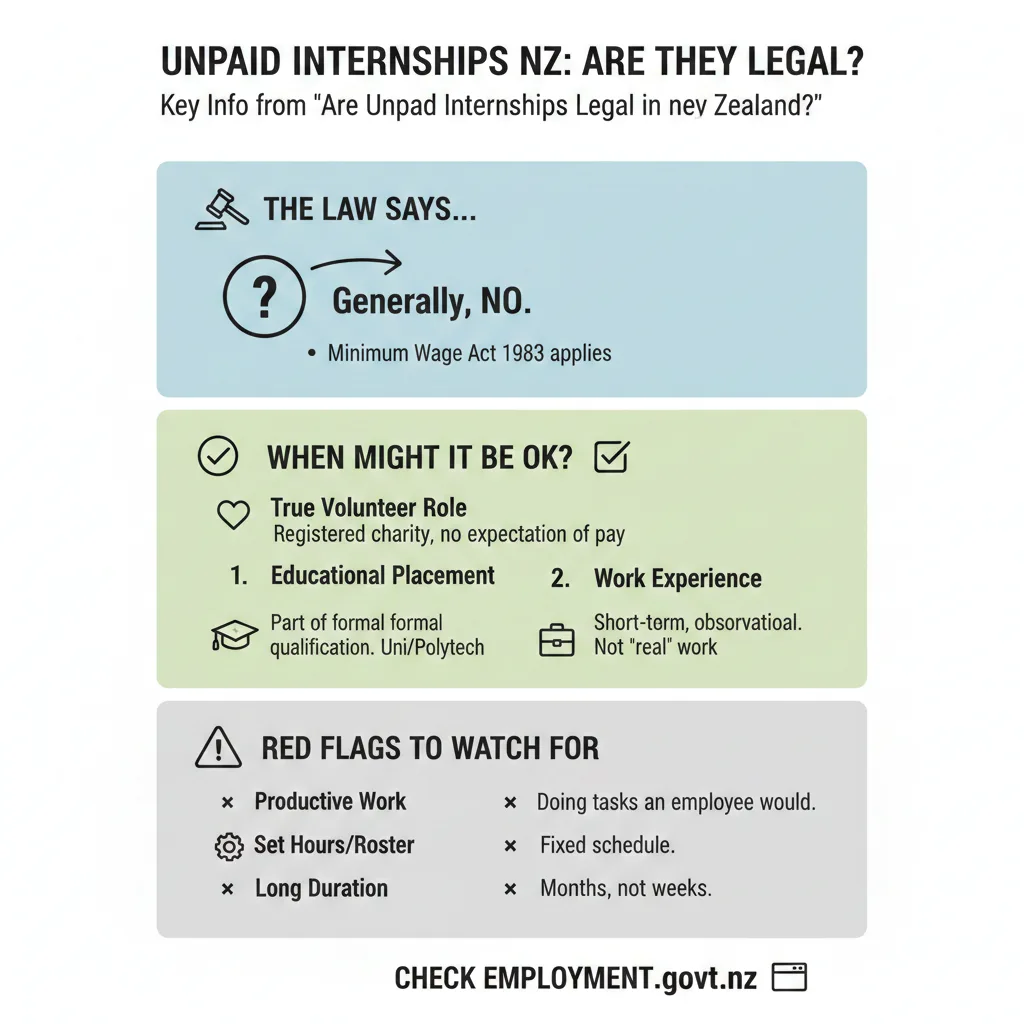
The Key Legal Requirements for Unpaid Internships
To keep an unpaid internship on the right side of the law, it must meet several specific criteria. If it doesn't, what started as an internship could be reclassified as paid employment, and the intern becomes entitled to minimum wage and full employment protections.
1. The Intern Must Be a Genuine Volunteer
This is the foundation of everything. The intern must be clearly informed in writing that they're volunteering and won't receive payment. There's no ambiguity here—if someone's performing work for your business, they need to know upfront whether they're being paid or not.
2. No Economic Benefit to the Business
This is where many employers slip up. The internship must not cause economic benefit to the business. In other words, the intern's work shouldn't generate profit or save the company money by replacing paid staff.
The exception here is registered charities, which can benefit economically from volunteer work. But for most businesses, if the intern's work is making you money, they should be paid.
3. Work That Employees Don't Normally Do
The intern shouldn't be doing work that an employee would ordinarily be paid to do. This is a critical test. If you have a role that would normally be filled by a paid staff member, you can't just call it an internship to avoid paying someone.
Instead, interns should be working on tasks that are supplementary or educational in nature—things that wouldn't normally be part of your regular business operations.
4. Primary Focus on Learning and Skill Development
The primary purpose of the internship must be allowing the intern to gain new skills and experience. This means the internship should be structured around learning, shadowing, training, and skill development rather than routine company tasks.
The Citizens Advice Bureau recommends that unpaid internships be short-term and focused on growth, which helps protect students from exploitation.
5. Limited Duration and Hours
The duration of work and hours worked should be limited. The longer someone volunteers and the more hours they work, the more likely they are to be considered an employee. There's no specific maximum in the law, but the expectation is that unpaid internships won't be long-term, full-time arrangements.
What Happens If These Criteria Aren't Met?
If an unpaid internship doesn't meet these requirements, it can be considered free labour or exploitation. In practical terms, this means:
- The "intern" may actually be classified as an employee
- They'd be entitled to back pay at the minimum wage rate
- They'd have full employment protections under the Employment Relations Act
- The employer could face penalties from the Labour Inspectorate
The Labour Inspectorate takes these matters seriously and has published guidance on work in a business operation without payment of wages.
Paid Internships: A Different Story
If you're offering a paid internship, the rules change significantly. Paid interns are employees and are covered by all employment law.
Here's what you need to do for a paid internship:
- Pay at least the minimum wage (currently $24.80 per hour from 1 April 2025)
- Provide a fixed-term employment agreement that specifies the reason for the fixed term
- Provide all standard employment protections and entitlements
- Include the internship end date in the agreement
A paid internship is a legitimate employment arrangement and actually protects both the employer and intern by being clear about expectations and legal obligations.
Work Trials vs. Internships: Know the Difference
Some employers try to use "work trials" as a way to test potential employees without paying them. This is different from internships and has different rules.
If you want to trial a potential employee's skills, you should pay them for the time they work. Alternatively, you can use a legitimate 90-day trial period if certain conditions are met:
- The employee is new (hasn't worked for your business before)
- The 90-day trial period is specified in the employment agreement
- A specified start date is in the offer letter
- The employee signs the agreement before starting
- Notice of termination is given within 90 days if needed
Generally, unpaid work trials are unlawful and shouldn't be used.
Studentships: A Special Case
There's another category worth understanding: studentships. These are different from internships and are actually scholarships, not jobs.
A studentship might involve a period of work experience in an academic department—helping researchers with projects, for example. Because it's classified as a scholarship rather than employment, the minimum wage doesn't apply, and it's not covered by employment law. Studentships are also tax-free.
Practical Advice for Students Considering an Unpaid Internship
If you're thinking about doing an unpaid internship, here's what you should check:
- Get it in writing: Ensure you have written confirmation that it's an unpaid volunteer position
- Understand the purpose: Make sure the role is genuinely about learning, not just getting free labour
- Check the hours: Verify that it's not a full-time, long-term commitment disguised as an internship
- Know your protections: Remember you're still covered by health and safety laws and human rights protections
- Consider alternatives: If the internship seems exploitative, ask about paid opportunities or seek advice from the Citizens Advice Bureau
Victoria University of Wellington's Careers Service emphasises that if an internship involves ongoing responsibilities or becomes more about the company's needs than your learning, it may need to be restructured or compensated.
Practical Advice for Employers Offering Internships
If you're considering taking on an intern, here's how to do it legally:
- Be clear about payment: Decide upfront whether the internship will be paid or unpaid
- Document everything: Put the arrangement in writing, including the unpaid status if applicable
- Design meaningful work: Structure the role around learning and skill development, not just filling gaps in your staffing
- Limit the scope: Don't treat interns as permanent staff members doing regular business tasks
- Respect their time: Keep hours reasonable and duration limited
- Provide support: Offer mentoring, feedback, and genuine learning opportunities
Following these guidelines protects both you and the intern, and helps build a positive reputation for your business in the graduate recruitment market.
Frequently Asked Questions
Can I have an unpaid intern doing the same work as a paid employee?
No. If the work is something an employee would normally do, the person should be paid. This is one of the key tests for whether an unpaid arrangement is legal.
What if I'm offering an unpaid internship at a charity?
Unpaid internships at registered charities have slightly different rules—they can provide economic benefit to the charity. However, all the other criteria still apply: the focus should be on learning, the work shouldn't replace paid staff, and hours should be reasonable.
Can I use an unpaid internship to replace maternity leave cover?
This would be problematic. If the internship is doing work that would normally be done by a paid employee (in this case, covering for someone on leave), it should be a paid position. The unpaid internship rules don't apply to filling temporary staffing gaps.
What's the difference between an unpaid internship and a work experience placement?
In New Zealand law, these are essentially the same thing. Both are unpaid volunteer arrangements that must meet the same criteria: genuine learning focus, no economic benefit to the employer, work that employees don't normally do, and limited duration.
If I'm doing an unpaid internship, am I entitled to holiday pay or sick leave?
No. Because unpaid interns aren't classified as employees, they're not entitled to standard employment entitlements like holiday pay, sick leave, or redundancy protections. However, you're still entitled to health and safety protections and human rights protections.
Can an employer change an unpaid internship to paid partway through?
Yes, and this actually happens when employers realise the work has crossed the line into regular employment. If an arrangement starts as unpaid but becomes more like paid work, it should be converted to a proper paid position with an employment agreement and minimum wage.
Key Takeaways
Unpaid internships are legal in New Zealand, but they're heavily regulated. The key is that unpaid work must genuinely be about the intern's learning and development, not about providing cheap labour for the business. If you're a student, make sure any unpaid internship meets the legal criteria and actually teaches you valuable skills. If you're an employer, follow the guidelines—not only is it the law, but offering genuine learning opportunities builds your reputation and attracts better talent.
For more information, visit Employment New Zealand's official guidance on volunteers, internships and studentships, or contact the Citizens Advice Bureau if you have concerns about an internship arrangement.
Related Articles

Industry Bodies and Professional Associations NZ
Whether you're launching a business, advancing your career, or navigating financial regulations, industry bodies and professional associations in New Zealand offer invaluable support. These organisati...

Emergency Benefit NZ: When You Have No Other Options
When you're struggling financially and don't qualify for other benefits, the Emergency Benefit might be your lifeline. It's a discretionary payment designed for Kiwis in genuine hardship who've exhaus...

Estate Administration NZ: Managing Someone's Affairs After Death
Losing a loved one is one of life's toughest challenges, and stepping in to manage their estate can feel overwhelming. In New Zealand, estate administration—the process of handling someone's affairs a...

Investor Visas NZ: Bringing Capital to New Zealand
Imagine transforming your wealth into a foothold in one of the world's most liveable countries, where stunning landscapes meet a thriving economy. Investor visas in New Zealand offer high-net-worth in...