90-Day Trial Period: What You Need to Know

Starting a new job in New Zealand is exciting, but spotting a 90-day trial period in your employment agreement can raise questions. Whether you're a Kiwi fresh out of uni, switching careers, or an emp...
Priya writes about immigration pathways, job searching, and building a career in New Zealand. She covers visa options, CV writing, interview preparation, and workplace culture for newcomers and locals alike.
Starting a new job in New Zealand is exciting, but spotting a 90-day trial period in your employment agreement can raise questions. Whether you're a Kiwi fresh out of uni, switching careers, or an employer hiring your next team member, understanding these trial periods is key to protecting your rights and making informed choices.
This guide breaks down everything you need to know about 90-day trial periods under New Zealand law as of 2026—from who can use them, your rights during the trial, to what happens if things don't work out. We'll cover practical steps, real-world examples, and resources to help you navigate this common employment practice confidently.
What is a 90-Day Trial Period?
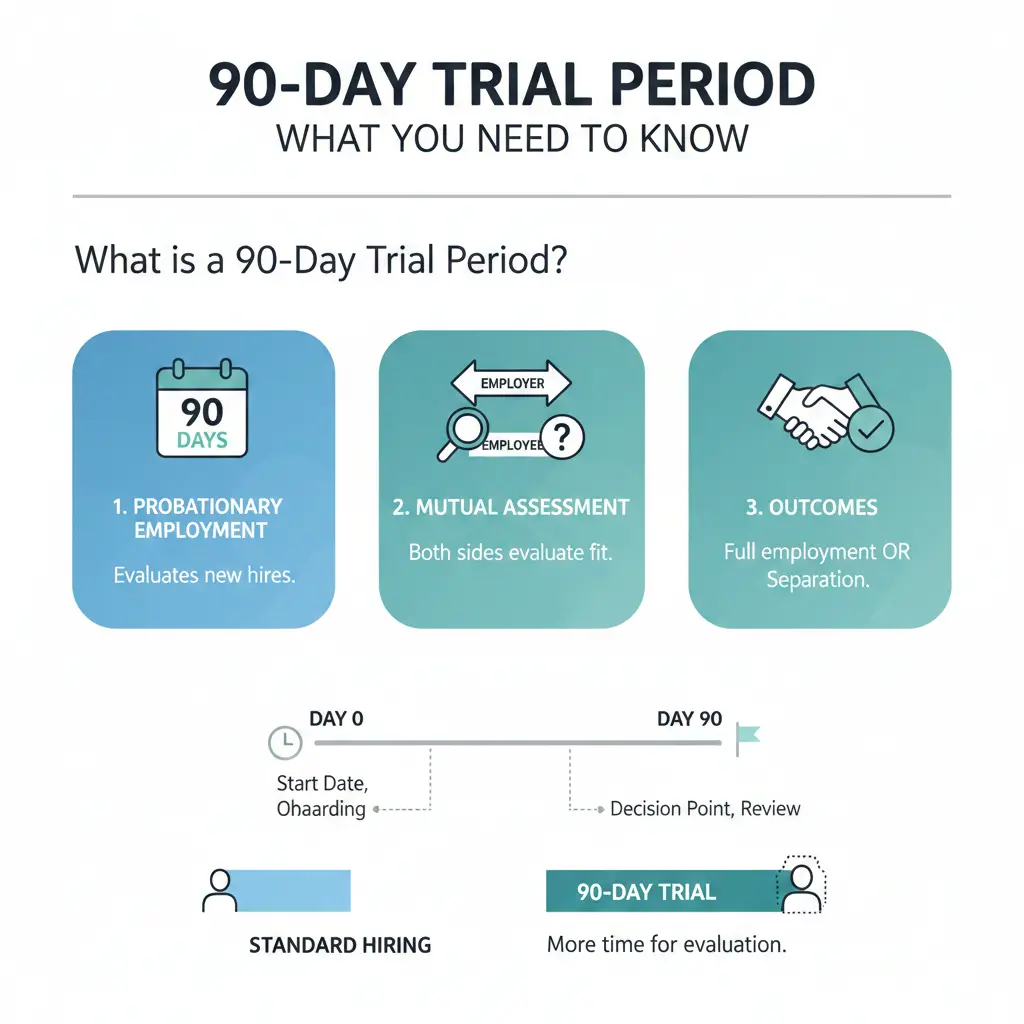
A 90-day trial period is a provision in New Zealand employment agreements that lets employers assess a new employee's suitability for the role during the first 90 calendar days of employment. It allows dismissal without the usual personal grievance rights for unjustified dismissal, giving employers flexibility while starting someone new.
Introduced under the Employment Relations Act 2000 (sections 67A and 67B), these trials help employers test skills, experience, and cultural fit without long-term commitment risks. For employees, it's a probation-like phase, but with specific legal protections—and limitations.
How Does a 90-Day Trial Differ from a Probationary Period?
Many Kiwis mix up trial periods with probationary periods, but they're distinct tools under the law. Here's a clear comparison:
| Aspect | 90-Day Trial Period | Probationary Period |
|---|---|---|
| Length | Maximum 90 calendar days (can be shorter, e.g., 30 days) | No fixed limit—can be longer if agreed |
| Who Can Use It? | New employees only (no prior work for the employer) | New or existing employees in a new role |
| Dismissal Rights | No reason required; no personal grievance for unjustified dismissal | Good reason needed, plus fair chance to improve; personal grievance possible |
| Legal Basis | Sections 67A & 67B, Employment Relations Act | Section 67, Employment Relations Act |
This table highlights why employers often prefer trials for true newcomers. Note: Combining both in one agreement can invalidate the trial, as seen in cases like Lewis v Immigration Guru Limited.
Who Can Use a 90-Day Trial Period in New Zealand?
Since December 2023, all employers—regardless of size—can include a 90-day trial in agreements with new hires. This reversed earlier restrictions limiting them to small businesses (under 20 employees).
- Any industry: From hospitality in Auckland to tech startups in Wellington, trials apply across sectors.
- New employees only: The employee mustn't have done any prior work for you, even unpaid or in a different role. Pre-employment tests count as work if they mimic job tasks—get advice to avoid pitfalls.
- No extensions: Strictly 90 days max from start date; use tools like the Employment Agreement Builder's 90-day calculator for exact end dates.
For example, a Christchurch café hiring a barista who's never worked there before can use a trial. But rehiring a former casual staffer? No trial allowed.
How to Set Up a Valid 90-Day Trial Period
Getting it wrong can make the trial unenforceable, exposing employers to personal grievances. Follow these steps for compliance:
- Include it in writing: The clause must be in the signed employment agreement before work starts. Use templates from official tools like the Employment Agreement Builder on business.govt.nz.
- Give time to review: Employees need reasonable opportunity to seek advice (e.g., from a union or lawyer) and understand implications.
- Specify dates: State start (employment commencement) and end dates clearly.
- Sign before day one: No signature? Postpone start—no retroactive trials.
"A trial period allows an Employer to assess and confirm an Employee’s suitability... but restricts personal grievances for that dismissal."
Employers: Act in good faith—discuss issues early, even if not required.
Your Rights as an Employee on a 90-Day Trial
Trials limit some protections, but you're not without rights. Here's what Kiwis need to know:
- No unjustified dismissal claims: Can't raise a personal grievance solely for being dismissed during the trial.
- Other protections intact: Personal grievances for discrimination, harassment, or health/safety issues are still valid.
- Notice required: Unless serious misconduct, get written notice per your agreement (often 1 week, or pay in lieu).
- Holiday pay and KiwiSaver: Accrue from day one—trials don't affect these.
- Minimum rights: Minimum wage, breaks, and ACC coverage apply fully.
If dismissed, notice must be given before the 90 days end, even if last day is after. Post-trial, you're permanent with full rights.
What if You're Dismissed During the Trial?
Employers don't need a reason, but best practice is providing one in writing and prior feedback. Steps for you:
- Review your agreement: Check notice period and trial clause.
- Seek support: Contact Employment New Zealand (0800 20 90 20) or a community law centre.
- Challenge if invalid: Wrong process (e.g., prior work done)? You may claim unjustified dismissal.
- Final pay: Due within specified time—includes holiday pay owed.
Real Kiwi example: A terminated trial employee successfully grieved when pre-interview work invalidated the trial.
Employers: Best Practices for Managing 90-Day Trials
To minimise risks:
- Train managers on good faith obligations.
- Document performance chats—aim for improvement first.
- Use sample termination letters, but personalise with reasons.
- After 90 days: Confirm permanency in writing.
Larger firms like those in retail often use trials for seasonal hires, ensuring smooth onboarding.
Common Pitfalls and How to Avoid Them
Avoid these traps:
- Pre-work slip-ups: No trials if assessments = work.
- Missing signatures: Delays start date.
- Over 90 days: Becomes probation-like.
- Poor process: Employment Relations Authority scrutinises strictly.
Next Steps for Kiwis
If you're job hunting, read agreements carefully—ask questions before signing. Employers, consult resources like Employment New Zealand for templates and advice. Facing issues? Reach out to MBIE's Employment NZ hotline (0800 20 90 20), a union, or free services like Community Law Centres. Knowledge is your best protection in Aotearoa's job market—stay informed, act promptly, and build successful careers.
Frequently Asked Questions
Sources & References
-
1
90 Day Trial Period Process - Employers Assistance — www.employers.co.nz
-
2
Probationary period or 90-day trial: knowing when and how to use — www.laneneave.co.nz
-
3
Trial and probationary periods | Employment New Zealand — www.employment.govt.nz
-
4
Changes To 90 Day Trial Periods - JB Morrison — www.jbmorrison.com
-
5
Trial periods - DLA Piper GENIE — knowledge.dlapiper.com
-
6
Labour rolls back 90 day trial periods in employment law | BuckettLaw — www.buckettlaw.co.nz
-
7
90-Day Trial Periods: Employer Rights & Responsibilities — www.turnerhopkins.co.nz
-
8
Trial period - Employment Agreement Builder - Business.govt — eab.business.govt.nz
-
9
The Ins and Outs of the 90-Day Trial: What Employers Need to Know — iremploymentlaw.co.nz
Related Articles

Employment Law 101: Annual Leave; Sick Pay; and Your Rights
Ever wondered if you're getting the annual leave or sick pay you're entitled to? As Kiwis, we all deserve fair treatment at work, but navigating employment law can feel like a maze—especially with big...
Minimum Wage 2026: Your Rights and What You Should Be Paid
Imagine clocking in for your shift at the local café in Auckland, only to realise your pay slip doesn't match what the law says you should be earning. For around 122,500 Kiwis living on or near the mi...

Public Holidays NZ 2025: Your Rights and Pay
If you're working in New Zealand, understanding your public holiday rights is crucial—it affects your pay, your time off, and your work-life balance. Whether you're an employee wondering how much you'...

Minimum Wage NZ 2025: Current Rates and Your Rights
Imagine clocking in for your shift, working hard all day, only to realise your pay slip doesn't add up. For Kiwis relying on the minimum wage NZ 2025, knowing your rights isn't just smart—it's essenti...