Public Holidays NZ 2025: Your Rights and Pay

If you're working in New Zealand, understanding your public holiday rights is crucial—it affects your pay, your time off, and your work-life balance. Whether you're an employee wondering how much you'...
Priya writes about immigration pathways, job searching, and building a career in New Zealand. She covers visa options, CV writing, interview preparation, and workplace culture for newcomers and locals alike.
If you're working in New Zealand, understanding your public holiday rights is crucial—it affects your pay, your time off, and your work-life balance. Whether you're an employee wondering how much you'll earn on a public holiday or an employer trying to get the rules right, this guide covers everything you need to know about New Zealand's public holidays in 2025.
What Are Public Holidays in New Zealand?
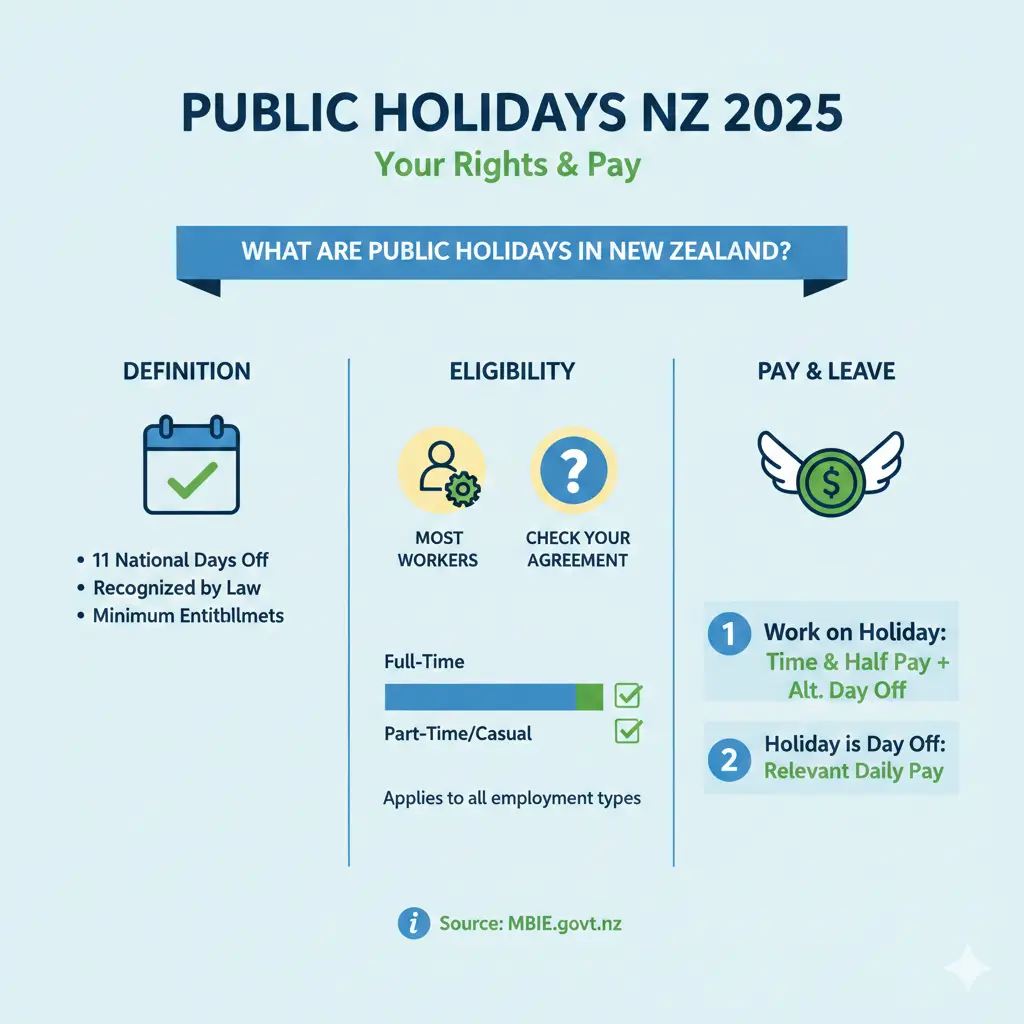
Public holidays in New Zealand are days when most businesses close and employees are entitled to paid time off. Unlike some countries, New Zealand has a mix of national public holidays that apply across the entire country and regional anniversary dates that vary by location.
There are 11 national public holidays in 2025, plus regional anniversary days that differ depending on where you live. These holidays are protected by employment law, meaning your employer can't simply refuse to give you the day off or penalise you for taking it.
The 11 National Public Holidays in 2025
Here are all the national public holidays you're entitled to in 2025:
- New Year's Day – Wednesday, 1 January
- Day after New Year's Day – Thursday, 2 January
- Waitangi Day – Thursday, 6 February
- Good Friday – Friday, 18 April
- Easter Monday – Monday, 21 April
- ANZAC Day – Friday, 25 April
- King's Birthday – Monday, 2 June
- Matariki – Friday, 20 June
- Labour Day – Monday, 27 October
- Christmas Day – Thursday, 25 December
- Boxing Day – Friday, 26 December
On these days, you're entitled to take the day off with pay. Your employer must either give you the day off or pay you extra if you're required to work.
Regional Anniversary Days
In addition to national holidays, most regions in New Zealand have one regional anniversary day each year. This is a public holiday specific to your area. For example:
- Auckland – Monday, 27 January
- Wellington – Monday, 20 January
- Nelson – Monday, 3 February
- Taranaki – Monday, 10 March
- Otago – Monday, 24 March
- Southland – Tuesday, 22 April
- Hawke's Bay – Friday, 24 October
- Marlborough – Monday, 3 November
- Canterbury – Friday, 14 November
- Westland – Monday, 1 December
- Chatham Islands – Monday, 1 December
You're entitled to the same protections on your regional anniversary day as you are on national public holidays. Check your local council or employment agreement to confirm which region applies to you.
How Public Holiday Pay Works in New Zealand
Ordinary Weekly Pay
When you take a public holiday, you're entitled to be paid your ordinary weekly pay. This is calculated based on your normal pay rate and the hours you'd usually work on that day of the week.
For example, if you normally earn $1,000 per week and work five days a week, your ordinary daily pay is $200. If a public holiday falls on a day you'd normally work, you're entitled to $200 in pay for that day.
If You Work on a Public Holiday
If your employer requires you to work on a public holiday, you're entitled to time off in lieu (another day off) or extra pay—usually at a higher rate. The exact entitlement depends on your employment agreement and the specific holiday.
For most public holidays, if you work, you should receive your ordinary weekly pay plus a loading (extra payment). However, there are some exceptions:
- ANZAC Day – Shops must close until 1 PM, so morning workers have special protections.
- Good Friday and Christmas Day – Most shops are required to be closed.
Always check your employment agreement or ask your employer what applies to you, as some industries (like healthcare, hospitality, and retail) have different arrangements.
Alternative Holidays
If a public holiday falls on a weekend, you're usually entitled to an alternative holiday on the next working day. For example, if Christmas Day falls on a Saturday, you'd get the following Monday off instead.
This means you don't lose out on your public holiday entitlement just because it lands on a weekend.
Special Rules for Different Holidays
ANZAC Day (25 April)
ANZAC Day has unique trading restrictions. Most shops must remain closed until 1 PM. If you work during the morning, you're entitled to your ordinary weekly pay. If you work in the afternoon or evening, your employer may require you to work, but you should receive additional compensation.
Good Friday and Christmas Day
These are the most strictly protected holidays. Most shops are required to be closed all day, meaning most employees won't be required to work. If you do work (perhaps in essential services), you're entitled to extra pay.
Easter Monday
Easter Monday is a national public holiday with the same protections as other holidays. If it falls on a weekend, you get an alternative day off.
Matariki (Māori New Year)
Matariki is a relatively new national public holiday, celebrating the Māori New Year. In 2025, it falls on Friday, 20 June. It's treated the same as other national public holidays for pay and time-off purposes.
Your Rights as an Employee
Under New Zealand employment law, you have the following rights on public holidays:
- You're entitled to take the day off with pay (your ordinary weekly pay)
- Your employer can't penalise you for taking a public holiday
- If you're required to work, you're entitled to extra compensation (either time off or extra pay)
- If a public holiday falls on a weekend, you get an alternative day off
- These rights apply whether you're full-time, part-time, or casual
If you believe your employer is breaching these rights, you can contact Employment New Zealand for free advice, or reach out to the Department of Labour.
Tips for Managing Public Holidays at Work
Check Your Employment Agreement
Your employment agreement should outline how public holidays are handled in your workplace. Some industries have collective agreements that provide better entitlements than the legal minimum.
Communicate with Your Employer
If you're unsure whether you'll be required to work on a public holiday, ask your employer in advance. This helps you plan and ensures there's no confusion about pay.
Keep Records
Keep records of public holidays you've worked and any extra pay or time off you've received. This protects you if there's a dispute later.
Know Your Regional Holiday
Make sure you know when your regional anniversary day is. You're entitled to this day off just like any other public holiday.
Moving Forward
Public holidays are a crucial part of your employment rights in New Zealand. Whether you're planning your year ahead or dealing with a specific public holiday situation, it's important to know where you stand. Make sure you understand your entitlements, check your employment agreement, and don't hesitate to seek advice if something doesn't seem right.
For more information, visit Employment New Zealand, which provides free, impartial advice on employment matters. If you have specific concerns about your public holiday entitlements, they're your first port of call.
Frequently Asked Questions
Sources & References
-
1
Holidays and Observances in New Zealand in 2025 — Time and Date — www.timeanddate.com
-
2
NZ Public Holidays 2025 — Public Holiday — publicholiday.co.nz
-
3
Public holidays and anniversary dates — Employment New Zealand — www.employment.govt.nz
Related Articles

Employment Law 101: Annual Leave; Sick Pay; and Your Rights
Ever wondered if you're getting the annual leave or sick pay you're entitled to? As Kiwis, we all deserve fair treatment at work, but navigating employment law can feel like a maze—especially with big...
Minimum Wage 2026: Your Rights and What You Should Be Paid
Imagine clocking in for your shift at the local café in Auckland, only to realise your pay slip doesn't match what the law says you should be earning. For around 122,500 Kiwis living on or near the mi...

Minimum Wage NZ 2025: Current Rates and Your Rights
Imagine clocking in for your shift, working hard all day, only to realise your pay slip doesn't add up. For Kiwis relying on the minimum wage NZ 2025, knowing your rights isn't just smart—it's essenti...

Disputes with Employers: How to Handle Workplace Issues
Imagine clocking in for your shift only to face unfair treatment, unpaid wages, or a boss who ignores your concerns. For Kiwis, workplace disputes with employers are more common than you might think,...