Work-Life Balance for Kiwis: Practical Tips
Imagine finishing your workday at 5pm sharp, grabbing your board for a surf at Piha Beach, or hiking the Tongariro Crossing without checking emails. That's the Kiwi dream, right? Yet despite New Zeala...
Emma writes about health, wellbeing, and ACC topics for Lifetimes NZ. She translates complex health information into clear, actionable advice for New Zealand readers.
Imagine finishing your workday at 5pm sharp, grabbing your board for a surf at Piha Beach, or hiking the Tongariro Crossing without checking emails. That's the Kiwi dream, right? Yet despite New Zealand topping the global charts for work-life balance, many of us feel the squeeze from rising costs, long hours, and blurred boundaries thanks to always-on tech. In 2025, Aotearoa claimed the number one spot in Remote's Global Life-Work Balance Index with a score of 86.87 out of 100, thanks to generous annual leave, high minimum wage, and our laid-back lifestyle surrounded by stunning scenery. But with 50.5% of workers reporting a worsening balance over the past year, it's clear we need practical strategies to make it real. This guide shares actionable tips tailored for Kiwis, drawing on local laws, resources, and real-world examples to help you reclaim your time for what matters—whānau, mates, and the great outdoors.
Why Work-Life Balance Matters More Than Ever for Kiwis
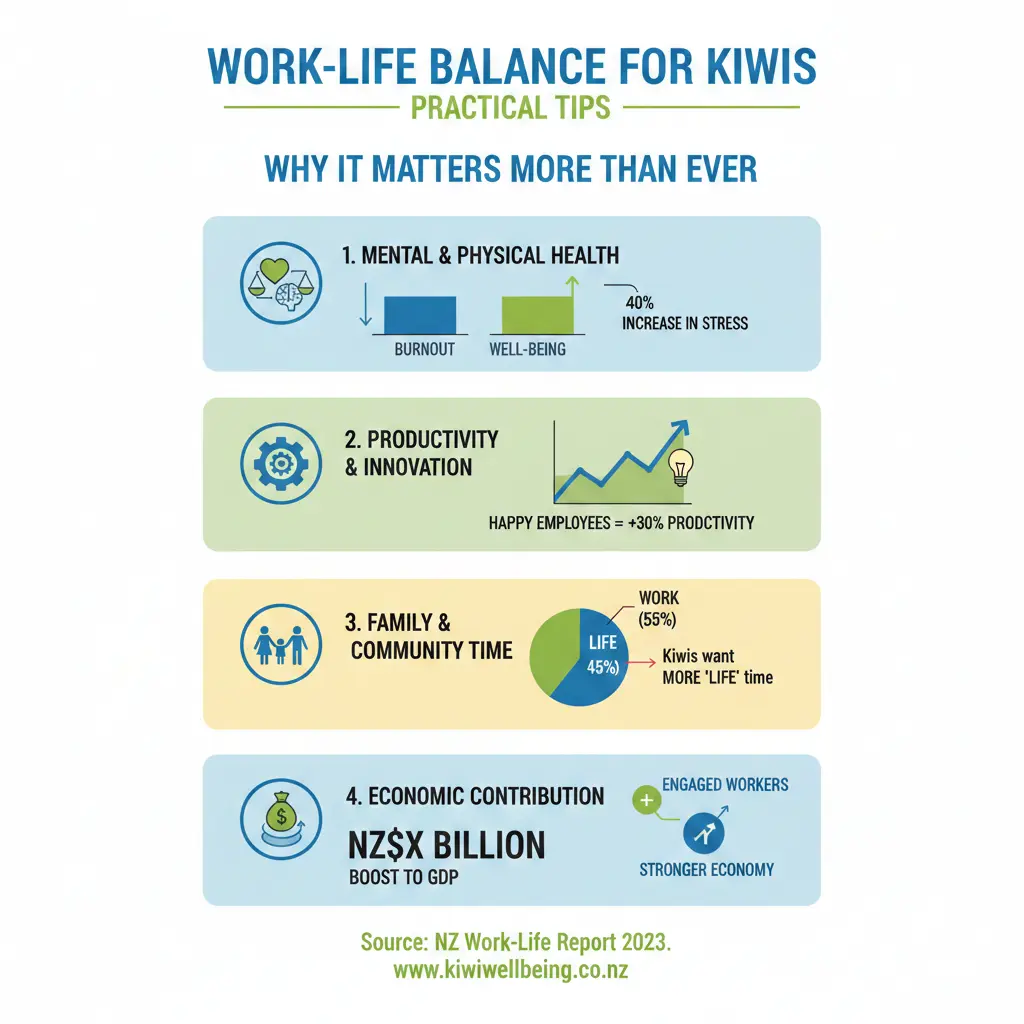
We've got the policies many countries envy: 32 days of paid annual leave, six months of fully paid parental leave, and a minimum wage of $16.42 an hour in 2025 (with updates expected in 2026). Our average workweek sits comfortably low, contributing to high happiness rankings and safety scores. Yet challenges persist. The NZCTU's Mood of the Workforce 2026 survey found 50.5% of respondents experienced deteriorating balance, driven by inflation outpacing wages, housing pressures, and understaffing. Globally, 83% of workers prioritise balance over pay when choosing jobs, a trend echoed here where 47% of NZ talent stay in roles for this reason alone.
For Kiwis, poor balance hits hard—think burnout from "doing more with less," as one survey respondent put it. It affects mental health (only 52% of Gen Z rate theirs as good), relationships, and even our world-famous productivity. But the good news? With tools like flexible working rights under the Holidays Act 2003 and Employment Relations Act 2000, you're empowered to negotiate better. Hybrid models shine too: 59% of hybrid workers rate their balance positively versus 50% of on-site staff.
Understanding New Zealand's Work-Life Balance Landscape
Our Global Standing and What It Means
New Zealand's third consecutive win in the Global Life-Work Balance Index isn't luck—it's policy plus paradise. We score high on statutory annual leave (four weeks minimum, plus public holidays), public happiness, and inclusivity. Compared to Australia (8th at 72.10) or the US (near-bottom), our 32.39 average weekly hours and "no-worries" vibe give us an edge. In 2026, with hybrid work entrenched, 70% of hybrid Kiwis report higher non-monetary satisfaction.
The Challenges We Face Locally
Despite the rankings, material pressures dominate: 67.4% don't feel fairly paid, and full-time hours barely cover living costs. Gen Z (74%) and Millennials (77%) prioritise balance, with 28% of Gen Z switching industries for it. Remote work blurs lines, amplifying burnout drivers like workload overload (24%) and lacking tools (24%).
Practical Tips to Achieve Work-Life Balance as a Kiwi
Here are proven, NZ-specific strategies. Start small, track progress, and adjust.
1. Know and Use Your Employment Rights
Under the Employment Relations Act, request flexible hours, remote work, or job-sharing after six months' service—employers must engage reasonably. Parental leave offers 26 weeks paid from week 27 of pregnancy (2026 rates via IRD). Take your four weeks' annual leave plus 11 public holidays; many employers top it up.
- Action step: Review your employment agreement. Use Employment NZ templates to request changes in writing.
- Pro tip: Negotiate like Randstad suggests: 47% stay for balance, so highlight mutual wins like retention.
2. Set Firm Boundaries with Tech and Emails
Hybrid work boosts balance for 59% of us, but "always-on" culture erodes it. Kiwi law doesn't mandate "right to disconnect," but good employers respect it.
- Switch off notifications post-5pm—use Do Not Disturb on your phone.
- Agree "no-email weekends" with your team; model it from the top.
- Batch-check emails twice daily to reclaim focus time.
"Countries like New Zealand help employees navigate balance with employee-first policies."
3. Prioritise Time Blocking and Weekly Planning
Average Kiwis work 32-34 hours weekly—protect non-work slots fiercely. Use the Pomodoro technique (25 minutes work, 5-minute break) adapted for our short days.
- Block calendar for lunch (30 minutes minimum), exercise, and whānau time.
- Sunday night: Plan your week, front-loading high-energy tasks.
- Track with free apps like Google Calendar or Notion, synced to KiwiSaver wellness goals.
4. Integrate Movement and Nature—Our Kiwi Superpower
We're surrounded by trails, beaches, and parks. Tramping, surfing, or a backyard BBQ recharge you faster than Netflix. Studies show nature dips cortisol by 20%.
- Join DOC-guided walks via doc.govt.nz.
- Aim for 150 minutes weekly moderate activity per Health NZ guidelines.
- Desk yoga or 10-minute walks during lunch—beat sedentary burnout (19% cite labour shortages).
5. Build Support Networks and Delegate
44% of Gen Z expect managers to set boundaries, but only 26% get it—step up yourself. Lean on whānau, mates, or EAP via ACC/employer.
- Delegate chores via shared apps like Splitwise.
- Join Balance NZ groups on Facebook for peer tips.
- Managers: Weekly check-ins on workloads, not just outputs.
6. Negotiate for What You Need in 2026
With 83% globally prioritising balance, use it in job hunts or reviews. Randstad's 2026 Workmonitor: Align career with life via "Me" strategies.
| Negotiation Tip | Kiwi Example |
|---|---|
| Flexible hours | Finish at 3pm twice weekly for school pickups |
| Hybrid setup | 3 office days, 2 remote—boosts satisfaction 70% |
| Extra leave | Buy 5 more days via many Kiwi employers |
| Wellness perks | KiwiSaver gym rebates or mental health days |
7. Monitor and Adjust for Burnout
Track via journal: Energy levels? Sleep? Use free tools from Headstrong or Lifeline. If overloaded (24% top driver), talk to WINZ for income support or IRD for tax relief on wellness spends.
Success Stories from Fellow Kiwis
Auckland teacher Sarah switched to four-day weeks, gaining time for her tamariki and marathons—productivity up 15%. Wellington hybrid worker Tom surfs daily, crediting boundaries for his promotion. These align with data: 31% leave inflexible jobs.
Reclaim Your Kiwi Balance Today
You're already ahead globally—now make it personal. Pick two tips: Set one boundary this week and block nature time. Track for a month, tweak as needed. Resources like Employment NZ, DOC, and Headstrong are your mates. Better balance means happier whānau, sharper focus at work, and more moments under our clean skies. Kia kaha— you've got this.
Frequently Asked Questions
Sources & References
-
1
New Zealand still the top country for work-life balance — hcamag.com — www.hcamag.com
- 2
- 3
-
4
Beyond the paycheque: how to negotiate autonomy and balance — randstad.co.nz — www.randstad.co.nz
-
5
Mood of the Workforce 2026 — union.org.nz — union.org.nz
-
6
Global Life-Work Balance Index 2025 — remote.com — remote.com
- 7
Related Articles

Stress Management Techniques That Actually Work
Stress is a constant companion for many Kiwis, whether you're juggling work deadlines, managing family responsibilities, or navigating life's unexpected challenges. The good news? Effective stress man...

Building Healthy Habits: A Kiwi's Guide
Ever feel like you're juggling too much, with work, family, and that endless Kiwi to-do list leaving little room for yourself? You're not alone—many of us struggle to fit healthy habits into our busy...