Estate Administration NZ: Managing Someone's Affairs After Death

Losing a loved one is one of life's toughest challenges, and stepping in to manage their estate can feel overwhelming. In New Zealand, estate administration—the process of handling someone's affairs a...
The Lifetimes NZ editorial team curates, fact-checks, and updates guides on personal finance, property, health, immigration, legal, business, and lifestyle topics relevant to Lifetimes NZ readers. Articles are produced with AI assistance and reviewed by the editorial team before publication.
Losing a loved one is one of life's toughest challenges, and stepping in to manage their estate can feel overwhelming. In New Zealand, estate administration—the process of handling someone's affairs after death—requires careful navigation of legal steps, from locating a will to distributing assets. With recent 2025 changes raising the small estate threshold to $40,000, many Kiwis can now handle simpler cases without court involvement, saving time and stress.
This guide breaks down everything you need to know about estate administration NZ, tailored for executors, administrators, and families. Whether you're dealing with a modest KiwiSaver balance or a family home, we'll cover the practical steps, timelines, and resources to get it right.
What is Estate Administration in New Zealand?
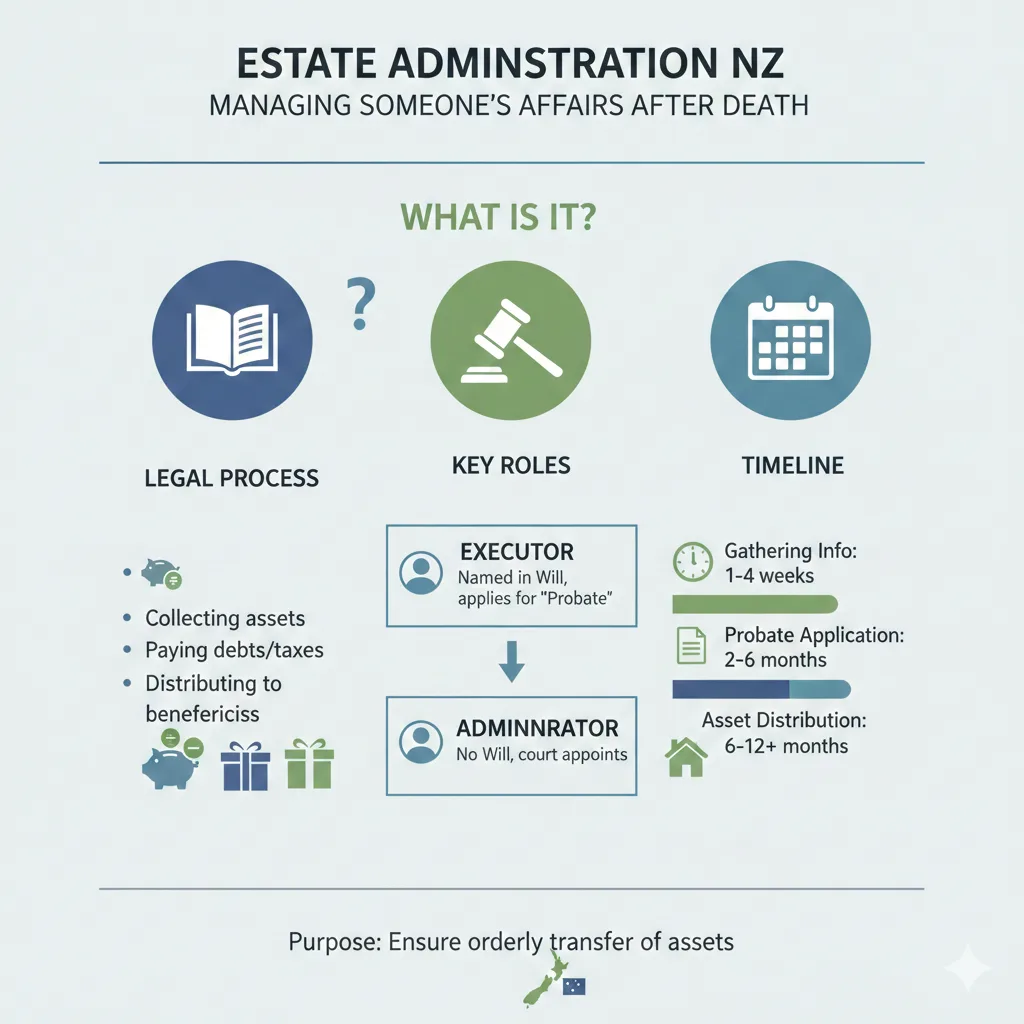
Estate administration is the legal and practical process of wrapping up a deceased person's financial affairs, including identifying assets, paying debts, and distributing what's left to beneficiaries. It's governed by the Wills Act 2007 and Administration Act, with executors (named in the will) or administrators (appointed if no will exists) taking charge.
For Kiwis, this often involves everyday assets like bank accounts, KiwiSaver, vehicles, or property. Executors must act impartially, keeping detailed records, as they can be held personally liable for mistakes.
Key Roles: Executor vs Administrator
- Executor: Named in the will to carry out its instructions. They apply for probate (court approval of the will).
- Administrator: Appointed by the court if there's no will (intestacy). They seek letters of administration.
Both roles demand organising assets, notifying IRD for tax clearance, and handling claims under acts like the Family Protection Act 1955.
Recent Changes: The 2025 Probate Threshold Update
From 24 September 2025, estates under $40,000 can bypass formal High Court processes, up from the previous $15,000 limit. This applies per institution (e.g., a single bank or KiwiSaver provider), allowing faster access to funds for funerals or bills without probate.
Practical tip: Check balances early. If total assets exceed $40,000 or include real estate, probate is likely needed. For joint accounts or relationship property, different rules apply under the Property (Relationships) Act.
When Probate Isn't Required
- Estates < $40,000 at any one institution.
- No disputes over entitlement.
- Banks/KiwiSaver providers accept death certificate, will copy, and ID proof.
This reform cuts delays for grieving whānau, but complex estates still need court oversight.
Step-by-Step Guide to Estate Administration
Here's a clear roadmap for managing someone's affairs after death in NZ. Start immediately upon notification of passing.
Step 1: Locate the Will and Death Certificate
Search for the original will—often with lawyers, family, or safe deposit boxes. Obtain the death certificate from Births, Deaths and Marriages (via DIA.govt.nz, fee applies). Without a will, intestacy rules prioritise spouse/partner, then children.
Step 2: Assess the Estate and Secure Assets
- Inventory all assets: Bank accounts, KiwiSaver, shares, property, vehicles (use AA or NZTA for transfers).
- Secure property: Change locks, insure homes.
- Notify institutions: Banks, IRD, ACC, power companies. Close non-essential accounts.
KiwiSaver note: Providers release funds post-threshold check or probate; surviving spouses may elect under relationship property rules.
Step 3: Apply for Probate or Letters of Administration
For estates over $40,000 or with real estate:
- Prepare documents: Original will, death certificate, executor affidavit, asset inventory.
- Sign affidavit before lawyer/JP.
- File at High Court (online via Justice.govt.nz or in-person).
- Wait 4-6 weeks (standard) or 4-8 weeks for processing.
Costs: Filing fees ~$200+, plus lawyer fees from estate funds.
Step 4: Pay Debts, Taxes, and Claims
Advertise for creditors (Public Notices). Pay from estate:
- Taxes: IRD clearance certificate required before distribution. File terminal tax return (due 31 March post-death year, plus provisional).
- Debts: Funeral (~$10,000 average), bills, loans.
- Claims period: 6 months from probate for Family Protection Act or Property (Relationships) Act claims.
Step 5: Distribute Assets
After 6 months (if no claims), transfer to beneficiaries per will/intestacy. Sell property via real estate agent if needed. Get final IRD sign-off. Full process: 6-12 months typical, longer for complexities.
Timelines and Costs in Estate Administration NZ
Straightforward probate: 4-8 weeks court time, but total administration 6-12 months. Complex cases (disputes, business assets): 2+ years.
| Stage | Typical Timeframe |
|---|---|
| Gathering documents | 2-4 weeks |
| Probate application | 4-8 weeks |
| Claims period | 6 months |
| Asset sales/tax clearance | 2-6 months |
| Distribution | 2-4 weeks |
Costs: Lawyer fees $3,000-$10,000+ (estate-paid), court ~$200, valuers/accountants extra. Small estates: Under $1,000 if informal.
Common Challenges and How to Overcome Them
Intestacy: Assets go spouse (1/3 + house/use), then kids equally. Update wills to avoid this.
Relationship property: Spouses/partners choose Option A/B within 6 months.
Disputes: Seek mediation via Community Law Centres or lawyers. Public court records post-probate.
Tip: Appoint professionals early—Perpetual Guardian or estate lawyers handle complexities.
Practical Tips for Executors in New Zealand
- Keep records: Receipts, valuations (use Quotable Value NZ for property).
- Notify WINZ/IRD promptly for benefits cessation.
- Use free resources: Community Law Manual, Justice.govt.nz probate forms.
- Consider enduring powers of attorney now to avoid future issues.
- Budget for tax: Estates over $40k assets may owe bright-line or estate duty (none since 1992, but income tax applies).
By 2050, NZ's intergenerational wealth transfer hits $1.6 trillion—proactive planning preserves legacies.
FAQ: Estate Administration NZ
1. Do I need probate for every estate?
No, estates under $40,000 per institution don't, unless disputed or involving property.
2. How long does the full process take?
6-12 months typically, including 6-month claims wait.
3. What if there's no will?
Apply for letters of administration; assets follow intestacy rules.
4. Can I distribute early?
Partial yes (e.g., education), but wait 6 months for full to avoid claims.
5. Who pays estate costs?
The estate covers lawyer, court, and admin fees.
6. How do I get a copy of the will post-probate?
Request from High Court ($30 fee).
Next Steps for Managing an Estate
Register death, locate will, and consult a lawyer via NZ Law Society's Lawyer Finder. For small estates, gather docs and approach banks directly. Always seek professional advice—this guide isn't a substitute for personalised guidance from lawyers or accountants familiar with NZ law.
Disclaimer: Tax and estate laws change; consult IRD.govt.nz, a qualified lawyer, or advisor for your situation. Rates current as of 2026.
Related Articles

Industry Bodies and Professional Associations NZ
Whether you're launching a business, advancing your career, or navigating financial regulations, industry bodies and professional associations in New Zealand offer invaluable support. These organisati...

Emergency Benefit NZ: When You Have No Other Options
When you're struggling financially and don't qualify for other benefits, the Emergency Benefit might be your lifeline. It's a discretionary payment designed for Kiwis in genuine hardship who've exhaus...

Unpaid Internships NZ: Are They Legal?
Unpaid internships are a common pathway for students and graduates to gain work experience in New Zealand, but there's often confusion about whether they're actually legal. The short answer is: unpaid...

Investor Visas NZ: Bringing Capital to New Zealand
Imagine transforming your wealth into a foothold in one of the world's most liveable countries, where stunning landscapes meet a thriving economy. Investor visas in New Zealand offer high-net-worth in...