Best Power Companies in NZ 2025: Price Comparison
Struggling with skyrocketing power bills? You're not alone—many Kiwis are feeling the pinch from rising electricity costs in 2025.Discovering the best power companies in NZ for 2025 means comparing pr...
The Lifetimes NZ editorial team curates, fact-checks, and updates guides on personal finance, property, health, immigration, legal, business, and lifestyle topics relevant to Lifetimes NZ readers. Articles are produced with AI assistance and reviewed by the editorial team before publication.
Struggling with skyrocketing power bills? You're not alone—many Kiwis are feeling the pinch from rising electricity costs in 2025.Discovering the best power companies in NZ for 2025 means comparing prices, plans, and perks tailored to your region and usage, potentially saving hundreds annually. With tools like Powerswitch and official MBIE data, switching to a cheaper provider has never been easier.
Understanding Electricity Prices in New Zealand
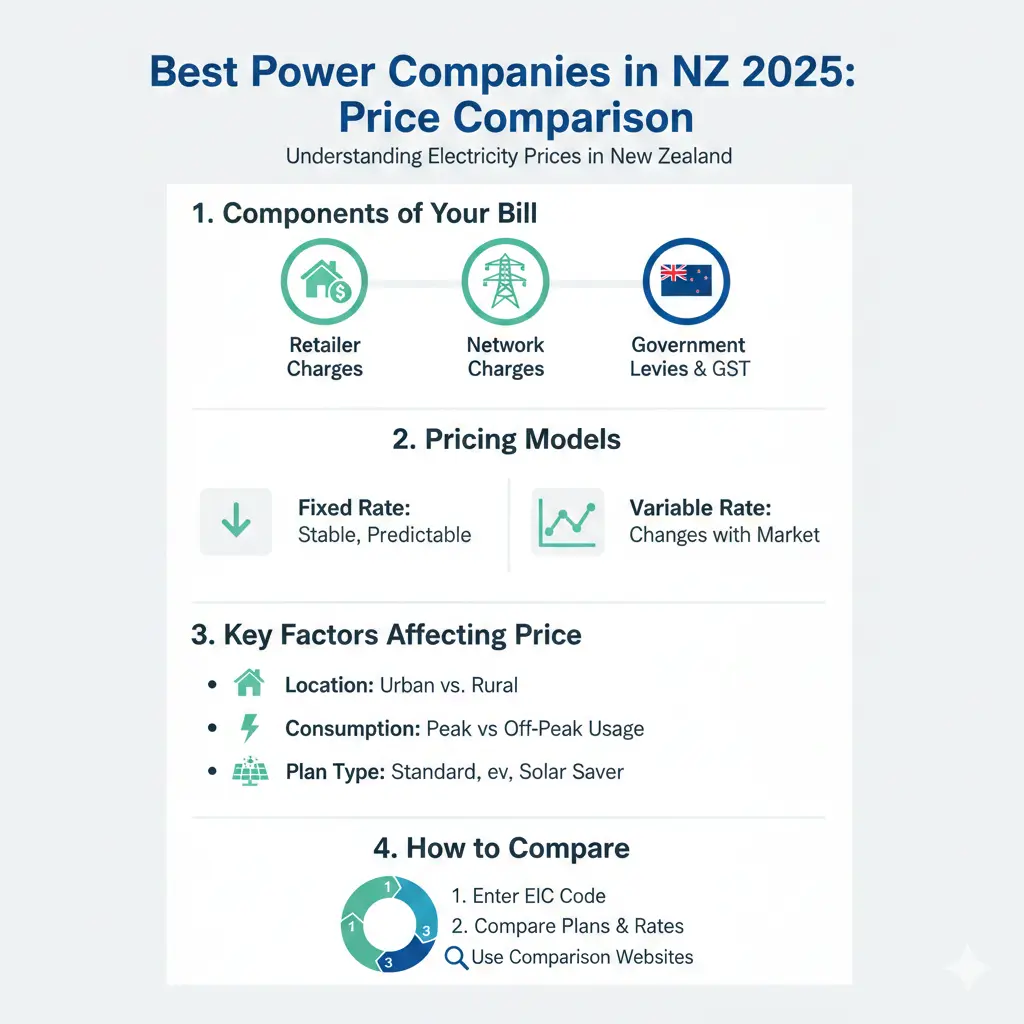
Your power bill breaks down into two main parts: lines charges (fixed by your local network, which you can't change) and energy costs (where retailers compete).In November 2025, the NZ average price sat at 39.3 cents per kWh for a typical household using 8,000 kWh annually on a low-user plan, according to official MBIE data. Wellington City offered the cheapest at 34.61c/kWh, while Balclutha topped the list at 48.93c/kWh—a whopping 41% difference.
Key Factors Driving Regional Price Differences
- Lines Charges: These cover the poles, wires, and maintenance. Rural or low-density areas like Balclutha face higher costs due to geography and infrastructure upgrades.
- Energy Retailer Margins: This is the competitive bit—switching providers targets these savings. Community trusts in places like Auckland (via Entrust) offer rebates not always reflected in benchmarks.
- Usage Profiles: Low users (under 8,000 kWh/year) pay lower fixed daily charges but higher per-kWh rates. Most Kiwi homes now qualify as low users, though this tariff is phasing out, pushing bills up.
Consumer NZ anticipates stable or slightly lower prices in 2026 thanks to increased generation investments and better hydro supply from recent rains, but don't expect big drops amid the cost-of-living squeeze.
How to Compare Power Companies Effectively
Grab your latest bill and note your daily fixed charge (cents/day), variable rate (c/kWh), and usage (kWh). Ignore the Electricity Authority levy—it's standard across providers. Then, use free comparison sites for personalised quotes.
Powerswitch: Your Free Government-Backed Tool
Powerswitch.org.nz compares thousands of electricity and gas plans across NZ retailers.It's independent, secure, and Kiwis using it save an average of $377 a year by switching. Enter your address, usage, and preferences—it handles the rest, even contacting providers for you. Double-check annually, as deals change.
Pro tip: Compare total costs, not just per-kWh rates. A low variable rate might pair with high fixed fees, negating savings for low users.
Other Comparison Sites
- PowerCompare.co.nz: Tailored plans with bundling options like electricity + gas discounts.
- Canstar.co.nz: Rates providers on satisfaction alongside prices, highlighting perks like $300 free power credits or free broadband bundles.
Coming soon: The Electricity Authority's new bill comparison website (launching March 2026) will simplify shopping with clearer bills and off-peak plan promotions.
Top Power Companies in NZ 2025: Price and Plan Comparison
Based on 2025 data, here are standout providers offering competitive rates around 22-30c/kWh, low fixed charges, and incentives. Prices vary by region and usage—always verify via Powerswitch for your postcode.
| Provider | Typical Variable Rate (c/kWh) | Daily Fixed Charge (Low User) | Key Perks | Best For |
|---|---|---|---|---|
| Electric Kiwi | ~22.8 | Low (check site) | Pay monthly fixed, free power hours (e.g., 1am-7am) | High nighttime users |
| Powershop | Competitive (~25) | Flexible | Buy power 'blocks', shop rewards; bundle discounts | Budget-conscious families |
| Mercury | Competitive (~25) | Affordable | 100% renewable; fixed-rate options | Green energy fans |
| Contact Energy | 25-30 | Standard | $300 credit on 1-year contracts; gas bundles save 17.25c/day | Bundlers (power + gas/internet) |
| Genesis | 26-32 | Low-user focus | Discounts for direct debit; EV charging plans | EV owners |
Note: Rates are indicative from late 2025 data; actuals depend on your lines company and meter (e.g., TOU for time-of-use). Peak rates (7-9am, 5-9pm) cost more than off-peak (11pm-7am).
2025 Regional Price Snapshot (MBIE Data, Nov 2025)
Wellington leads with 34.61c/kWh total, Auckland close behind. Rural spots like Balclutha hit 48.93c/kWh—switch retailers to shave 5-10% off energy costs.
- Auckland: ~37c/kWh (Entrust rebates help)
- Christchurch: ~38c/kWh
- Dunedin: ~42c/kWh
- Invercargill: ~45c/kWh
Renewable Energy Plans: Going Green Without the Premium
Most major providers source 80-100% renewable energy (hydro, wind, geothermal). Mercury and Meridian boast near-100% renewables at competitive rates—no greenwashing premium. Look for:
- Fixed Green Plans: Lock in rates with certified renewable matching.
- Carbon-Neutral Add-Ons: Minimal extra cost for full offsetting.
- EV-Friendly: Off-peak rates for charging align with renewable peaks.
The Electricity Authority encourages more off-peak renewable plans in 2026.
Practical Tips to Slash Your Power Bill in 2025
- Switch Providers: Use Powerswitch—takes 5 minutes, no cost, switch in days.
- Time Your Usage: Shift to off-peak: run dishwasher/washing machine overnight.
- Bundle Services: Save 10-20% combining power, gas, broadband.
- Check Eligibility: Low-income? Ask WINZ about power vouchers or community trusts.
- Monitor Meters: Upgrade to smart meters for accurate billing and TOU tariffs.
- Energy Audit: Free via EECA (eeca.govt.nz) for insulation/heat pump advice.
"We're seeing positive signs... Increasing supply should help alleviate high prices." — Paul Fuge, Consumer NZ Powerswitch
Next Steps: Take Control of Your Power Bill Today
Head to Powerswitch.org.nz now—input your details for instant quotes from top providers like Electric Kiwi and Powershop. Review your bill monthly, shift usage to off-peak, and bundle for extras. With 2026 bringing new tools and stable prices, 2025 is prime time to lock in savings. You'll thank yourself when the next bill arrives lighter.
Frequently Asked Questions
Sources & References
-
1
Electricity Prices by Region - Moneyhub (MBIE QSDEP Data, Nov 2025) — www.moneyhub.co.nz
-
2
Compare Energy Plans – Canstar NZ — www.canstar.co.nz
-
3
NZ Electricity Price Comparison - Insurspy — insurspy.co.nz
-
4
What to expect from power prices in 2026 - RNZ News — www.rnz.co.nz
-
5
New power bill comparison website - 1News — www.1news.co.nz
-
6
Rising power bills in 2026 - NZ Herald — www.nzherald.co.nz
-
7
Regional power prices map - Electricity Authority — www.ea.govt.nz
-
8
Power Compare deals — www.powercompare.co.nz
-
9
Powerswitch: Compare energy plans — www.powerswitch.org.nz
Related Articles
Reducing Your NZ Internet Bill: Fiber vs. 5G Wireless Home Broadband
Struggling with a hefty internet bill each month? You're not alone—many Kiwis are feeling the pinch from rising broadband costs in 2026. But here's the good news: switching between **fibre** and **5G...

DIY Home Maintenance: 5 Repairs Every Kiwi Homeowner Should Know
Owning a home in New Zealand comes with its fair share of rewards, but it also means staying on top of maintenance to keep your place safe, warm, and weathertight. With our unpredictable weather—from...
Home Security Systems: Protecting Your NZ Property on a Budget
Imagine coming home to find your door ajar or hearing a strange noise in the night—it's a Kiwi homeowner's worst nightmare. With burglary rates holding steady across New Zealand, protecting your prope...
Electricity Bill Killers: How to Cut Your NZ Power Bill by 30%
Your electricity bill doesn't have to be a budget killer. With smart planning and a few strategic changes, many Kiwi households can cut their power costs by 30% or more—without sacrificing comfort or...