Electricity Prices NZ: Why They Vary and How to Compare
Ever stared at your power bill in disbelief, wondering why your mate in Wellington pays less than you do in the deep south? You're not alone—electricity prices in New Zealand vary wildly by region, pl...
Sarah covers personal finance, tax, and KiwiSaver topics for Lifetimes NZ. She focuses on making money management straightforward and practical for everyday Kiwis.
Ever stared at your power bill in disbelief, wondering why your mate in Wellington pays less than you do in the deep south? You're not alone—electricity prices in New Zealand vary wildly by region, plan, and even the time of day, leaving Kiwis scratching their heads and reaching for the calculator. With forecasts of another 5% hike in 2026 on top of last year's 12% jump, understanding these differences is more crucial than ever for keeping your hard-earned cash where it belongs—in your pocket.
In this guide, we'll unpack why electricity prices NZ fluctuate so much, break down your bill's hidden components, and show you step-by-step how to compare providers to slash costs. Whether you're in bustling Auckland or remote Balclutha, these insights will empower you to make smarter choices amid rising network charges and market pressures.
Why Electricity Prices Vary Across New Zealand
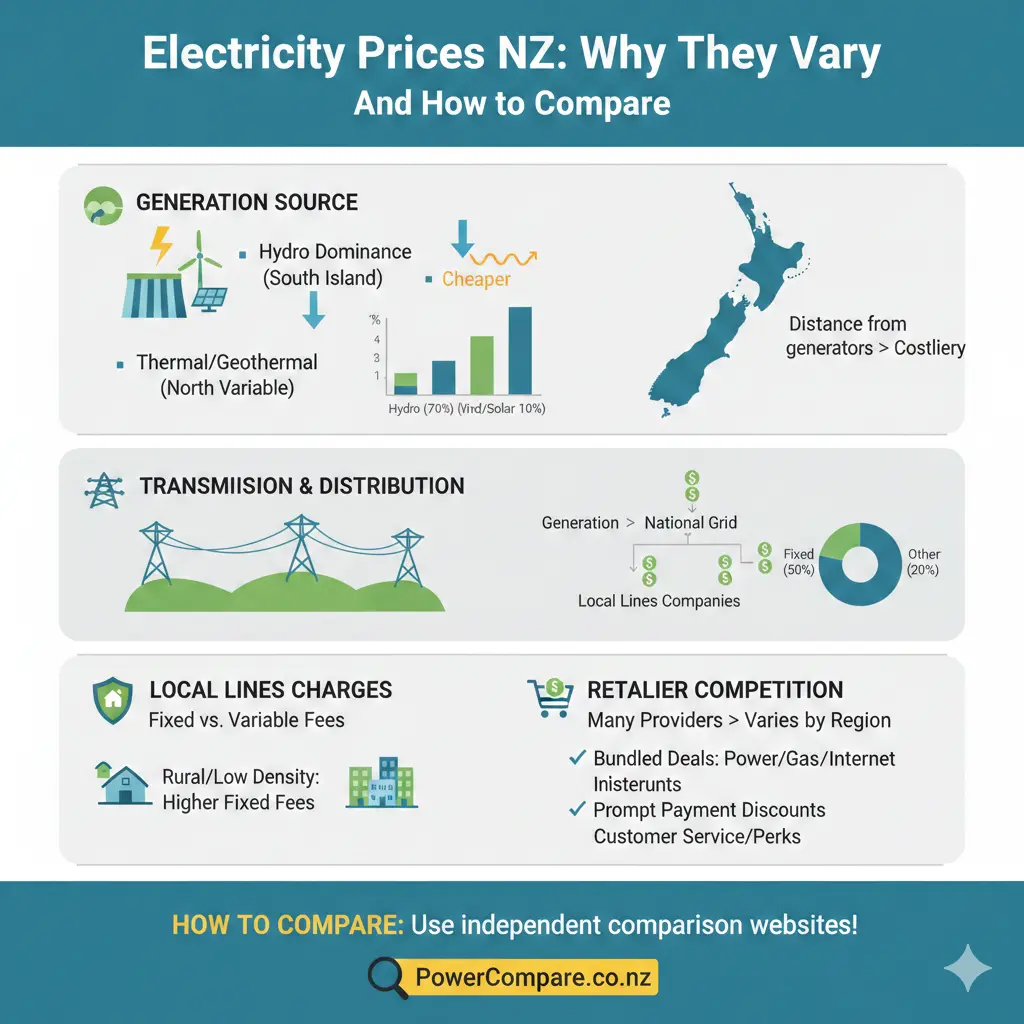
Electricity isn't one-size-fits-all in Aotearoa. Prices hinge on two main pillars: lines charges (the wires and poles you can't shop around) and energy costs (where competition kicks in). Official MBIE data from November 2025 reveals the stark reality: the national average sits at 39.3 cents per kWh, but Wellington City boasts the cheapest at 34.61c/kWh while Balclutha tops the charts at 48.93c/kWh—a whopping 41% premium. That's a 14.32c gap that could add hundreds to your annual bill.
Lines Charges: The Geography Trap You Can't Escape
Lines charges make up the bulk of regional differences, covering the cost of delivering power through transmission and distribution networks. Rural spots like Balclutha face higher rates due to sparse populations spreading costs thin over fewer homes. Urban hubs like Auckland and Wellington benefit from density—more households share the infrastructure, diluting per-user expenses.
Recent infrastructure upgrades are fuelling hikes too. Networks investing in resilience against storms or electrification (think EVs and heat pumps) pass costs to consumers. Community-owned trusts offer some relief: Entrust in Auckland dishes out annual rebates, while others provide 1–5c/kWh discounts not always reflected in benchmarks.
- Density wins: Cities like Wellington keep lines charges low.
- Rural penalty: Isolated areas pay more for the same kWh.
- Upgrade burden: New poles and wires mean higher bills now.
Energy and Retailer Costs: Where Switching Saves
Energy charges—the actual juice from generators like Manapouri—are fairly uniform nationwide. But retailers layer on margins, meter fees, and levies, creating savings opportunities. Competition here is fierce, with plans varying by usage patterns. Low-user plans suit efficient homes (under 8,000kWh/year), while standard suits bigger households.
Wholesale volatility from dry winters lingers, pushing retailer prices up. Yet, savvy Kiwis can undercut this by picking competitive margins.
2026 Price Hikes: What's Driving the Surge?
Brace for impact—Consumer NZ warns of at least a 5% national rise in 2026, following 2025's 12% leap. Lines companies are ramping charges from April, with households facing $10–25/month extra ex-GST initially, tapering to $5–15/yearly thereafter through 2030. Seniors could see $55–70 monthly jumps from March, blamed on network investments and market swings by giants like Meridian, Contact, and Genesis.
Powerswitch's Paul Fuge calls 5% conservative; some bills already exceed that, varying by region, retailer, and plan. Central Otago locals face winter pain despite hydro spills, as networks gear up for EV demand and repairs.
| Year | Trend | Key Drivers |
|---|---|---|
| Pre-2025 | Gradual rise | Infrastructure upgrades |
| 2025 | 12% increase | Lines charge reset |
| 2026+ | 5%+ expected | Network capacity, wholesale lag |
How Your Power Bill is Structured
A typical bill dissects into these bites:
| Component | What It Covers | Avg. Impact |
|---|---|---|
| Energy Usage | kWh consumed | Variable by plan |
| Fixed Daily | Connection fees | $1–2/day |
| Network (Lines) | Grid delivery | 50–60% of bill |
| Levies | Govt. fees | Fixed per kWh |
| GST | 15% tax | On total |
Low-user fixed charges are phasing out by 2027 (started 2022), favouring efficient homes. Track usage via your meter's kWh read—aim for 22kWh/day average.
How to Compare Electricity Prices in NZ: Step-by-Step
Don't stick with defaults—comparing can save 10–20% yearly. Here's your playbook:
- Know your usage: Check bills for annual kWh (e.g., 8,000 for low-user).
- Pinpoint your region: Use MBIE's QSDEP for benchmarks—Wellington's edge shines here.
- Hit comparison sites: Powerswitch.org.nz (govt-backed, free) or PowerCompare.co.nz list 40+ towns.
- Filter plans: Low vs standard user; avoid fixed-term locks unless rates plummet.
- Check lines company: Fixed per postcode—confirm via retailer tools.
- Switch seamlessly: No downtime; new provider handles it. Expect credits for early exit.
Top Tools for Kiwis
- Powerswitch: Official, comprehensive, usage-based quotes.
- PowerCompare: Quick side-by-side, promo alerts.
- MoneyHub: Regional deep dives with MBIE data.
Pro tip: Time switches for April 1 hikes—retailers often launch competitive plans then.
Low-User vs Standard: Pick Right
Post-2004 regs mandate low-user options for conservation. If under 8,000kWh/year, it's cheaper; fixed charges dropping faster. Test via your app or bill estimator.
Practical Tips to Cut Your Power Bill
Beyond switching, trim usage:
- LED bulbs, efficient appliances—slash 20% off kWh.
- Off-peak hot water controllers.
- EVs? Charge overnight on low-rate plans.
- Winter Energy Payment for superannuitants via WINZ.
- Audit leaks: Draught-stop, insulate.
For vulnerable households, govt eyes support amid hikes—no new subsidies yet, but monitor Work and Income.
"Electricity generator-retailers manage supply... helping keep household bills more stable."
Take Control of Your Power Bills Today
Electricity prices NZ don't have to drain you—regional variances and hikes are facts of life, but comparison and efficiency are your weapons. Start with Powerswitch for a personalised quote, track usage monthly, and switch if savings top $200/year. Small shifts like low-user plans add up, especially with 2026 pressures looming.
Disclaimer: This isn't personalised financial advice. Consult a licensed adviser or contact IRD/WINZ for your situation. Rates change—verify latest via official tools.
Frequently Asked Questions
Sources & References
-
1
Electricity Prices by Region - MoneyHub NZ — www.moneyhub.co.nz
-
2
Power Companies Confirm Seniors Bill Hike - Dirt Devil Detailing — dirtdevildetailing.co.nz
-
3
Power Bills Set to Rise: Consumer NZ Warning - The Central App — centralapp.nz
-
4
Consumer NZ Warns of 5% Power Price Hike - 1News — www.1news.co.nz
-
5
Comparing Power Companies Rates - Powershop — www.powershop.co.nz
-
6
Understanding Lines Charges Impact - Commerce Commission — www.comcom.govt.nz
-
7
Consumer NZ Warns of Further Rises - Insurspy — insurspy.co.nz
-
8
Wholesale Price Trends - Electricity Authority — www.emi.ea.govt.nz
-
9
Power Compare Deals and Plans — www.powercompare.co.nz
Related Articles

Industry Bodies and Professional Associations NZ
Whether you're launching a business, advancing your career, or navigating financial regulations, industry bodies and professional associations in New Zealand offer invaluable support. These organisati...

Emergency Benefit NZ: When You Have No Other Options
When you're struggling financially and don't qualify for other benefits, the Emergency Benefit might be your lifeline. It's a discretionary payment designed for Kiwis in genuine hardship who've exhaus...

Unpaid Internships NZ: Are They Legal?
Unpaid internships are a common pathway for students and graduates to gain work experience in New Zealand, but there's often confusion about whether they're actually legal. The short answer is: unpaid...

Estate Administration NZ: Managing Someone's Affairs After Death
Losing a loved one is one of life's toughest challenges, and stepping in to manage their estate can feel overwhelming. In New Zealand, estate administration—the process of handling someone's affairs a...