Reducing Your NZ Internet Bill: Fiber vs. 5G Wireless Home Broadband
Struggling with a hefty internet bill each month? You're not alone—many Kiwis are feeling the pinch from rising broadband costs in 2026. But here's the good news: switching between **fibre** and **5G...
The Lifetimes NZ editorial team curates, fact-checks, and updates guides on personal finance, property, health, immigration, legal, business, and lifestyle topics relevant to Lifetimes NZ readers. Articles are produced with AI assistance and reviewed by the editorial team before publication.
Struggling with a hefty internet bill each month? You're not alone—many Kiwis are feeling the pinch from rising broadband costs in 2026. But here's the good news: switching between **fibre** and **5G wireless home broadband** could slash your expenses while keeping speeds blazing fast for streaming, gaming, and working from home.
This guide breaks down the key differences, compares real-world costs and performance in New Zealand, and shares practical tips to help you pick the right plan. Whether you're in bustling Auckland or rural Canterbury, we'll show you how to reduce your NZ internet bill without sacrificing reliability.
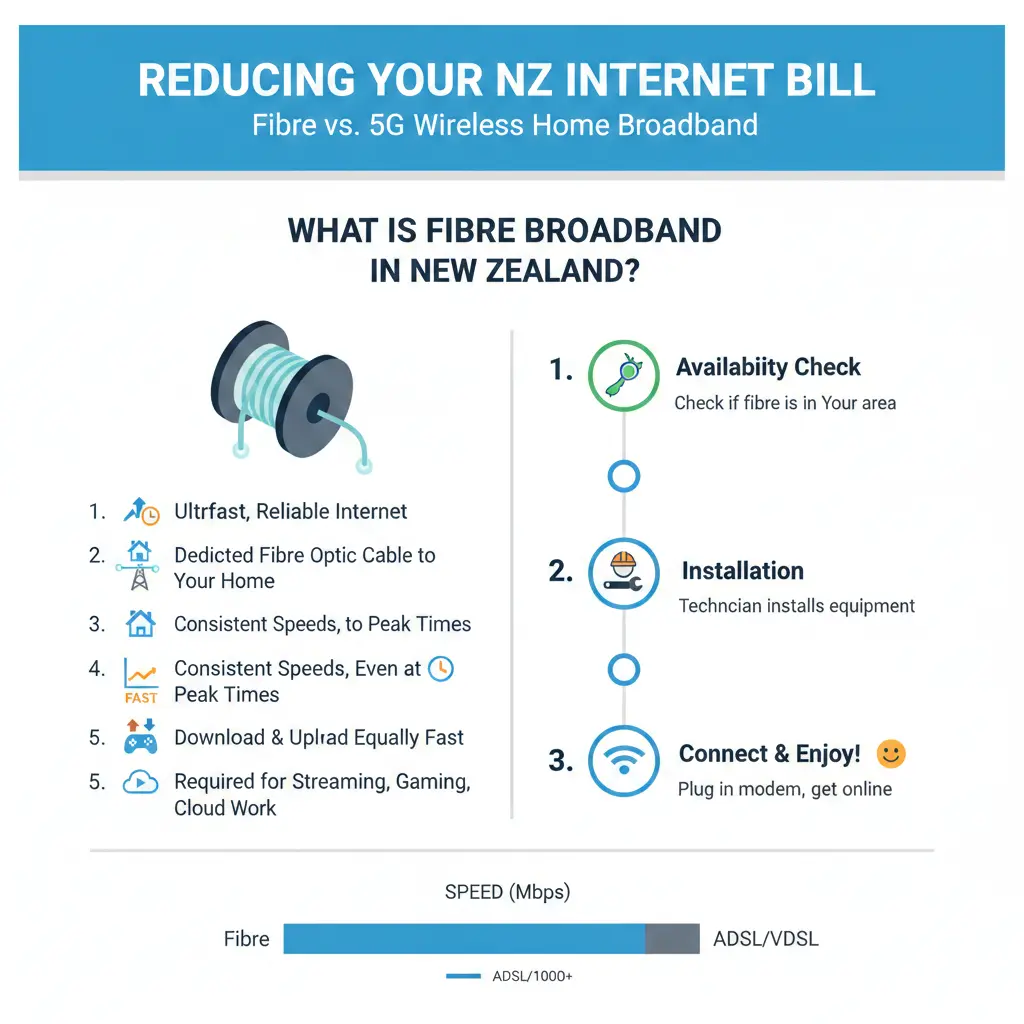
What is Fibre Broadband in New Zealand?
Fibre broadband uses thin glass cables to transmit data via light signals, delivering ultra-fast speeds over long distances—up to 70km without degradation. In NZ, it's the gold standard, powered by networks like Chorus, Enable, Tuatahi First Fibre, and Northpower, covering over 75% of towns and cities with plans expanding monthly.
Common plans include:
- Fibre 300/100: 300Mbps download/100Mbps upload—perfect for most households, handling four simultaneous UHD Netflix streams.
- Fibre Max: Up to 900Mbps down/500Mbps up, ideal for heavy users.
- Hyperfibre: 2000Mbps+ symmetric speeds for data-intensive tasks, though overkill for typical Kiwi homes.
Fibre's **low latency** (around 1-2ms) and stability make it unbeatable for gaming, video calls, and multiple devices. It's resilient to storms since it's buried underground, ensuring consistent performance even in bad weather.
Fibre Availability and Costs
Check your address on Broadband Map (powered by the Commerce Commission) to see if fibre's live at your place. Most providers offer free installation, with standard 300Mbps plans starting around $70-85/month in 2026, often with six months half-price deals.
Pro tip: Bundle with power or mobile for extra savings—providers like One NZ and 2degrees frequently run specials.
What is 5G Wireless Home Broadband?
5G wireless beams internet from cell towers to a modem with a built-in SIM, no digging required. It's a game-changer for rural Kiwis without fibre, offering average speeds of 306Mbps download (far better than 4G's 58Mbps).
Upload speeds average 26Mbps, with latency low enough for smooth video calls and gaming. Towers are spaced hundreds of metres apart, connecting to the nearest one for redundancy—if one drops, you switch seamlessly.
Providers like One NZ and Spark lead the pack, with easy plug-and-play modems that use 5GHz bands for speed near demanding devices.
5G Availability and Costs
5G shines where fibre can't reach—rural areas with good signal. Use provider coverage checkers (e.g., One NZ's map) to confirm. Plans often start at $60-75/month, sometimes cheaper than entry-level fibre, with unlimited data common.
It's portable too—great for renters or holiday homes.
Fibre vs 5G: Head-to-Head Comparison
Both deliver gigabit potential, but fibre edges out in consistency. Here's a breakdown based on 2026 NZ data:
| Feature | Fibre | 5G Wireless |
|---|---|---|
| Avg Download Speed | 314Mbps (300 plan) to 903Mbps (Max) | 306Mbps |
| Avg Upload Speed | 108-498Mbps | 26Mbps |
| Latency | 1-8ms | Low, but variable (congestion/weather) |
| Reliability | Storm-proof, consistent | Tower-dependent, but redundant |
| Best For | Urban families, multi-device homes | Rural, no-fibre areas, renters |
| Monthly Cost (2026 avg) | $70-100 | $60-85 |
Fibre wins for stability and upload speeds, crucial for backups or content creation. 5G matches for downloads but can fluctuate in peak hours or bad weather. For households with 5+ users, fibre's bandwidth headroom prevents buffering.
How to Reduce Your Internet Bill: Practical Tips
Ready to save? Follow these Kiwi-specific steps:
1. Compare Plans on Trusted Sites
Use Broadband Compare or Canstar to filter by speed, price, and provider ratings. Look for half-price intros (up to 6 months) and unlimited data.
2. Switch if Fibre's Available
If fibre's at your door, ditch wireless—fibre's cheaper long-term with better value per Mbps. Rural? 5G beats satellite or VDSL.
3. Negotiate or Bundle
Call your provider before contract end—mention competitor deals. Bundle with KiwiSaver-linked mobile plans from Spark or Vodafone for $10-20/month savings.
4. Optimise Your Setup
- Position 5G modems near windows for best signal.
- Use 5GHz Wi-Fi for speed, 2GHz for range.
- Test speeds via Speedtest.net—complain if below advertised.
5. Watch for UFB Subsidies
Rural builds? Check Rural Broadband Initiative for funded connections.
Switching providers is easy—most handle porting for free, with minimal downtime.
Real Kiwi Stories: Who Switched and Saved?
"Switched from 4G to 5G in Waikato—bill dropped $15/month, speeds doubled for farming apps." — Rural user via Broadband Compare.
In cities, fibre switchers report 20-30% savings via promos, without speed loss.
FAQ
Is 5G faster than fibre in NZ?
No, fibre is generally faster and more consistent (up to 900Mbps+ vs 5G's 300Mbps avg), but 5G suffices for most streaming/browsing.
Can I get 5G broadband without fibre?
Yes, ideal for rural or unbuilt areas—check signal first.
How much can I save switching?
$10-30/month via deals; fibre often cheaper long-term for urban Kiwis.
Does weather affect 5G?
Possibly, unlike wired fibre, but NZ towers are robust.
What's the best plan for gaming?
Fibre Max for lowest latency; 5G works if signal's strong.
Unlimited data standard?
Yes on most fibre/5G plans from major providers.
Next Steps to Cut Your Bill Today
Don't let high bills drain your wallet—start by entering your address on Broadband Compare or Canstar. Shortlist 3 plans, haggle for deals, and switch within a month. You'll enjoy faster internet and more cash for Kiwi essentials like flat whites or weekend adventures. Questions? Drop a comment below—we're here to help!
Related Articles

DIY Home Maintenance: 5 Repairs Every Kiwi Homeowner Should Know
Owning a home in New Zealand comes with its fair share of rewards, but it also means staying on top of maintenance to keep your place safe, warm, and weathertight. With our unpredictable weather—from...
Home Security Systems: Protecting Your NZ Property on a Budget
Imagine coming home to find your door ajar or hearing a strange noise in the night—it's a Kiwi homeowner's worst nightmare. With burglary rates holding steady across New Zealand, protecting your prope...
Electricity Bill Killers: How to Cut Your NZ Power Bill by 30%
Your electricity bill doesn't have to be a budget killer. With smart planning and a few strategic changes, many Kiwi households can cut their power costs by 30% or more—without sacrificing comfort or...
Heating Your Home Efficiently in NZ
As winter bites harder across Aotearoa, many Kiwis face skyrocketing power bills while shivering in draughty homes. But heating your home efficiently in NZ doesn't have to mean choosing between warmth...