Accredited Employer Work Visa: How the System Works

If you're considering working in New Zealand on a temporary visa, the Accredited Employer Work Visa (AEWV) is one of the most straightforward pathways available. Whether you're a skilled professional,...
The Lifetimes NZ editorial team curates, fact-checks, and updates guides on personal finance, property, health, immigration, legal, business, and lifestyle topics relevant to Lifetimes NZ readers. Articles are produced with AI assistance and reviewed by the editorial team before publication.
If you're considering working in New Zealand on a temporary visa, the Accredited Employer Work Visa (AEWV) is one of the most straightforward pathways available. Whether you're a skilled professional, tradesperson, or specialist worker, understanding how this visa system works can help you navigate the application process with confidence and clarity. This guide walks you through everything you need to know about securing and managing an AEWV in 2026.
What is the Accredited Employer Work Visa?
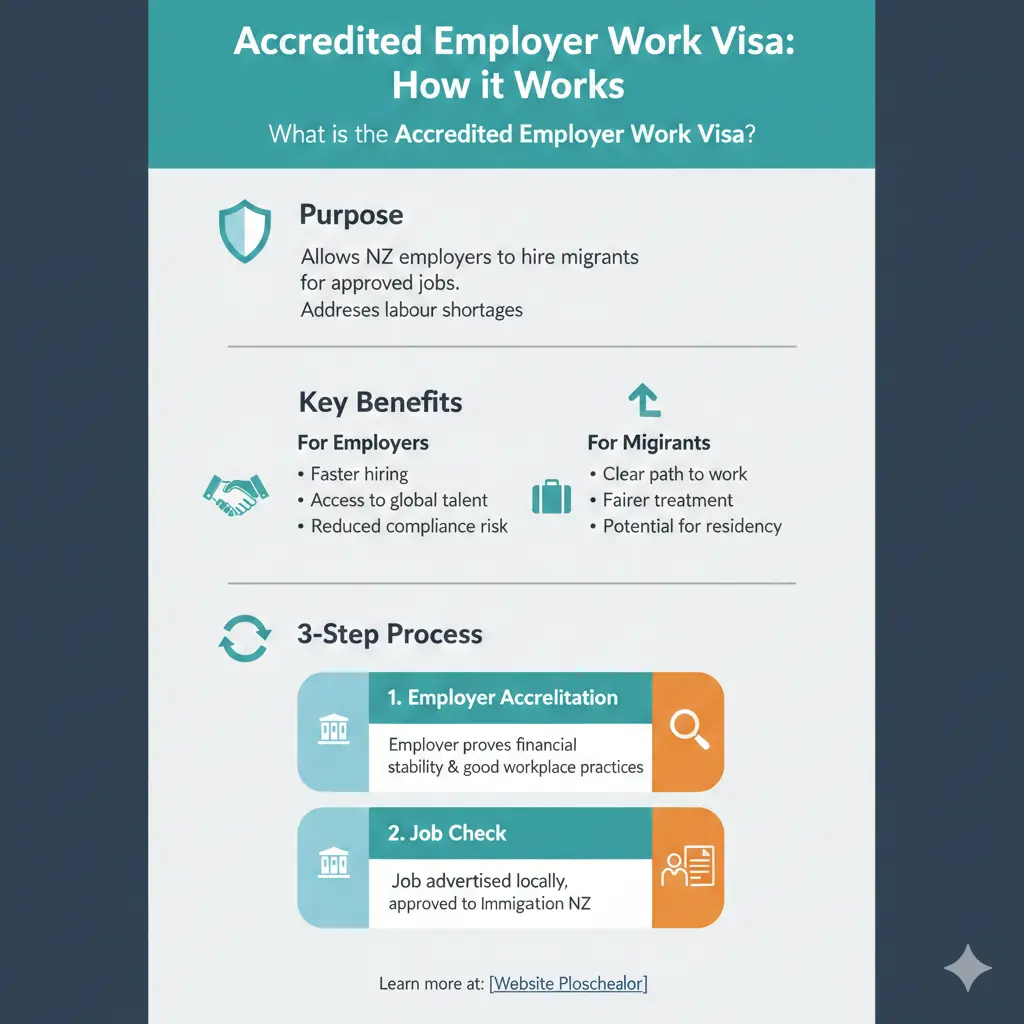
The Accredited Employer Work Visa is a temporary work visa designed for migrants who have a genuine job offer from an employer accredited by Immigration New Zealand. Unlike some other visa pathways, the AEWV puts the employer at the centre of the process—they initiate the application on your behalf and must be registered with Immigration New Zealand to sponsor workers.
This visa allows you to work full-time in New Zealand for up to 5 years, depending on your job, skill level, salary, and when you applied. It's become the most common pathway for skilled workers in 2025 due to its straightforward online process and employer-based approval structure.
Key Requirements You'll Need to Meet
Employment Requirements
To qualify for an AEWV, you'll need:
- A valid job offer from an accredited New Zealand employer for at least 30 hours of work per week
- Work experience and/or qualifications that match the job requirements
- A salary of at least NZD $33.56 per hour (the updated wage threshold from August 2025, reflecting New Zealand's median wage)
- To meet skill level requirements depending on your occupation
Personal Requirements
You'll also need to demonstrate:
- You're at least 18 years old
- A valid passport with at least 6 months validity beyond your intended stay
- English language proficiency if your job is classified as ANZSCO skill level 4 or 5
- A clean police clearance from your home country and any country where you've lived for more than 12 months
- A medical certificate from an Immigration New Zealand-approved panel physician
- Financial proof showing you can support yourself (typically NZD $5,000 minimum)
The Application Process: Step-by-Step
Step 1: Secure a Job Offer from an Accredited Employer
Your journey begins with finding employment. You can search for positions through trusted New Zealand job portals like Seek and TradeMe Jobs, or use the official Immigration New Zealand Job Check database. Before accepting an offer, verify that the employer is listed as accredited under the AEWV scheme on the Immigration New Zealand website.
Step 2: Employer Initiates the Job Check
Once you've accepted an offer, your employer will complete a job check form to verify the role meets AEWV requirements. From 29 September 2025, Immigration New Zealand introduced a redesigned job check form with clearer guidance and built-in checks to reduce delays. Employers now provide additional context upfront, including business size, number of New Zealand employees, and justification for the role.
Step 3: Gather Your Documents
Prepare the following documents for your application:
- Valid passport (minimum 6 months validity)
- Signed job offer letter and employment contract
- Educational certificates and qualifications
- Police clearance from your home country
- Medical certificate from an approved physician
- Bank statements or sponsorship letter showing financial capacity
- Health insurance proof
- Recent passport-sized photos
If any documents are in a language other than English, have them translated by a certified translator.
Step 4: Create an Immigration New Zealand Account and Apply Online
Your employer will send you a link to the online application form. Create an account on the Immigration New Zealand website and complete your application accurately. Pay the visa fee (from NZD $1,540) during submission.
Step 5: Wait for Processing
Immigration New Zealand aims to process 80% of AEWV applications within 7 weeks. However, it's wise to apply at least 3 months before your intended travel date to account for potential delays in background or document verification.
What You Can and Cannot Do on an AEWV
What You're Allowed to Do
- Work full-time for the accredited employer specified on your visa
- Study for up to 3 months in any 12-month period, or undertake any study required as part of your employment
- Bring dependents (spouse and children) under separate visas
- Access some public health services in New Zealand
- Enjoy full protection under New Zealand Employment Law
What You Cannot Do
- Work for any employer other than the one specified on your visa without permission
- Work more than the hours stipulated in your job offer
- Exceed your 3-month study limit outside of employment-related study
Wage Thresholds and Skill Level Considerations
Wage thresholds are central to the AEWV system and are updated regularly to reflect New Zealand's job market. From 18 August 2025, the wage threshold was updated to NZD $33.56 per hour, based on the June 2024 median wage. This ensures the visa system remains fair, protects local wages, and supports employers genuinely needing skilled workers.
Your skill level determines additional requirements. If your job is classified as ANZSCO skill level 4 or 5 and isn't exempt, you'll need to demonstrate English language proficiency. Higher-skilled roles (levels 1–3) may have different requirements and opportunities, particularly with the introduction of new residence pathways in 2026.
Green List Occupations and Recent Changes
Immigration New Zealand maintains a Green List of occupations where there's genuine demand. If your role is on the Green List, the application process may be streamlined. From 7 July 2025, the AEWV application form was updated for Green List occupations and roles requiring occupational registration, making the process more straightforward.
The 2026 reforms also introduced two new residence pathways: the Skilled Work Experience Pathway and the Trades and Technician Pathway. These recognise skilled workers and tradespeople already contributing to the New Zealand workforce, offering clearer routes to permanent residence after gaining New Zealand work experience.
Maximum Stay and Extension Options
Your AEWV can be granted for up to 5 years, depending on your circumstances. However, if you've stayed for the maximum time allowed and wish to apply for another AEWV, you must spend the required time outside New Zealand first.
You have several options to extend your stay:
- Extend with the same employer: Apply for an extension if your employment continues
- Switch employers: Apply for a new AEWV with a different accredited employer under AEWV rules
- Apply for permanent residence: After meeting experience criteria, you can apply for permanent residence under the Skilled Migrant Category
Costs and Processing Times
The AEWV visa fee starts from NZD $1,540. Additional costs include:
- Health checks (varies by provider)
- Police certificates (varies by country)
- Document translation (if required)
- Health insurance (required for temporary visa holders)
Total costs typically range from NZD $700 to NZD $1,000 excluding health and police certificate expenses.
Processing times vary by visa type, but AEWV applications are typically processed within 6–10 weeks, with 80% completed within 7 weeks.
Getting Started: Your Next Steps
The Accredited Employer Work Visa offers a clear, structured pathway for skilled workers wanting to build their career in New Zealand. The key is to plan ahead, verify your employer's accreditation, and gather your documents early.
Start by searching for roles with accredited employers on Seek or TradeMe Jobs, then verify the employer's status on the Immigration New Zealand website. Once you've secured a job offer, allow at least 3 months for the application process. Keep in mind that the 2026 reforms have introduced new residence pathways, so if you're planning to stay long-term, an AEWV can be a stepping stone towards permanent residence.
For the most current information and to begin your application, visit Immigration New Zealand. If you need personalised advice, consider consulting with a licensed immigration adviser who can guide you through the process specific to your circumstances.
Frequently Asked Questions
Sources & References
-
1
Accredited Employer Work Visa — Immigration New Zealand — www.immigration.govt.nz
- 2
-
3
New Zealand Redesigns Job Check Process for Accredited Employer Work Visa — Envoy Global — www.envoyglobal.com
-
4
New Zealand Major Visa Changes 2026 — YouTube — www.youtube.com
- 5
Related Articles

Working Multiple Jobs NZ: Tax and Legal Considerations
Juggling multiple jobs can boost your income, but it's crucial to understand the tax implications and legal requirements that come with working more than one role in Aotearoa. Whether you're a contrac...

Name Changes NZ: Legal Process and Costs
Considering a fresh start with a new name? Whether it's after marriage, divorce, or simply embracing a personal transformation, changing your name in New Zealand is straightforward but requires follow...

Holiday Home Tax Rules NZ: Private Use and Rental
Own a bach in Coromandel or a holiday home in Queenstown? You're not alone—many Kiwis cherish these escapes, but renting them out while enjoying personal use can trip you up on tax rules. Getting the...

Industry Bodies and Professional Associations NZ
Whether you're launching a business, advancing your career, or navigating financial regulations, industry bodies and professional associations in New Zealand offer invaluable support. These organisati...