Best Start Tax Credit: What It Is & Who Qualifies
If you've just had a baby or are planning to start a family, you might be wondering how to make ends meet during those early years. The Best Start tax credit is one of New Zealand's most valuable fami...
The Lifetimes NZ editorial team curates, fact-checks, and updates guides on personal finance, property, health, immigration, legal, business, and lifestyle topics relevant to Lifetimes NZ readers. Articles are produced with AI assistance and reviewed by the editorial team before publication.
If you've just had a baby or are planning to start a family, you might be wondering how to make ends meet during those early years. The Best Start tax credit is one of New Zealand's most valuable family support payments, designed to help parents and caregivers with the costs of raising a newborn. Whether you're earning a solid income or receiving a benefit, you could qualify for up to $73 per week to support your child's first three years of life.
What Is Best Start?
Best Start is a weekly payment from Inland Revenue (IR) that helps support families with young children. It's part of the Working for Families package and is one of the most accessible family support payments available in Aotearoa.
The key feature that makes Best Start unique is its income-free first year. During your child's first year of life (or from when your paid parental leave finishes, whichever is later), you'll receive the full Best Start payment regardless of how much your family earns. This means that even if you're a high earner, you'll get the same weekly amount as someone on a lower income during that crucial first 12 months.
After your child turns one, the payment becomes income-tested. This means your family income will affect how much you receive in years two and three.
How Much Can You Get?
Best Start payments are straightforward:
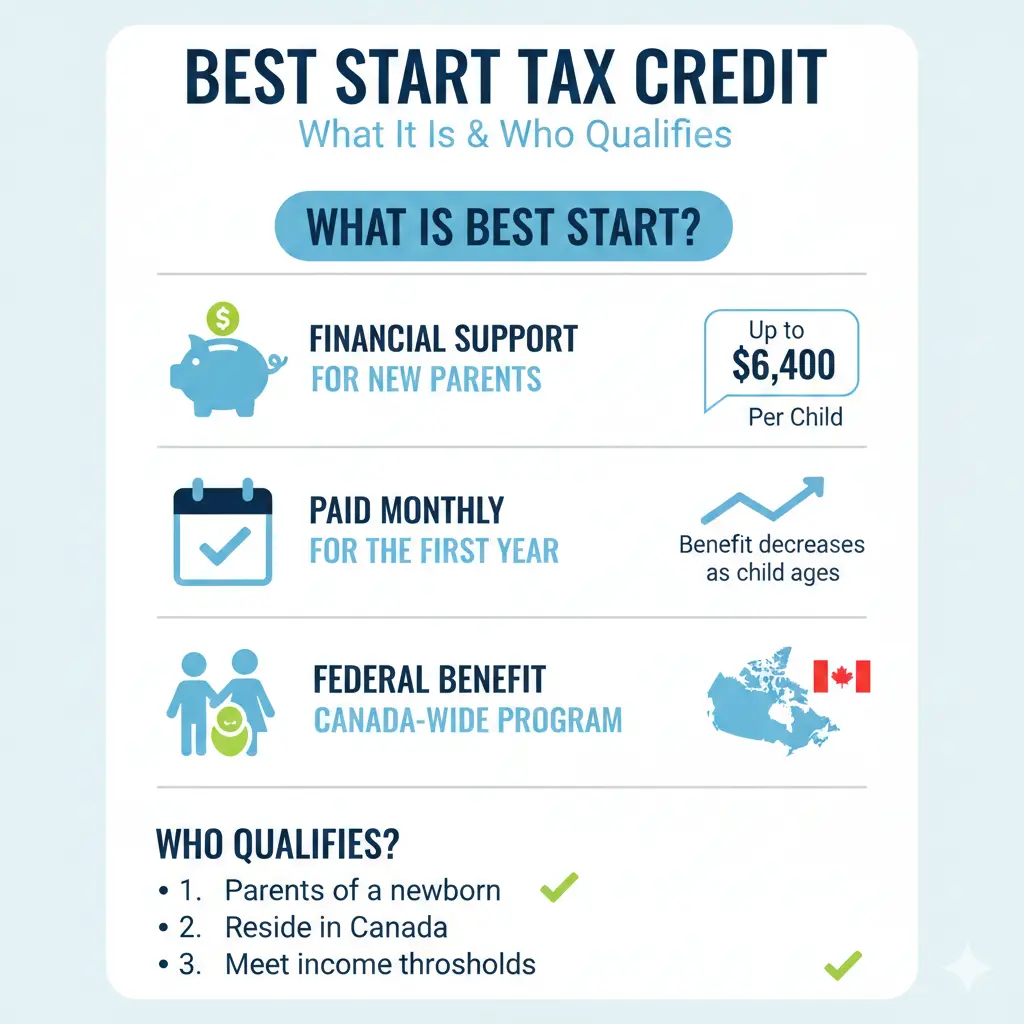
- Year 1 (birth to first birthday): $73 per week, no matter your income
- Year 2 (first to second birthday): Up to $73 per week, reducing if your family income exceeds $79,000
- Year 3 (second to third birthday): Up to $73 per week, reducing if your family income exceeds $79,000
In annual terms, this means you could receive up to $3,838 per year during the first year, with potential reductions in years two and three based on your income.
It's worth noting that IR rounds your instalments down to the nearest dollar, so if your payment calculates to $421.75, you'll receive $421.
Who Can Get Best Start?
Eligibility Requirements
To qualify for Best Start, you need to meet these criteria:
- Be the primary caregiver of your child
- Your child was born on or after 1 April 2018
- Be an NZ citizen or resident, or care for a child who is a resident and present in New Zealand
- Be registered for Working for Families
Income Types That Qualify
One of the great things about Best Start is that your income type doesn't matter. You can qualify if you earn:
- A salary or wage
- Self-employed income
- A main benefit (such as the Jobseeker Support or Sole Parent Support)
- New Zealand superannuation
- A student allowance
All of these income types are included in your family income calculation, so IR will take them into account when working out your entitlement in years two and three.
How Income Affects Your Payments
The Income Threshold
The income threshold for Best Start is $79,000 per year. This is important because:
- If your combined family income is $79,000 or less, you'll get the full $73 per week in years two and three
- If your family income is over $79,000, your payment reduces by a certain amount for every dollar you earn above that threshold
Real-World Example
Let's look at how this works in practice. The Faraj family has a newborn daughter, Azra. During Azra's first year (when her mum Samira is on paid parental leave), they receive the full $73 per week regardless of income.
When Azra turns one, the family's combined income is $83,500. Because this is over the $79,000 threshold, their Best Start payment reduces. The reduction applies to every dollar earned above $79,000—so in this case, $4,500 of their income affects their entitlement.
This means they'll receive a reduced payment in year two, but they'll still get something to help support their growing family.
How to Apply for Best Start
Easiest Option: Apply When You Register Your Baby
The simplest way to apply for Best Start is when you register your baby's birth. You can do this online through SmartStart, and you can apply for Best Start at the same time. This is the quickest route because everything is done in one go.
Alternative: Apply Separately with Inland Revenue
If you didn't apply when registering your baby, you can apply for Best Start at any time directly with IR. You might choose this option if you want to explore other Working for Families payments at the same time, such as the Family Tax Credit.
What Information You'll Need
To apply, have these details ready:
- Your IRD number
- Your name and contact details
- Your bank account details (if you're not already a Working for Families or Ministry of Social Development customer)
- Your citizenship or resident status
- Your partner's details (if you have one), including their IRD number and contact information
- Your child's name, birthdate, and IRD number
If your child is under 12 months old when you apply, you don't need to provide family income information. However, if you're applying for a child aged up to three years or other Working for Families payments, you'll need to complete the family income section.
When Do Payments Start?
Best Start payments usually start about 3 weeks after your application is processed. Payments begin when your parental leave payments end (if you're receiving them), or from your child's birth if you're not on parental leave.
Important: Best Start Doesn't Automatically Renew
Here's something crucial to remember: Best Start payments do not automatically continue year to year. You'll need to confirm your details with IR each year.
IR will send you a letter asking you to confirm your details before your child's first and second birthdays (if you were receiving payments that year). Make sure you respond promptly so there's no gap in your payments.
Changes Coming in 2026
If you're having a baby on or after 1 April 2026, there's an important change to know about. From that date, Best Start payments will be income-tested from when your child is born, rather than having a full first year of income-free payments.
This means if your baby arrives after 1 April 2026, your family income will affect your Best Start entitlement from day one. Make sure to factor this in when planning your finances if you're expecting a baby later in the year.
Next Steps
If you're expecting a baby or have recently had one, here's what to do:
- Register your baby's birth through SmartStart and apply for Best Start at the same time—this is the easiest option
- Gather your information (IRD numbers, bank details, and your partner's details if applicable)
- Check the Working for Families calculator to see what other payments you might qualify for alongside Best Start
- Mark your calendar for when you need to confirm your details each year—don't let your payments lapse
- Contact Inland Revenue if you have questions or didn't receive a confirmation letter when expected
Best Start is designed to give your whānau real financial support during those important early years. With up to $73 per week in year one, it's a valuable payment that most New Zealand families can access. The key is to apply early and remember to confirm your details each year so your payments keep coming.
Frequently Asked Questions
Sources & References
-
1
Best Start - Inland Revenue — www.ird.govt.nz
- 2
-
3
Apply for Best Start payments - New Zealand Government — www.govt.nz
-
4
The Working for Families tax credit package - Community Law — communitylaw.org.nz
-
5
Best Start Tax Credit - Bountiful NZ — bountifulpacks.co.nz
Related Articles

Childcare Options and Costs in NZ 2026
Finding the right childcare for your tamariki (children) is one of the biggest decisions you'll make as a parent, and it's often one of the biggest expenses too. Whether you're returning to work after...
Childcare Subsidies & Financial Support in NZ
Raising tamariki in Aotearoa comes with its joys and challenges, especially when balancing work, study, or training with the costs of quality childcare. If you're searching for childcare subsidies NZ...
Child Support (Child Maintenance) in New Zealand
Navigating separation or shared parenting in New Zealand often brings up questions about child support NZ – that essential financial help ensuring kids get what they need, no matter where they live. W...

Parental Leave Rights: What Kiwi Parents Need to Know
Bringing a new baby into the world is one of life's biggest adventures, but for Kiwi parents, navigating parental leave NZ entitlements can feel like a maze. Whether you're expecting, adopting, or bec...