Tax and Work Income Registration: IRD Numbers for Newcomers

Moving to New Zealand is an exciting step, but sorting out your tax and work income registration can feel daunting if you're a newcomer. Your IRD number is the key to legally earning income, paying ta...
The Lifetimes NZ editorial team curates, fact-checks, and updates guides on personal finance, property, health, immigration, legal, business, and lifestyle topics relevant to Lifetimes NZ readers. Articles are produced with AI assistance and reviewed by the editorial team before publication.
Moving to New Zealand is an exciting step, but sorting out your tax and work income registration can feel daunting if you're a newcomer. Your IRD number is the key to legally earning income, paying taxes correctly, and accessing benefits like KiwiSaver—think of it as your ticket to smooth financial integration in Kiwi life.
Whether you're on a work visa, student visa, or just arrived as a new resident, getting your IRD (Inland Revenue Department) number sorted early means you can start work without delays, choose the right tax code, and enrol in KiwiSaver for retirement savings. In this guide, we'll walk you through the process step by step, with practical tips tailored for Kiwis welcoming newcomers or those settling in Aotearoa.
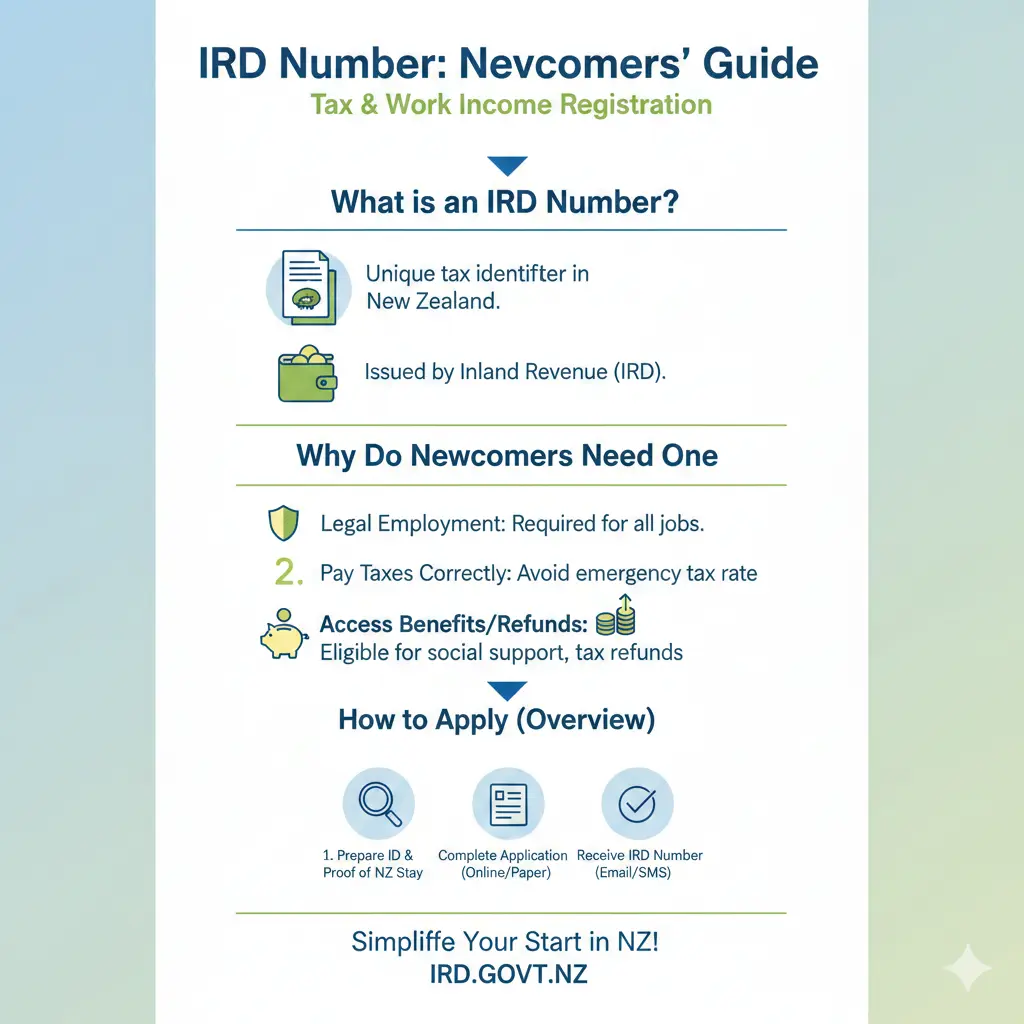
What is an IRD Number and Why Do Newcomers Need One?
An IRD number is a unique 8-9 digit identifier issued by Inland Revenue for tax purposes. It's essential for anyone earning income in New Zealand, including wages, salaries, or self-employment earnings. Without it, employers can't process your payroll legally, and you risk tax complications down the line.
For newcomers, the IRD number unlocks:
- Legal employment—employers must have your IRD to pay you and deduct PAYE (Pay As You Earn) tax.
- Correct tax codes to avoid over- or under-paying tax on your income.
- KiwiSaver enrolment, New Zealand's voluntary retirement savings scheme with employer and government contributions.
- Access to services like Working For Families tax credits or student loans if eligible.
Fun fact: Even visitors on working holiday visas need one to work legally. Keep it safe—you'll use it for life, for everything from banking to selling a house.
Who Needs an IRD Number as a Newcomer?
If you're planning to work, study, or earn any income in New Zealand, you need an IRD number. This includes:
- New arrivals on work, student, or resident visas.
- Working holiday visa holders (e.g., from PVT schemes).
- Australian, Cook Islands, Niuean, or Tokelauan passport holders moving here.
- Anyone self-employed or starting a side hustle.
Check first if you already have one—IRD numbers are lifelong. Search via myIR (Inland Revenue's online portal) or call 0800 227 774.
New Arrivals vs. Established Residents
New arrivals (those who recently entered NZ on a visa) have a streamlined process using Immigration NZ details to verify identity, saving time and paperwork. If you've been here longer or are an NZ citizen, use the standard 'living in NZ' application.
Step-by-Step Guide: How to Apply for an IRD Number
Applying is free and mostly online. The process differs slightly if you're a new arrival or already settled. Aim to apply soon after arrival—especially if your visa has an entry deadline.
Option 1: New Arrival to New Zealand (Fastest Process)
Ideal if you've just arrived on a work, student, or resident visa. Inland Revenue checks your identity with Immigration NZ—no extra docs needed initially.
- Gather details: Passport info, Immigration NZ application number (from your visa approval email), and your most recent overseas tax number (if applicable). For Aussies, just passport details.
- Apply online: Visit ird.govt.nz, select 'New arrival to New Zealand' application. Fill in details and submit.
- Wait: Get your IRD by text/email in 2 days or post in 10 days. They'll contact you if more info is needed.
Tip: You must apply by your visa's arrival date. After that, switch to the standard process.
Option 2: Living in New Zealand (Not a New Arrival)
For those already here without new arrival status. This involves online application plus in-person ID verification.
- Gather physical ID docs:
- Primary (Category A): NZ passport, overseas passport + NZ visa (not needed for AU/CK/NI/TK passports), full NZ birth certificate, citizenship certificate, firearm licence, etc.
- Secondary (Category B): NZ driver's licence, overseas DL, Kiwi Access Card, HANZ 18+ card, student photo ID, or International Driving Permit.
- Scan docs: Photo/name pages for passports; both sides for licences. Include visa pages or Immigration NZ letter for overseas passports.
- Apply online: Use the 'Living in NZ' form on ird.govt.nz. Upload scans.
- Verify in person: Within 20 days, take original physical docs to an AA Driver Licensing Agent (not AA Auto Centres). Find locations via the application link.
- Receive IRD: By text/email in 10 working days (online) or 12 days (paper form).
For kids: Parents provide their own Category A/B docs plus child's passport/birth certificate/student ID.
Paper Forms (If Online Isn't for You)
Use updated IR595 (in NZ) or IR742 (offshore) forms from October 2025. Submit with docs to AA or IRD office. New forms are simpler—destroy old versions.
Documents Checklist for Newcomers
| Document Type | New Arrival | Living in NZ |
|---|---|---|
| Passport | Required | Primary ID |
| Visa/Immigration NZ Number | Required (except Aussies) | With overseas passport |
| NZ Bank Details | Optional | Optional but recommended |
| Driver's Licence | N/A | Secondary ID |
Tax Codes: Getting Your Income Tax Right
Once you have your IRD, select a tax code for your employment income. It tells employers how much PAYE to deduct based on your situation—no dependants? Use 'M' (main income, no kids). Parents might qualify for 'M1' or family codes.
Update via myIR or the IRD app. Wrong code means a tax bill or refund at year-end—get it right to avoid surprises. For 2026 rates, check ird.govt.nz for income brackets (e.g., 10.5% on first $15,600, up to 39% over $180,000).
Employers must use your IRD and tax code from day one. If self-employed, use 'ST' (self-employed) for provisional tax.
KiwiSaver Enrolment for Newcomers
KiwiSaver is auto-enrolled for new employees aged 18-65 earning over $520/week (2026 threshold). Provide your IRD to your employer—they'll enrol you within 6 weeks.
Contributions: 3%, 4%, 6%, 8%, or 10% of gross pay (employee choice). Employers match minimum 3%, government adds $521/year if you contribute $1,042+.
Newcomer tips:
- Opt out within 8 weeks if not interested (e.g., short-term visa).
- Choose a provider like KiwiBank, ANZ, or ASB via myIR.
- Track via the KiwiSaver app or sorted.org.nz.
Employer Requirements and Your First Payday
Employers need your IRD, tax code, and KiwiSaver details before paying you. Share via email or the new employee form (IR330). They withhold PAYE, ACC levies (for work injuries), and student loan repayments if applicable.
ACC is compulsory—covers 80% of wages if injured at work. No-fault scheme, funded via pay deductions.
Common Pitfalls and Pro Tips for Newcomers
- Don't delay: Apply ASAP to start work legally.
- Physical docs only for verification: No photos or copies at AA.
- Bank account helps: Not mandatory but needed for refunds/payments.
- myIR portal: Register post-IRD for tax returns, refunds.
- Help: Call 0800 227 774 or visit an IRD office in Auckland, Wellington, Christchurch.
Next Steps to Settle Your Tax and Work Affairs
Grab your passport and visa details, head to ird.govt.nz, and apply today. Once you have your IRD, update your employer, pick a tax code, and join KiwiSaver. Bookmark myIR for ongoing management—it's your hub for refunds, returns, and more. You're now set to thrive in New Zealand. Questions? Chat with IRD or visit lifetimes.co.nz for more settling guides.
Frequently Asked Questions
Sources & References
-
1
Living in New Zealand – IRD number application — ird.govt.nz — www.ird.govt.nz
-
2
Easier process for IRD numbers — ird.govt.nz — www.ird.govt.nz
-
3
How to get an IRD number — govt.nz — www.govt.nz
- 4
- 5
-
6
New arrival to New Zealand - IRD number application — ird.govt.nz — www.ird.govt.nz
-
7
What is IRD and how to get it in New Zealand? — kiwieducation.com — kiwieducation.com
-
8
IRD numbers for individuals — ird.govt.nz — www.ird.govt.nz
Useful Tools
Related Articles

Best Cities to Live in NZ: A Honest Comparison for Newcomers
Choosing where to settle in New Zealand can feel overwhelming, especially if you're a newcomer eyeing the best cities to live in NZ. Whether you're moving for work, study, or a fresh start, this hones...

Shipping Your Life to NZ: Cost Comparisons of Major Moving Companies
Moving your entire life to New Zealand doesn't have to break the bank or your spirit. Whether you're a Kiwi returning home from overseas or someone chasing that fresh start in Aotearoa, comparing cost...

The Ultimate Checklist for Moving to New Zealand
Moving to New Zealand is an exciting step towards a fresh start in one of the world's most beautiful countries. Whether you're chasing job opportunities, a laid-back lifestyle, or our stunning landsca...

Setting Up Your NZ Life: Bank Accounts; IRD Numbers; and Utilities
Moving to a new place in New Zealand can feel overwhelming, but getting your bank account, IRD number, and utilities sorted early makes settling in smooth and stress-free. Whether you're a new migrant...