Family Tax Credit Explained: Part of Working for Families

Raising a family in New Zealand comes with its share of financial pressures, from school costs to everyday essentials. That's where the Family Tax Credit, a cornerstone of the Working for Families pac...
Sarah covers personal finance, tax, and KiwiSaver topics for Lifetimes NZ. She focuses on making money management straightforward and practical for everyday Kiwis.
Raising a family in New Zealand comes with its share of financial pressures, from school costs to everyday essentials. That's where the Family Tax Credit, a cornerstone of the Working for Families package, steps in to provide real support for Kiwi whānau. Delivered through Inland Revenue (IRD), this tax credit helps ease the load for eligible families, with payments tailored to your income and circumstances.
Whether you're a solo parent juggling work and childcare or a couple balancing two incomes, understanding how the Family Tax Credit works can unlock hundreds or even thousands of dollars annually. In this guide, we'll break it down step by step, using 2026 rates and real Kiwi examples to show exactly how it applies to you.
What is the Family Tax Credit?
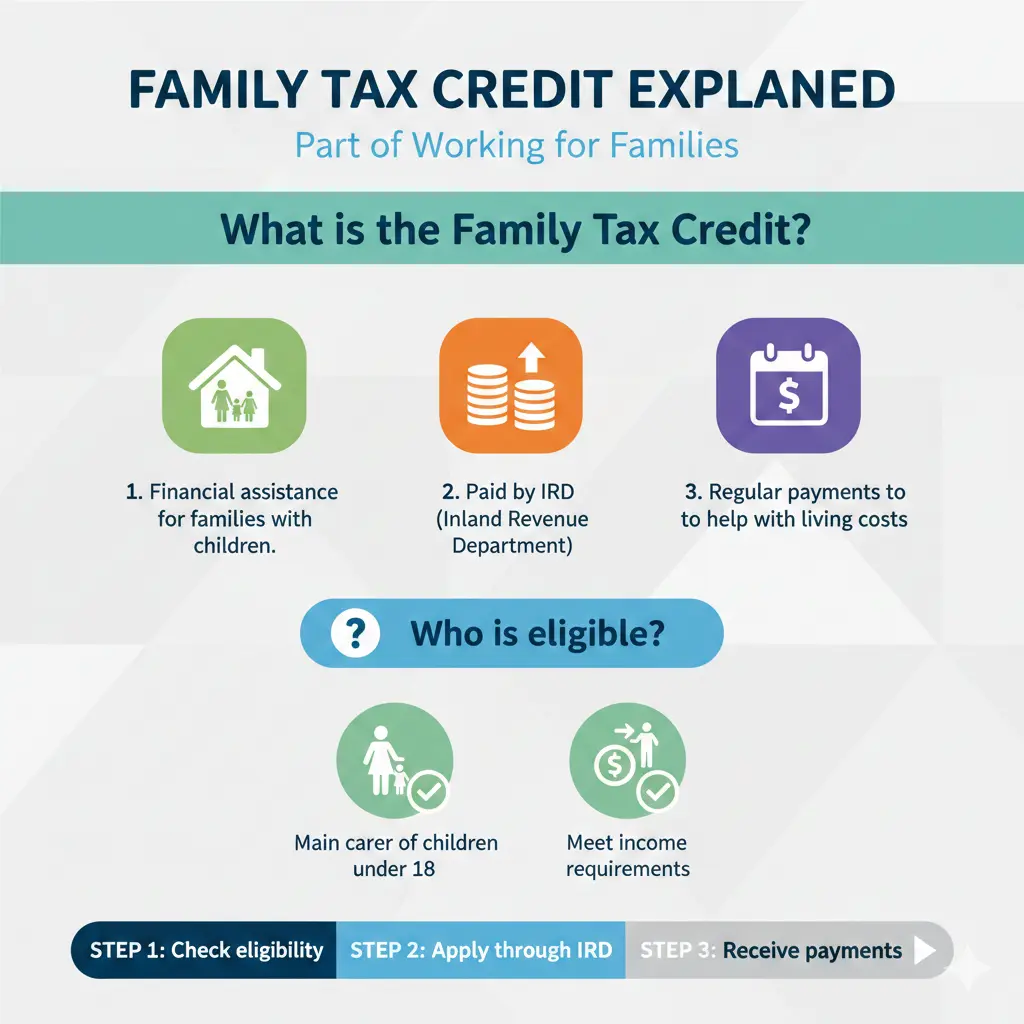
The Family Tax Credit is the primary payment within the Working for Families scheme, designed to help with the costs of raising dependent children. Unlike other components that have work requirements, this credit is available regardless of whether you're employed, on a benefit, or a mix of both.
Administered by IRD, it's calculated based on your family's annual income, the number of dependent children, and any shared care arrangements. A dependent child is typically under 18, or 18-19 if still in school or tertiary study and financially reliant on you.
Key Features of Family Tax Credit
- Income-tested: Full payments if your family income is $42,700 or less; reduced above that via abatement.
- Per-child basis: Higher rate for the eldest child, standard for others.
- Flexible payments: Weekly, fortnightly, or annual lump sum.
- Part of a package: Works alongside In-Work Tax Credit, Minimum Family Tax Credit, and Best Start.
For 2026, the full yearly rates stand at $7,524 for the eldest dependent child and $6,130 for every other child. Weekly equivalents are $144 and $117 respectively.
Who Qualifies for Family Tax Credit?
To access this credit, you must meet straightforward criteria set by IRD:
- Be the principal caregiver for at least one financially dependent child under 18 (or 18-19 in approved education).
- Be aged 16 or older.
- Be a New Zealand tax resident living in NZ, or have NZ-resident children living here.
Family income includes wages, salaries, benefits, and certain government payments, but excludes some like KiwiSaver contributions. Shared care? IRD prorates based on days spent with each parent.
Defining Family Income
Your family income is key—it's the combined taxable income of you and your partner (if applicable), plus net losses from other sources. IRD provides a detailed guide on what counts, ensuring transparency.
Tip: Use IRD's Working for Families calculator to estimate your eligibility before applying—it's quick and accurate for 2026 rates.
How is Family Tax Credit Calculated?
IRD uses a simple formula: start with the maximum credit based on your kids, then apply abatement if income exceeds $42,700.
Full Entitlement (Family Income ≤ $42,700)
If you're under the threshold, you get the maximum:
| Dependent Children | Full Yearly Amount | Weekly Amount |
|---|---|---|
| Eldest child | $7,524 | $144 |
| Every other child | $6,130 | $117 |
Add up per child for your total. Payments increase automatically with new family members.
Abatement for Higher Incomes (>$42,700)
Above $42,700, abatement kicks in at 27 cents per dollar over the threshold. Formula: (Income - $42,700) × 0.27 = abatement amount.
Subtract this from your full credit. If abatement exceeds the credit, you get $0, and any excess reduces other Working for Families credits like In-Work Tax Credit.
Payment Options
- Weekly: Full yearly entitlement ÷ 52, rounded down to nearest dollar.
- Fortnightly: ÷ 26, rounded down.
- Annual lump sum: Paid post-tax year end, ideal if you prefer saving it up.
You can switch methods anytime via myIR.
Real Kiwi Examples: Family Tax Credit in Action
Let's apply this to everyday scenarios.
Example 1: Sarah, Single Mum (Low Income)
Sarah has two kids: Emily (4, eldest) and Oliver (7 months). Family income: $37,800 (< $42,700).
| Child | Yearly Credit |
|---|---|
| Emily | $7,524 |
| Oliver | $6,130 |
| Total | $13,654 |
Weekly: ~$262. Sarah gets the full amount, paid weekly as chosen.
Example 2: Rahui Family (Moderate Income)
Three kids, income $60,000. Full credit: $7,524 (eldest) + 2×$6,130 = $19,784.
Abatement: ($60,000 - $42,700) × 0.27 = $4,719. Entitlement: $19,784 - $4,719 = $15,065 yearly (~$109 weekly).
Example 3: Claire & Laura (Higher Income)
Two kids, $100,000 income. Full: $13,654. Abatement: ($100,000 - $42,700) × 0.27 = $15,431.
Abatement > full credit, so $0 Family Tax Credit. Excess abatement hits In-Work Tax Credit.
These examples highlight how the system scales—low earners get maximum help, tapering fairly.
Changes and Updates Affecting Your Payments
Life changes? Notify IRD promptly:
- New baby or child leaving care.
- Income shifts, job changes, or separation.
- Shared custody adjustments.
IRD recalculates automatically, but overpayments must be repaid. For 2026, note boosts to related credits like In-Work Tax Credit (up to $50 extra fortnightly for low-middle incomes).
Interaction with Other Benefits
Family Tax Credit complements KiwiSaver, ACC, and WINZ payments but factors into income-tested benefits. Always check with IRD.
Practical Tips to Maximise Your Family Tax Credit
- Register early: Via myIR or paper form—tell IRD your payment preference.
- Track income: Use the IRD app for real-time updates.
- Shared care: Provide custody details for accurate splits.
- Combine credits: Pair with Best Start ($73/week for newborns) or Minimum Family Tax Credit for guarantees.
- Tax filing: File on time to avoid delays in lump sums.
Disclaimer: This is general info—seek personalised advice from IRD or a financial adviser, as entitlements depend on individual circumstances.
Next Steps: Claim Your Family Tax Credit Today
Don't leave money on the table—head to myIR, use the Working for Families calculator, and apply now. For personalised help, call IRD at 0800 227 773 or visit a Community Law Centre. Track everything, stay updated via govt.nz, and watch your family's finances strengthen. With Working for Families, you're supported every step.
Frequently Asked Questions
Sources & References
-
1
Family tax credit - Inland Revenue — www.ird.govt.nz
- 2
-
3
Tax Relief - Beehive.govt. (PDF) — www.beehive.govt.nz
-
4
Working for Families payments | New Zealand Government — www.govt.nz
- 5
-
6
Payment Boost Confirmed for NZ Pensioners and Families in 2026 — www.exclusivechauffeur.co.nz
-
7
Working for Families overview - Inland Revenue — www.ird.govt.nz
-
8
Best Start Tax Credit - Bountiful — bountifulpacks.co.nz
Related Articles

Industry Bodies and Professional Associations NZ
Whether you're launching a business, advancing your career, or navigating financial regulations, industry bodies and professional associations in New Zealand offer invaluable support. These organisati...

Emergency Benefit NZ: When You Have No Other Options
When you're struggling financially and don't qualify for other benefits, the Emergency Benefit might be your lifeline. It's a discretionary payment designed for Kiwis in genuine hardship who've exhaus...

Unpaid Internships NZ: Are They Legal?
Unpaid internships are a common pathway for students and graduates to gain work experience in New Zealand, but there's often confusion about whether they're actually legal. The short answer is: unpaid...

Estate Administration NZ: Managing Someone's Affairs After Death
Losing a loved one is one of life's toughest challenges, and stepping in to manage their estate can feel overwhelming. In New Zealand, estate administration—the process of handling someone's affairs a...