Childcare Subsidies & Financial Support in NZ
Raising tamariki in Aotearoa comes with its joys and challenges, especially when balancing work, study, or training with the costs of quality childcare. If you're searching for childcare subsidies NZ...
The Lifetimes NZ editorial team curates, fact-checks, and updates guides on personal finance, property, health, immigration, legal, business, and lifestyle topics relevant to Lifetimes NZ readers. Articles are produced with AI assistance and reviewed by the editorial team before publication.
Raising tamariki in Aotearoa comes with its joys and challenges, especially when balancing work, study, or training with the costs of quality childcare. If you're searching for childcare subsidies NZ to ease the financial load, you're in the right place. In 2026, the government offers a range of supports—from free early childhood education hours to targeted subsidies through Work and Income—that can make a real difference for Kiwi families.
Whether you're a working parent in Auckland facing steep centre fees, a student in Wellington needing after-school care, or a family in Christchurch juggling school holidays, these subsidies are designed to help. We'll break down eligibility, rates, and how to apply, using the latest 2026 figures so you can access the support you're entitled to right away.
Understanding Childcare Subsidies in New Zealand
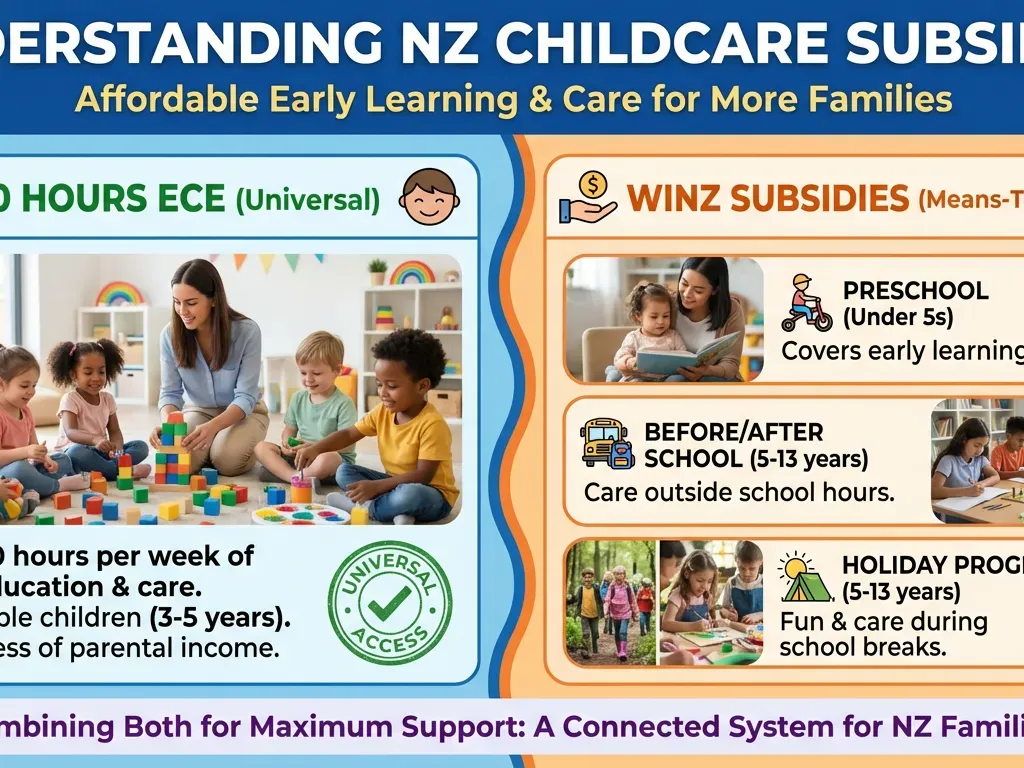
New Zealand's childcare support system combines universal access with means-tested payments to ensure more families can afford early learning and out-of-school care. The cornerstone is the **20 Hours ECE** programme, providing up to 20 hours per week of free education and care for eligible children, regardless of parental income. On top of that, Work and Income (WINZ) administers subsidies for low-to-moderate income households, covering preschool, before/after-school, and holiday programmes.
These subsidies aim to boost workforce participation and give kids access to quality care. However, as fees continue to rise in 2026—despite government funding increases—many providers pass on costs, making subsidies even more crucial. All approved providers must be registered with the Ministry of Education, and payments go directly to them, so you don't handle the cash.
Key Types of Childcare Subsidies
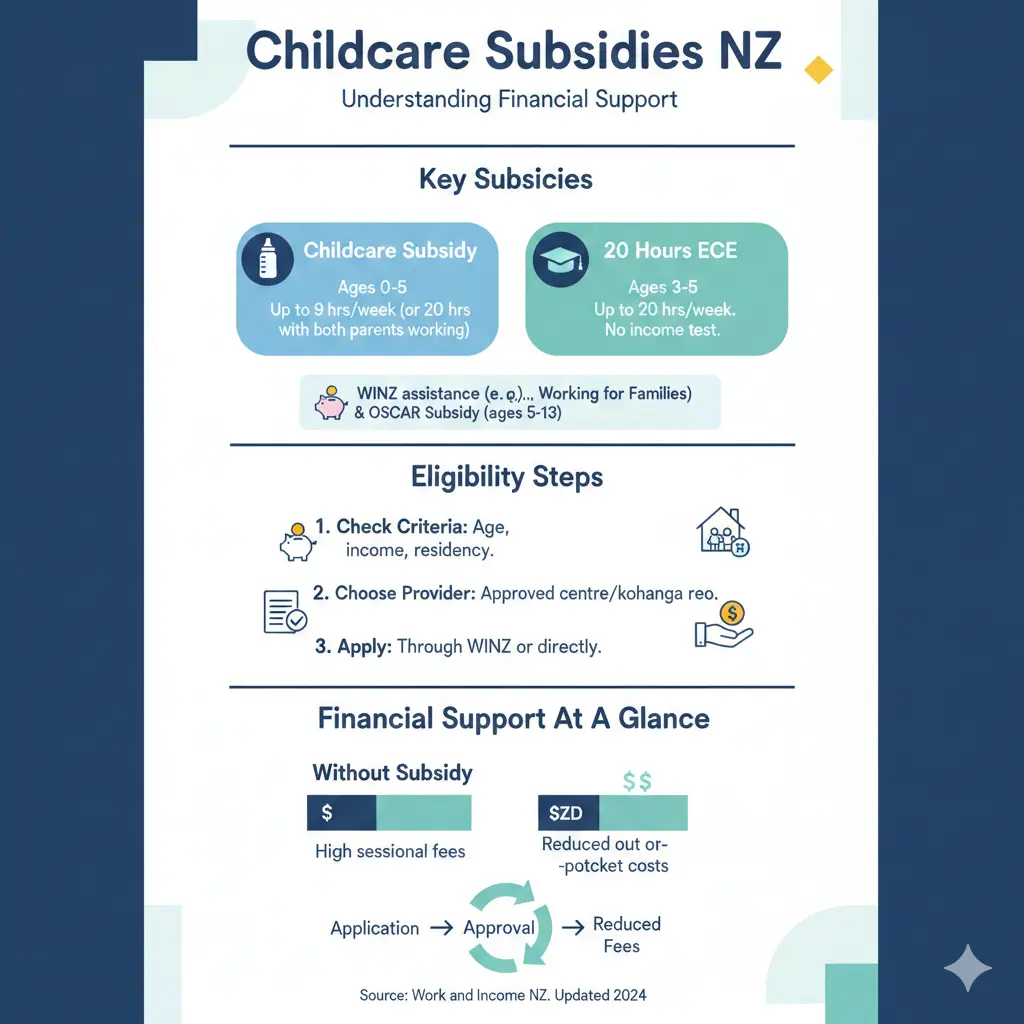
- 20 Hours ECE: Free for 3-4 year-olds at approved services like kindergartens and education & care centres. Up to 6 hours a day, 20 hours a week. Daycare for infants under 3 isn't fully covered.
- Childcare Subsidy (WINZ): For under-5s (or under-6s with Child Disability Allowance). Helps with preschool costs if you're working, studying, or training.
- OSCAR Subsidy: Out-of-School Care and Recreation for 5-13 year-olds. Covers before/after-school (up to 20 hours/week) and holidays (up to 50 hours/week).
20 Hours Free ECE: Universal Access for Kiwi Kids
Introduced in 2007 (and tweaked since), the 20 Hours ECE scheme is a game-changer for preschoolers. Every child aged 3 or over (up to starting school) qualifies at approved providers—no income test needed. This covers teacher-led centres, kindergartens, and home-based care, but check your provider's participation.
In 2026, government funding rates have increased to support quality care. For example:
| Service Type | Under 2 ($/hour incl. GST) | 2 and Over ($/hour incl. GST) | 20 Hours ECE ($/hour incl. GST) |
|---|---|---|---|
| Quality (All-day Teacher-led) | $10.17 | $5.46 | $11.87 |
| Playcentre | $12.66 | $6.36 | $8.28 |
Pro tip: If your current centre doesn't offer 20 Hours ECE, switch to one that does—use the Ministry of Education's list of approved providers. Savings can hit $200+ per week.
Childcare Subsidy: Support for Working and Studying Parents
If you need more than 20 hours or have younger kids, the Childcare Subsidy steps in. Administered by Work and Income, it's for families where both partners (or the sole parent) are working, job hunting, studying full-time, or training—up to 50 hours/week in some cases.
Eligibility basics:
- Child under 5 (or 6 with disability allowance).
- Household income below thresholds (e.g., combined weekly earnings under ~$2,300 for max rates—check WINZ for your situation).
- No suitable care available from partners.
Amounts depend on family size, income, and hours needed. Starts from the first day of care, paid directly to providers. For students, StudyLink handles it alongside your main benefit.
OSCAR Subsidy for School-Aged Kids
Perfect for school holidays or busy mornings/evenings, OSCAR covers 5-13 year-olds. From April 2025 rates (still current in 2026), you can claim up to $6.52/hour per child if income is under $2,335.99 gross weekly. Up to 20 hours/week before/after-school, 50 hours/week holidays.
Providers like Kelly Club or Kelly Sports make applying easy— they'll guide you through WINZ.
Government ECE Funding Rates in 2026
Providers receive direct funding per child-hour, inclusive of GST. Here's a snapshot for popular services from 1 January 2026:
| Funding Type | Under 2 | 2 and Over | 20 Hours ECE |
|---|---|---|---|
| Quality Teacher-led (All-day) | $10.17 | $5.46 | $11.87 |
| Playcentre Quality | $12.66 | $6.36 | $8.28 |
| Equity Funding (Special Needs, EQI 1) | $0.55/hour | ||
Additional grants like Equity (up to $0.55/hour for high needs) and Targeted funding boost low-decile services. Full pay parity supports teacher salaries.
Eligibility Check: Are You Qualified?
Run through this quick checklist:
- Is your child under 5 for preschool subsidies or 5-13 for OSCAR?
- Are you (and partner) working/studying/training at least 15-30 hours/week?
- Household income under WINZ thresholds? Use their online estimator.
- Provider registered? Confirm via Ministry of Education.
Special cases: Domestic students get StudyLink support; sole parents on benefits qualify easier.
How to Apply for Childcare Subsidies NZ
Applying is straightforward and mostly online:
- 20 Hours ECE: Enrol at an approved provider—they handle it.
- Childcare/OSCAR: Create a MyMSD account at workandincome.govt.nz. Upload ID, income proof, and provider details. Approval in days; backdated if needed.
- Track via MyMSD app. Providers invoice WINZ directly.
Practical tip: Apply before care starts to avoid gaps. If refused, appeal within 3 months—many win on review.
Maximising Your Subsidies and Cutting Costs
- Combine 20 Hours ECE with WINZ subsidies for over-20 hours.
- Check Working for Families tax credits via IRD—they pair well.
- Shop around: Home-based care often cheaper post-subsidy.
- Haggle fees or seek hardship grants from providers.
- Use OSCAR for holidays—saves thousands yearly.
"Childcare support begins from the day the childcare begins. All subsidies are paid directly to the childcare provider."
Next Steps to Secure Your Childcare Support
Don't let costs hold you back—start today by checking your eligibility at Work and Income or using the ECE finder tool. Chat with your provider about subsidies they accept, and bundle with IRD's Working for Families for full support. With these tools, Kiwi whānau can thrive without the pinch.
Frequently Asked Questions
Sources & References
-
1
ECE Service Funding Rates 2026 — oece.nz
-
2
Childcare Subsidies in New Zealand - MoneyHub NZ — www.moneyhub.co.nz
-
3
OSCAR Childcare Subsidies - Kelly Sports — kellysports.co.nz
-
4
Help paying for childcare | New Zealand Government — www.govt.nz
-
5
Childcare Subsidy - Work and Income — www.workandincome.govt.nz
-
6
Childcare Fees Continue Rising in 2026 Despite Government Subsidy Promises — www.spincityskates.co.nz
-
7
Out of School Care and Recreation (OSCAR) Subsidy - Kelly Club — kellyclub.co.nz
-
8
Childcare Subsidy - StudyLink — www.studylink.govt.nz
Related Articles

Childcare Options and Costs in NZ 2026
Finding the right childcare for your tamariki (children) is one of the biggest decisions you'll make as a parent, and it's often one of the biggest expenses too. Whether you're returning to work after...

Best Start Tax Credit: What It Is & Who Qualifies
If you've just had a baby or are planning to start a family, you might be wondering how to make ends meet during those early years. The Best Start tax credit is one of New Zealand's most valuable fami...

Child Support (Child Maintenance) in New Zealand
Navigating separation or shared parenting in New Zealand often brings up questions about child support NZ – that essential financial help ensuring kids get what they need, no matter where they live. W...

Parental Leave Rights: What Kiwi Parents Need to Know
Bringing a new baby into the world is one of life's biggest adventures, but for Kiwi parents, navigating parental leave NZ entitlements can feel like a maze. Whether you're expecting, adopting, or bec...