Childcare Options and Costs in NZ 2026

Finding the right childcare for your tamariki (children) is one of the biggest decisions you'll make as a parent, and it's often one of the biggest expenses too. Whether you're returning to work after...
The Lifetimes NZ editorial team curates, fact-checks, and updates guides on personal finance, property, health, immigration, legal, business, and lifestyle topics relevant to Lifetimes NZ readers. Articles are produced with AI assistance and reviewed by the editorial team before publication.
Finding the right childcare for your tamariki (children) is one of the biggest decisions you'll make as a parent, and it's often one of the biggest expenses too. Whether you're returning to work after parental leave or looking for part-time care, New Zealand offers a range of childcare options to suit different needs and budgets. In 2026, understanding your choices and what government support is available can help you make the best decision for your whānau (family) and your hip pocket.
Types of Childcare Available in Aotearoa
New Zealand has several childcare options, each with different costs, environments, and philosophies. Here's what's available:
Early Childhood Education (ECE) Centres
Traditional daycare centres are the most common option for working parents. These facilities employ qualified teachers and carers who look after children from babies through to school age. The minimum adult-to-child ratios are one adult per five infants, or one adult to 10 preschoolers. Many centres provide nutritious meals and enrichment programmes.
For children under two years old, expect to pay around $5–$8 per hour at most ECE centres. For children aged three and over who aren't receiving government funding, hourly rates are typically similar. However, once your child turns three, you'll become eligible for the government's 20 Hours ECE subsidy, which significantly reduces your out-of-pocket costs.
Home-Based Childcare
Home-based educators, also known as in-home childcare, operate from their own homes and typically look after up to four children at a time. Agencies like PORSE, Barnardos, and Home Grown Kids connect families with registered carers. Home-based education fees range from $5 to $12 or more per hour, depending on the educator and your location.
Te Kōhanga Reo (Language Nests)
If you want your child immersed in te reo Māori, Te Kōhanga Reo offers a culturally rich early learning environment. Government funding rates for 2026 are $14.79 per hour for children under two (Quality standard) and $9.62 per hour for children aged two and over. These are significantly higher than standard ECE funding, reflecting the specialised nature of these services.
Playcentres
Playcentres are community-run, parent-led services that are known for being the most affordable option. Some centres request only a donation or small fee per term—on average around $30 per term. If you're eligible for a WINZ childcare subsidy, you could pay nothing at all. In 2026, government funding for Playcentres is $12.66 per hour for children under two (Quality standard) and $11.07 per hour for children aged two and over.
Playgroups
Playgroups are informal, parent-led sessions where children play together with adult supervision. They're typically the most affordable option, with government funding of just $1.83 per hour per child in 2026. Playgroups are ideal if you're looking for part-time, flexible care rather than full-time childcare.
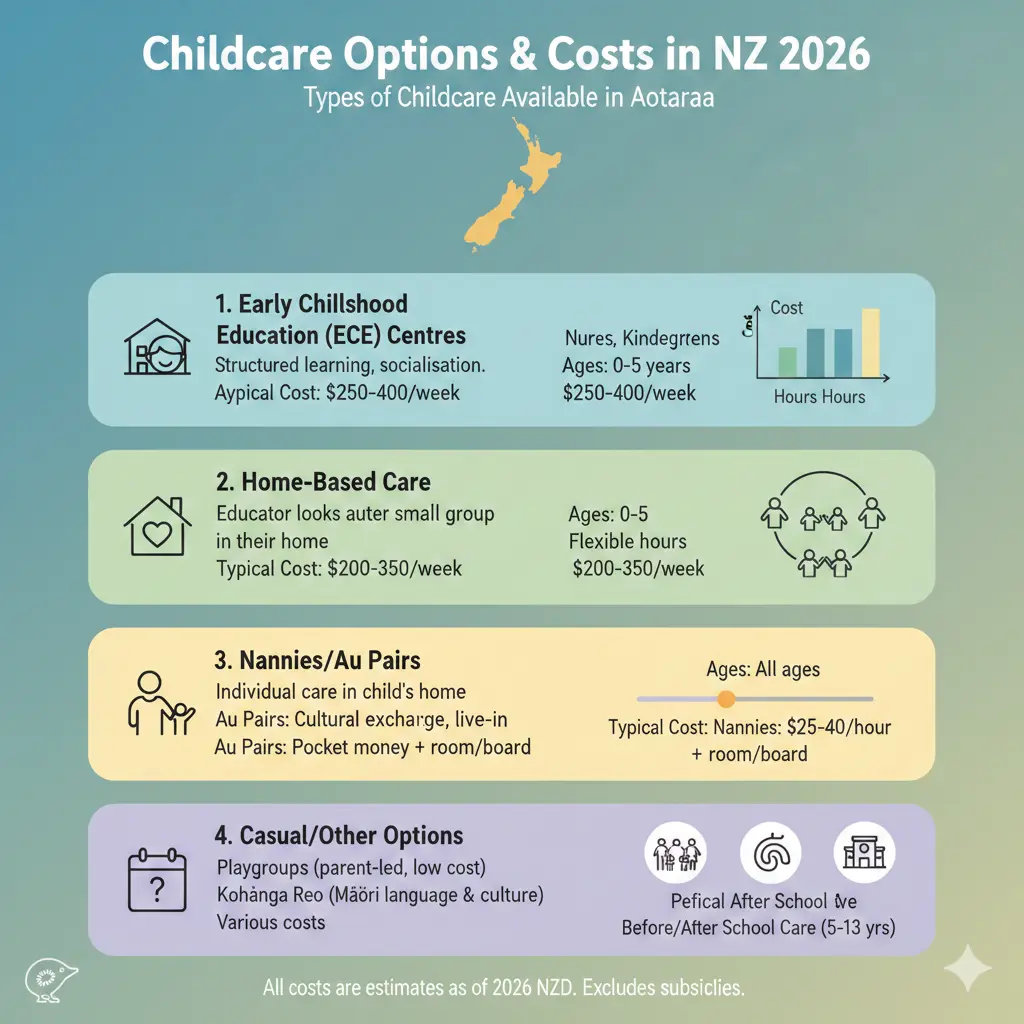
Typical Childcare Costs in 2026
The cost of childcare varies significantly depending on your location, the type of service, and your child's age. Here's what you can expect:
Weekly Childcare Costs
For babies and toddlers under three years old, New Zealanders spend on average $130–$160 per week. If you return to work at the end of your paid parental leave period, the annual cost of childcare starts from around $4,160.
Private daycare centres charge differently depending on your region and the hours you need. For example, one Auckland centre charges:
- Children aged 12 months to three years: $299–$445 per week (depending on days attended)
- Children aged three years and over with 20 Hours ECE: $225–$290 per week (depending on days attended)
Another example shows full-time care for children under three at $500 per week for long days (7:30am–5:30pm) or $415 per week for short days (8:30am–3:30pm).
Additional Costs to Budget For
Beyond weekly fees, you'll likely encounter:
- Enrolment and administration fees: Many centres charge $200–$500 upfront
- Bonds: Typically $500, refundable when your child leaves (provided notice is given and fees are paid)
- Nappies and supplies: Around $30 per week or $1,560 per year if the centre doesn't provide them
- Optional extras: Enrichment programmes, farm school visits, or specialised activities
Government Support: The 20 Hours ECE Subsidy
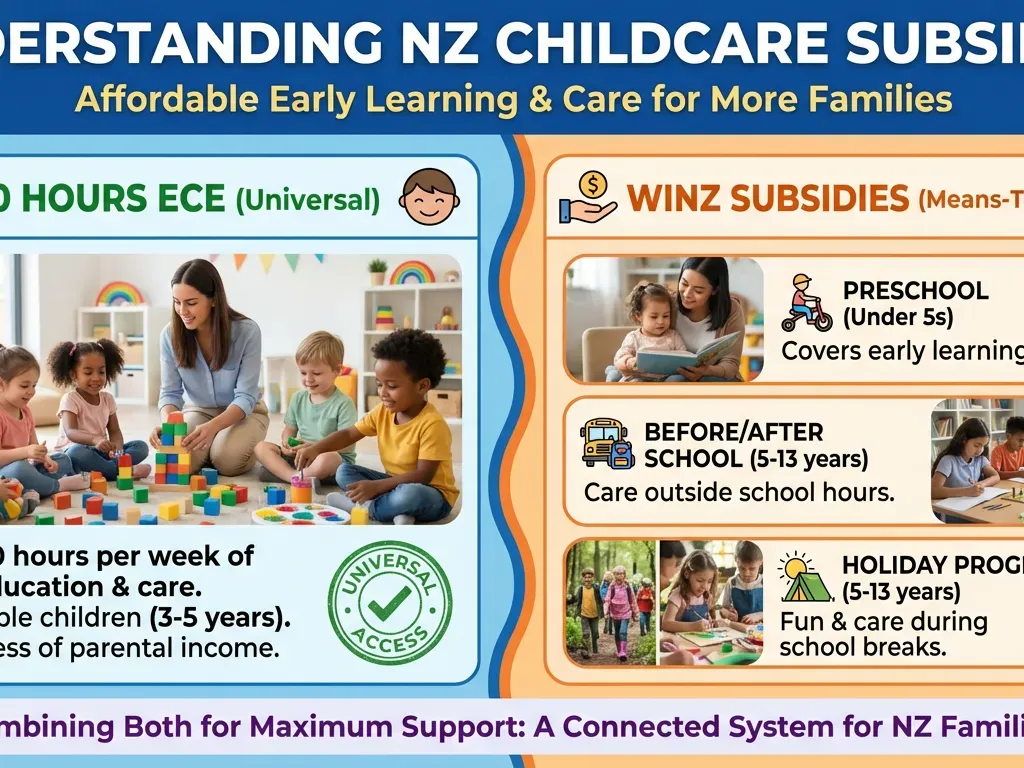
The most significant government support available is the 20 Hours Early Childhood Education (ECE) subsidy for three, four, and five-year-olds. This covers 20 hours per week of free early learning at most ECE services, including private daycare centres, kindergartens, and Montessori schools.
The subsidy is automatically applied when you enrol your child at a participating service—you don't need to apply separately. This can reduce your weekly childcare costs significantly. For example, a centre that charges $445 per week for five days might reduce to $290 per week once the 20 Hours subsidy is applied.
WINZ Childcare Subsidy
If you're on a lower income or receiving a benefit, you may be eligible for the WINZ childcare subsidy, which can help pay for up to 50 hours per week depending on your circumstances. This is separate from the 20 Hours ECE subsidy and can be used alongside it.
To find out if you're eligible and what rates you might receive, you'll need to contact Work and Income (WINZ) directly.
Choosing the Right Childcare for Your Whānau
With so many options, here's what to consider when making your decision:
- Your budget: Playcentres and playgroups are the most affordable; private centres are more expensive
- Your child's age: Some services specialise in babies, while others focus on preschoolers
- Your work schedule: Do you need full-time care, part-time care, or flexible hours?
- Location and convenience: Can you easily drop off and pick up from the centre?
- Philosophy and values: Do you want Māori immersion, Montessori, or a traditional approach?
- Qualifications: Check that educators are registered and qualified
Next Steps
Finding the right childcare takes time and research. Start by listing your priorities—budget, location, hours needed, and your values—then visit a few services to see which feels right for your whānau. Don't forget to:
- Check if your child's potential service is registered and what qualifications the educators have
- Ask about waiting lists (some popular centres have long queues)
- Enquire about the 20 Hours subsidy and any additional costs
- Contact WINZ if you think you might be eligible for extra support
- Look into community options like playcentres if budget is a concern
With careful planning and knowledge of your options, you'll find a childcare solution that works for your whānau and your budget.
Frequently Asked Questions
Sources & References
-
1
ECE Service Funding Rates 2026 — oece.nz
-
2
Fees and Optional Charges - Childcare Mairangi Bay — kakapocreek.co.nz
-
3
Childcare options and their cost — www.ohbaby.co.nz
-
4
Fees — Daisies — www.daisies.co.nz
-
5
How much does it cost to raise children in New Zealand? — www.wisemove.co.nz
-
6
Childcare Fees, Costs and Hidden Charges — oece.nz
-
7
Childcare - Work and Income — www.workandincome.govt.nz
Related Articles
Childcare Subsidies & Financial Support in NZ
Raising tamariki in Aotearoa comes with its joys and challenges, especially when balancing work, study, or training with the costs of quality childcare. If you're searching for childcare subsidies NZ...

Best Start Tax Credit: What It Is & Who Qualifies
If you've just had a baby or are planning to start a family, you might be wondering how to make ends meet during those early years. The Best Start tax credit is one of New Zealand's most valuable fami...

Child Support (Child Maintenance) in New Zealand
Navigating separation or shared parenting in New Zealand often brings up questions about child support NZ – that essential financial help ensuring kids get what they need, no matter where they live. W...

Parental Leave Rights: What Kiwi Parents Need to Know
Bringing a new baby into the world is one of life's biggest adventures, but for Kiwi parents, navigating parental leave NZ entitlements can feel like a maze. Whether you're expecting, adopting, or bec...