Main Benefits Overview: What Support Is Available
If you're facing financial hardship in Aotearoa, you're not alone—and there's genuine support available. The New Zealand Government offers several main benefits designed to help people through tough t...
The Lifetimes NZ editorial team curates, fact-checks, and updates guides on personal finance, property, health, immigration, legal, business, and lifestyle topics relevant to Lifetimes NZ readers. Articles are produced with AI assistance and reviewed by the editorial team before publication.
If you're facing financial hardship in Aotearoa, you're not alone—and there's genuine support available. The New Zealand Government offers several main benefits designed to help people through tough times, whether you're out of work, raising children alone, or unable to work due to illness or disability. Understanding what's on offer and whether you qualify could make a real difference to your whānau's wellbeing. Let's walk through the main benefits available to Kiwis right now.
Understanding Main Benefits in New Zealand
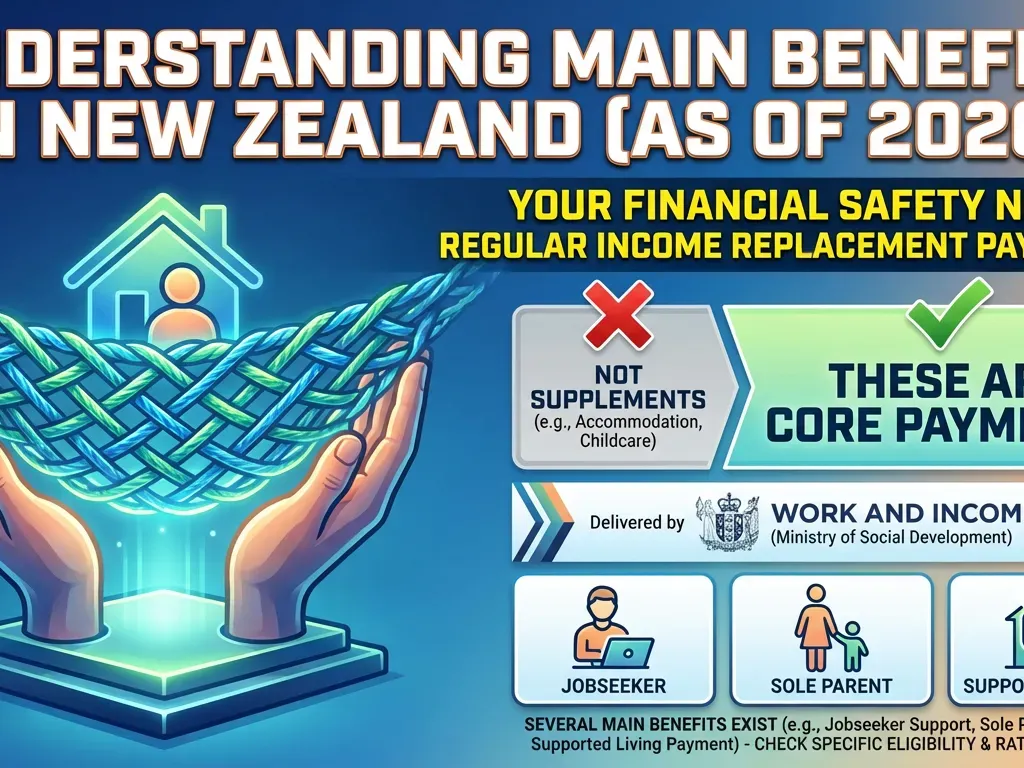
Main benefits are regular payments from Work and Income (part of the Ministry of Social Development) designed to provide a financial safety net. They're different from other forms of support like accommodation supplements or childcare assistance—these are the core income replacement payments. As of 2026, there are several main benefits you might be eligible for, each with specific eligibility requirements and payment rates.
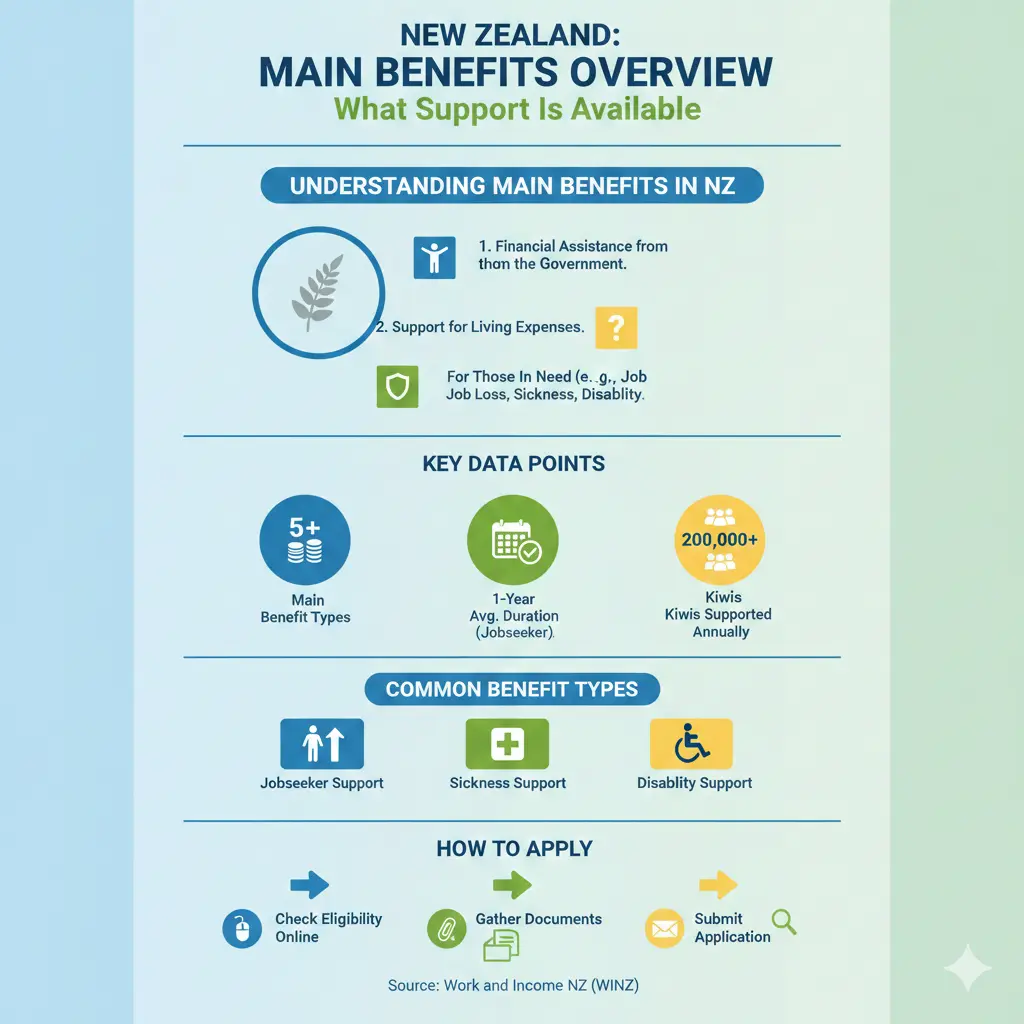
Jobseeker Support
Jobseeker Support is for people aged 18 and over who are looking for work but are currently unemployed. The payment helps cover your living costs while you search for employment.
Who Can Get Jobseeker Support?
- You're aged 18 or over
- You're in New Zealand and available to work
- You're actively looking for suitable employment
- You meet the income and asset tests
There are some important changes coming in 2026 for younger people. If you're aged 18 or 19, you'll now need to meet a Parental Assistance Test before accessing Jobseeker Support or Emergency Benefit. This test includes two parts: a parental income test (checking if your parents' income is at or below $65,529) and a parental support gap test (showing you can't reasonably rely on your parents for support).
Additional Support for Young Job Seekers
The Government is also introducing incentives for young people. If you're aged 18 to 24 and have been on Jobseeker for 12 months or more, you could be eligible for a $1,000 bonus payment if you find work through community job coaching and stay off the benefit for 12 months. This payment becomes available from October 2026 for those who meet the criteria.
Sole Parent Support
Sole Parent Support is for parents (usually mothers) who are raising one or more dependent children without a partner. This benefit recognises the extra costs and challenges of solo parenting.
Who Can Get Sole Parent Support?
- You're the principal caregiver for one or more dependent children
- You're aged 16 or over
- You're not in a relationship (or your partner doesn't have an adequate income)
- You meet the income and asset tests
- Your children are under 14 (in most cases)
Sole Parent Support recognises that looking after children full-time while also earning enough to support a family is extremely challenging. The benefit is designed to provide stability for your whānau during this important time.
Supported Living Payment (SLP)
Supported Living Payment is for people aged 16 to 64 who can't work because of a health condition, injury, or disability. Unlike Jobseeker Support, you don't need to be actively looking for work—the focus is on your wellbeing and what support you need.
Who Can Get Supported Living Payment?
- You're aged 16 to 64
- You have a health condition, injury, or disability that significantly limits your ability to work
- Your condition is likely to last at least two years (or be permanent)
- You've been assessed by a Work and Income assessor
- You meet the income and asset tests
Getting onto SLP involves a thorough assessment process. Work and Income will look at your medical evidence, what work you might be able to do, and what support could help you. It's important to provide detailed information about how your condition affects your daily life and work capacity.
Other Main Benefits
Beyond these three, there are other main benefits available depending on your circumstances:
- Unemployment Benefit for 16-17 Year Olds: Available for young people aged 16-17 who are unemployed and looking for work. This is separate from Jobseeker Support.
- Student Allowance: For full-time tertiary students who meet eligibility criteria. Applications for the Manaaki New Zealand Scholarship Programme open 1 March 2026.
- Veteran's Pension: For ex-service personnel who meet specific criteria.
How to Apply for Main Benefits
Applying for a main benefit involves several steps:
- Contact Work and Income: You can apply online at workandincome.govt.nz, by phone, or in person at your local Work and Income office.
- Provide Documentation: You'll need to provide proof of identity, income details, asset information, and any relevant medical or employment documentation.
- Complete the Assessment: A Work and Income assessor will review your application and may ask additional questions.
- Receive a Decision: You'll be notified whether your application is approved or declined, usually within a few weeks.
- Ongoing Requirements: Once approved, you'll need to meet ongoing obligations—such as looking for work (for Jobseeker) or providing updated medical information (for SLP).
Income and Asset Tests Explained
All main benefits have income and asset tests. These are designed to ensure support goes to those who genuinely need it.
Income Test
Your own income (from work, investments, or other sources) affects how much benefit you receive. The more income you have, the less benefit you'll get. Different benefits have different income thresholds.
Asset Test
The value of what you own (property, savings, investments) also matters. If your assets exceed certain limits, you may not qualify for a benefit or your payment may be reduced. Your home is usually not counted as an asset.
These tests can be complex, especially if you have a partner, dependent children, or significant assets. Work and Income can explain how these tests apply to your specific situation.
Recent Changes and What's New in 2026
The Government has made several changes to benefits and support in 2026:
- Parental Assistance Test for 18-19 Year Olds: As mentioned, young people in this age group now need to demonstrate they can't rely on parental support.
- Jobseeker Incentive Payments: The new $1,000 bonus for young people staying off benefits for 12 months is now available.
- Tertiary Education Changes: The 2026 funding determinations have updated support for vocational and tertiary learners, including changes to literacy and numeracy provision.
- Expanded Support for Job Coaching: More places are available for young people to access community job coaching support.
Getting Help and Support
Navigating the benefit system can feel overwhelming. Here are some practical next steps:
- Visit workandincome.govt.nz for detailed information about each benefit and to apply online.
- Call Work and Income on 0800 559 009 to discuss your situation and get personalised advice.
- Visit your local Work and Income office in person if you need face-to-face support with your application.
- Seek advice from a community organisation like Citizens Advice Bureau or a local community law centre if you need help understanding your options.
- Keep records of all communications with Work and Income and gather documentation early—this makes the process smoother.
Getting support when you need it is not a sign of failure—it's what these systems are designed for. Whether you're between jobs, raising children alone, or managing a health condition, main benefits exist to help you get through difficult periods. The key is understanding what's available, meeting the eligibility criteria, and getting your application in.
Frequently Asked Questions
Sources & References
-
1
2026 Funding Policy Settings Changes — Tertiary Education Commission — www.tec.govt.nz
-
2
Government to Cut Benefit for 4,300 Teens in November 2026 — Stuff.co.nz — www.youtube.com
-
3
Changes in 2026 to Jobseeker Support for 18- and 19-year-olds — Work and Income — www.workandincome.govt.nz
-
4
Financial Help for Your Family — New Zealand Government — www.govt.nz
-
5
Manaaki New Zealand Scholarships — Education New Zealand — www.nzscholarships.govt.nz
Related Articles

Working for Families: Are You Eligible for Government Support?
Struggling to make ends meet with kids at home? You're not alone—many Kiwi families are turning to Working for Families for that extra financial boost. This government support package could put hundre...

Accommodation Supplement: Are You Eligible?
Struggling to keep up with rising rent or mortgage payments in New Zealand? You're not alone—many Kiwis are feeling the pinch, especially in high-cost areas like Auckland or Queenstown. The Accommodat...