Working for Families: Are You Eligible for Government Support?

Struggling to make ends meet with kids at home? You're not alone—many Kiwi families are turning to Working for Families for that extra financial boost. This government support package could put hundre...
Aroha writes about parenting, education, and family life in Aotearoa. She covers school choices, childcare, family benefits, and practical advice for raising a family in New Zealand.
Struggling to make ends meet with kids at home? You're not alone—many Kiwi families are turning to Working for Families for that extra financial boost. This government support package could put hundreds or even thousands of dollars back in your pocket each year, helping cover everything from school costs to groceries.
Whether you're a single parent juggling work and childcare, or a couple with young ones, understanding if you're eligible is the first step. In this guide, we'll break down the essentials, from eligibility rules to payment types and how to apply—all tailored for New Zealand families in 2026.
What is Working for Families?
Launched in 2005, Working for Families (WfF) is a suite of tax credits and payments designed to ease the financial load for families raising dependent children. It supplements household income, reduces child poverty, and makes it easier to balance work and family life.
The programme is jointly run by Inland Revenue (IRD) and Work and Income (WINZ). IRD handles the main tax credits, while WINZ supports with childcare and accommodation supplements. Payments are typically weekly, fortnightly, or lumped annually, based on your family income and circumstances.
In 2026, with living costs rising, WfF remains a lifeline—especially after recent tweaks like boosts to the In-Work Tax Credit (IWTC) by up to $50 per fortnight for low-to-middle-income families.
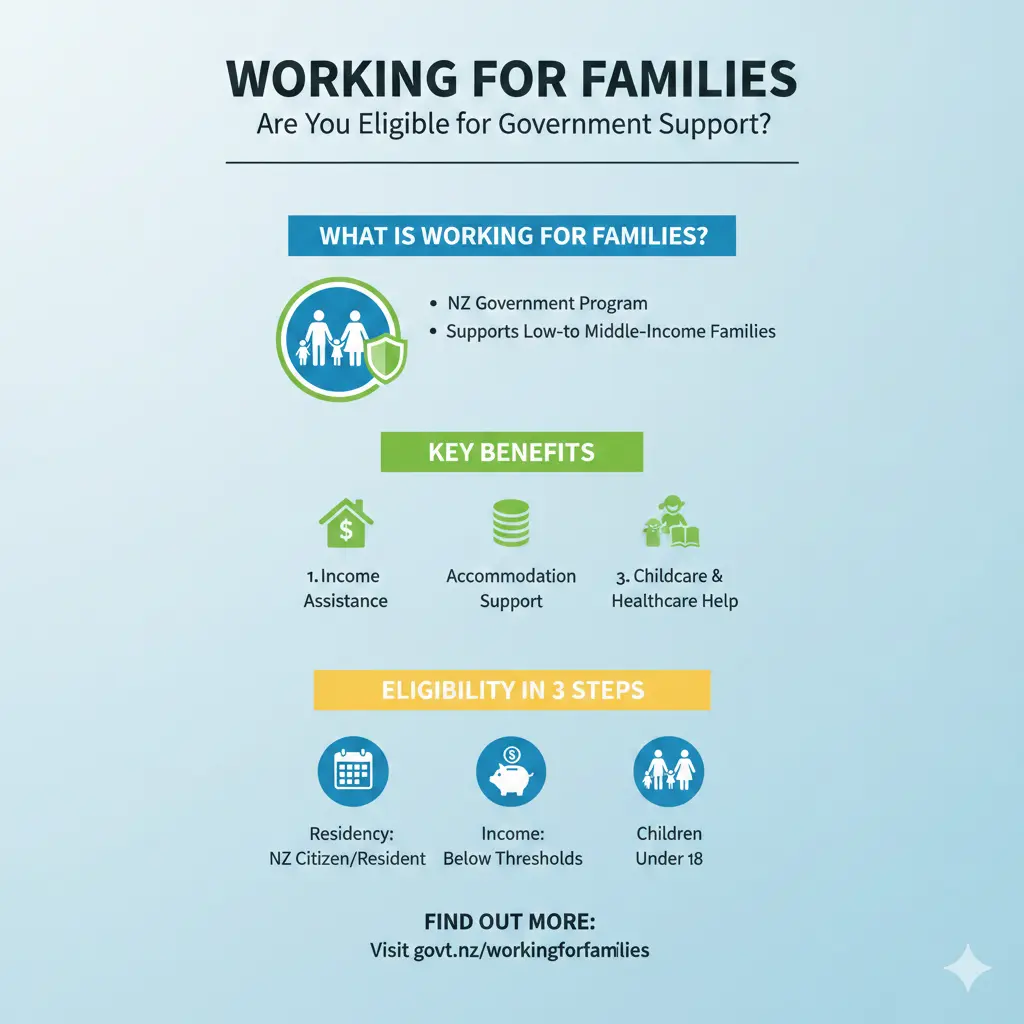
Who Qualifies for Working for Families?
Eligibility is straightforward but specific. You must tick these boxes:
- Be aged 16 years or older.
- Be the principal caregiver for at least one dependent child under 18 (or 18-19 if still in school or tertiary study).
- Meet residency requirements: Be a New Zealand tax resident living here, or have NZ citizen/resident children living with you.
- Care for the child more than temporarily—at least one-third of a four-month period if sharing care.
- Not receive a main benefit from WINZ (though some income-tested benefits allow WfF).
Special Situations
Separated parents: You can qualify if you have exclusive care for at least one-third of a four-month period.
Best Start Tax Credit: Extra rules apply—you need an IRD number for the child, and must have been in NZ for 12 continuous months at some point.
Income thresholds: Payments phase out as family income rises, but you can still get some up to $180,000 for certain supports like FamilyBoost (more on that later).
Use IRD's free Working for Families calculator to check your situation instantly—it's quick and based on current 2026 rates.
Types of Working for Families Payments
WfF comprises four main tax credits, plus extras. Amounts depend on income, child numbers/ages, and work hours. Here's the breakdown for 1 April 2025 to 31 March 2026:
| Payment Type | Who It's For | Key Details (2026) |
|---|---|---|
| Family Tax Credit | All eligible families | Paid regardless of income source. Base rate per child, higher for younger kids. Abates over income thresholds. |
| In-Work Tax Credit (IWTC) | Families in paid work | Single parents: 20+ hours/week. Couples: 30+ combined. Boosted by $50/fortnight (phases out with income). |
| Minimum Family Tax Credit (MFTC) | Low-income working families | Tops up income to a guaranteed minimum. Threshold up $4/fortnight; helps ~3,000 families. |
| Best Start Tax Credit | Newborns (0-3 years) | Weekly payment for principal caregivers. Can't combine with Parental Tax Credit. |
Recent 2025 Budget changes expanded IWTC and MFTC, plus introduced FamilyBoost: 25% refund on early childhood education (ECE) fees for families earning under $180,000.
WINZ adds:
- Childcare subsidies for pre-school, before/after school care.
- Accommodation Supplement.
How Much Will You Get?
It varies widely. A family with two kids under 13 and $60,000 income might receive $6,000-$10,000 yearly, but use the official calculator for precision—charts and tools don't account for shared care.
Expect a Notice of Entitlement from IRD annually (Feb/March), or after changes. It's in myIR or posted.
2026 Rates Snapshot (Examples)
- Family Tax Credit: Up to $144/week for first child under 16.
- IWTC: $72-$122/fortnight base, plus boosts.
- Best Start: $60/week initially, then income-tested.
Rates update yearly—check IRD for exacts as they adjust for inflation and policy.
How to Apply for Working for Families
It's all online via myIR—no paper forms needed:
- Log in or create a myIR account with your IRD number.
- Go to ird.govt.nz/working-for-families.
- Enter family details, income, and child info.
- Submit—IRD assesses and sends your entitlement notice.
Tip: Update changes ASAP (new baby, job loss, separation) to avoid over/underpayments. Payments auto-adjust yearly.
If on WINZ benefits, they coordinate with IRD seamlessly.
Common Mistakes to Avoid
- Forgetting to report income changes—could mean repaying overpayments.
- Missing work hour requirements for IWTC.
- Not claiming Best Start promptly after birth.
- Ignoring shared care calculations.
Pro tip: Track everything in myIR and set reminders for annual reviews.
Next Steps to Secure Your Support
Don't leave money on the table—head to the IRD calculator today and run your numbers. Apply through myIR if eligible, and check WINZ for extras like childcare help. With 2026 rates in play, now's the time to review your family situation.
Questions? Call IRD on 0800 227 773 or visit a WINZ office. You're just a few clicks from support that makes a real difference.
Frequently Asked Questions
Sources & References
- 1
-
2
Can you get Working for Families? - Inland Revenue — www.ird.govt.nz
-
3
Working for Families - Eligibility and Benefits — ebp.co.nz
-
4
Working for Families - Bountiful NZ — bountifulpacks.co.nz
-
5
Working for Families Tax Credits - National Accountants — www.nationalaccountants.co.nz
-
6
Estimate your entitlement - Working for Families — www.ird.govt.nz
-
7
Working for Families — www.workandincome.govt.nz
-
8
Tax Relief Factsheet — www.beehive.govt.nz
Related Articles
Main Benefits Overview: What Support Is Available
If you're facing financial hardship in Aotearoa, you're not alone—and there's genuine support available. The New Zealand Government offers several main benefits designed to help people through tough t...

Accommodation Supplement: Are You Eligible?
Struggling to keep up with rising rent or mortgage payments in New Zealand? You're not alone—many Kiwis are feeling the pinch, especially in high-cost areas like Auckland or Queenstown. The Accommodat...