Pension Age and Residency Requirements for NZ Super
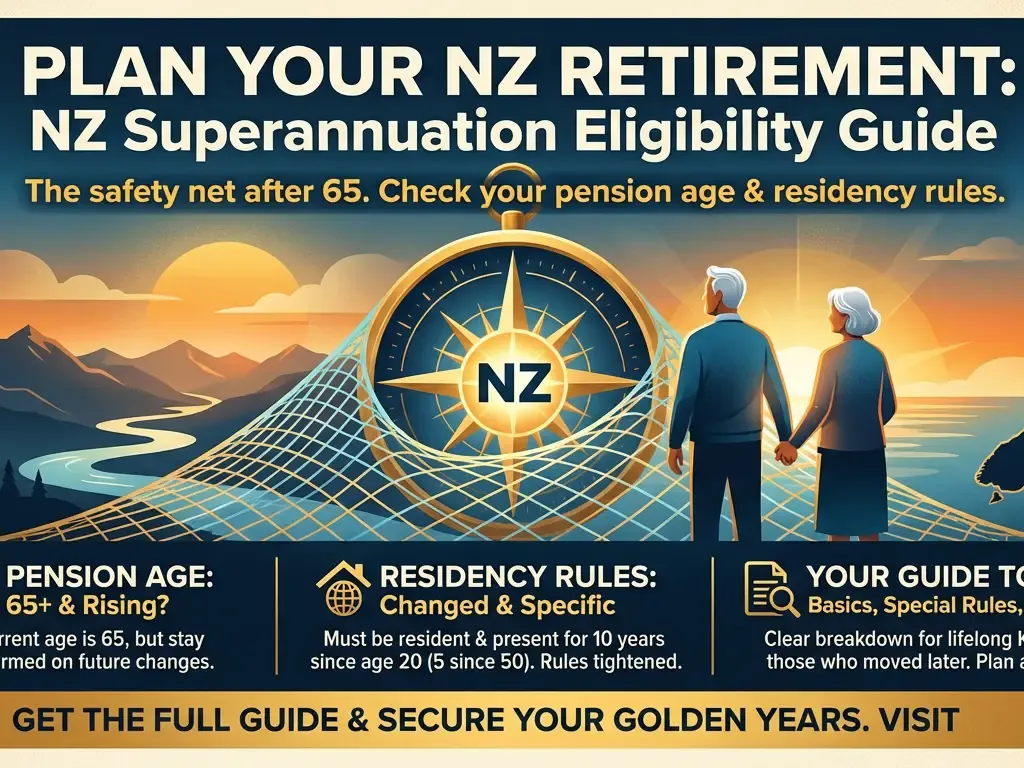
Planning your retirement in New Zealand means understanding the ins and outs of NZ Superannuation—it's the safety net many Kiwis rely on after 65. But with changing residency rules and specific age re...
The Lifetimes NZ editorial team curates, fact-checks, and updates guides on personal finance, property, health, immigration, legal, business, and lifestyle topics relevant to Lifetimes NZ readers. Articles are produced with AI assistance and reviewed by the editorial team before publication.
Planning your retirement in New Zealand means understanding the ins and outs of NZ Superannuation—it's the safety net many Kiwis rely on after 65. But with changing residency rules and specific age requirements, knowing if you qualify can make all the difference to your golden years.
Whether you're a lifelong Kiwi or moved here later in life, this guide breaks down the pension age and residency requirements for NZ Super. We'll cover everything from the basics to special rules, so you can check your eligibility and plan ahead confidently.
What is the Pension Age for NZ Super?
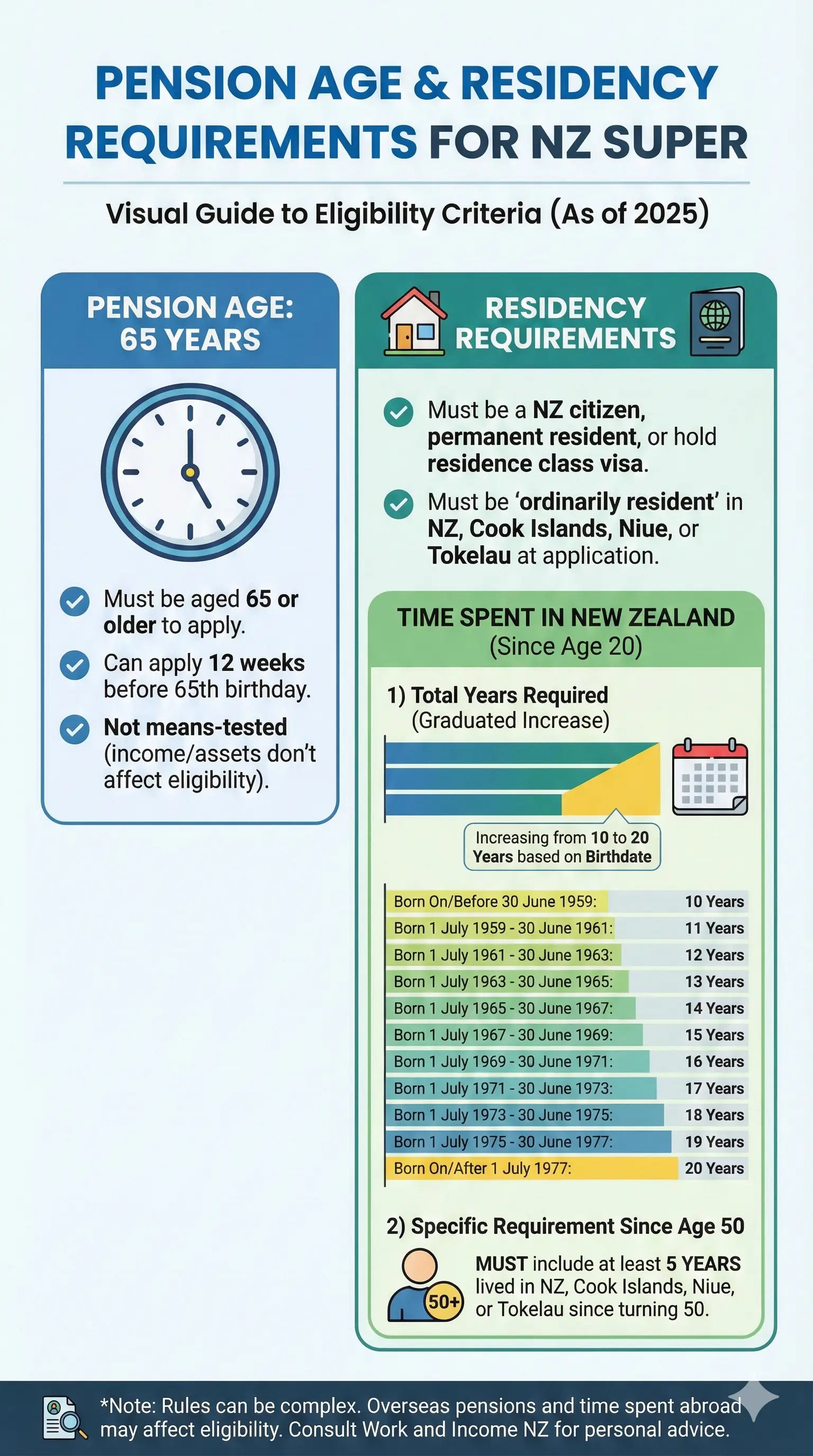
The qualifying age for NZ Super remains firmly at 65 years old in 2026—no changes there despite global talks about raising it. You must be 65 or older on the day you apply, and it's not automatic; you'll need to submit an application through Work and Income.
This age applies universally, whether you're working full-time, part-time, or enjoying retirement already. NZ Super isn't means-tested, so your income, savings, or KiwiSaver balance won't affect your eligibility.
Why 65? A Quick History
Since its introduction in 1974, the pension age has stayed at 65 to provide a reliable retirement income for New Zealanders. While some countries have pushed theirs higher, our system prioritises accessibility for those who've contributed through taxes over the years.
Core Residency Requirements for NZ Super
To get NZ Super, you must meet strict residency criteria beyond just turning 65. These ensure the scheme supports those with a genuine connection to New Zealand.
First, you need to be ordinarily resident in New Zealand, the Cook Islands, Niue, or Tokelau when you apply. 'Ordinarily resident' means New Zealand is your home—assessed by where you live day-to-day, your family ties, job, and intentions. It's not the same as tax residency or immigration status; the Supreme Court has ruled it's about your personal circumstances at application time.
You also need the right status: New Zealand citizen, permanent resident, or holder of a residence class visa.
The 10-Year Rule and How It's Changing
Most discussions start with the classic 10-year rule: if you were born on or before 30 June 1959, you need at least 10 years of living in New Zealand after age 20, including 5 years after age 50. These years don't have to be consecutive, but you must have been both resident and physically present—no long overseas stints counting as NZ time.
However, the requirement is gradually increasing to 20 years based on your birth date. Here's the breakdown for 2026:
| Date of Birth | Total Years Required from Age 20 (incl. 5 from Age 50) |
|---|---|
| On or before 30 June 1959 | 10 years |
| 1 July 1959 - 30 June 1961 | 11 years |
| 1 July 1961 - 30 June 1963 | 12 years |
| Later birth dates (phasing to 20 years) | Up to 20 years by those turning 65 after a set date |
For example, if you were born on 28 March 1961, you'll need 11 years total post-20, with 5 after 50. These changes started phasing in from 1 July 2024, affecting those turning 65 now and beyond.
The 5-Year Rule Explained
No matter your birth date, the 5-year rule is non-negotiable: at least 5 of your required years must be after turning 50. This focuses on recent connections to New Zealand, ensuring you've built a life here in your later working years.
Practical tip: Track your time in NZ carefully. Time spent overseas on holidays might not count if you're not physically present and resident.
Overseas Pensions and Social Security Agreements
Haven't hit the NZ residency years? Don't worry—Social Security Agreements (SSAs) can help. You can count time lived in SSA countries towards your requirement.
NZ has agreements with: Australia, Canada, Denmark, Greece, Ireland, Jersey, Guernsey, Malta, the Netherlands, South Korea, and the United Kingdom. Realm countries like the Cook Islands, Niue, or Tokelau also count fully.
For instance, if you've spent years in Australia as a NZ citizen with a Special Category Visa or permanent residency, showing intent to stay there permanently, that time might qualify. But it's case-by-case—Work and Income assesses your ties.
Impact of Overseas Pensions
If you're receiving an overseas pension, it could affect your NZ Super rate. Under SSAs, NZ Super may be reduced to avoid double-dipping, but you'll still get something if you meet criteria. Always declare overseas income when applying.
Special Circumstances and Exceptions
Life isn't always straightforward, and NZ Super rules recognise that with exceptions for:
- Refugees or protected persons: Years are calculated from your arrival date in NZ, potentially waiving some requirements.
- Overseas payments post-approval: Once approved, you can receive NZ Super abroad for up to 26 weeks (or longer in some SSA countries) without losing it—just notify Work and Income before travelling.
- Not quite 65 yet? If short on years, wait until you qualify—apply anytime after 65 once criteria are met.
For Australians or those splitting time, prove your 'ordinary residence' with evidence like rental agreements, bank statements, or family links.
How to Apply for NZ Super in 2026
Applying is straightforward but requires planning. Start 2-3 months before your 65th birthday:
- Check eligibility online via the Work and Income NZ Super calculator.
- Gather proof: birth certificate, passport, residency proof, and residence history (e.g., IRD records, tenancy agreements).
- Apply online, by post, or at a service centre—include bank details for fortnightly payments.
- Expect a decision in 4-6 weeks; you'll get a SuperGold card too for discounts.
Pro tip: If partnered, apply together—rates are higher for couples. Current 2026 rates (after tax) are around $500/week single, $380 each for couples, but check Work and Income for exact figures as they adjust annually.
Common Mistakes to Avoid
- Assuming citizenship alone qualifies you—residency years matter.
- Forgetting the 5-year post-50 rule.
- Overlooking SSA countries for extra years.
- Applying from overseas without prior approval.
Plan Your Retirement with Confidence
Understanding pension age and residency requirements for NZ Super puts you in control. Most Kiwis qualify with ease, but if you've travelled or lived abroad, double-check your years now.
Next steps: Use the Work and Income eligibility checker, track your residence history, and consider chatting with a retirement adviser via Retirement Commission. Apply early, and enjoy the security NZ Super provides. Your future self will thank you.
Frequently Asked Questions
Sources & References
-
1
The New Zealand Superannuation Scheme Not So Super? - Lawlink — lawlink.co.nz
-
2
Who can get NZ Super - Work and Income — www.workandincome.govt.nz
-
3
Understanding New Zealand's Superannuation Scheme - Wise Move — www.wisemove.co.nz
-
4
Applying for NZ Superannuation | New Zealand Government — www.govt.nz
-
5
Change to residence criteria for NZ Super and Veteran's Pension - Work and Income — www.workandincome.govt.nz
-
6
A guide to the NZ Pension - New Zealand Seniors — www.nzseniors.co.nz
-
7
New Zealand Superannuation - Work and Income — www.workandincome.govt.nz
-
8
NZ Super | Retirement Commission Te Ara Ahunga Ora — retirement.govt.nz
Related Articles

The Truth About NZ Superannuation: Will It Be There When You Retire?
Picture this: you're finally hitting 65, dreaming of lazy mornings with a flat white and adventures in the Coromandel, only to wonder if NZ Superannuation—the safety net we've all counted on—will actu...
Retirement Villages and Aged Care Options in NZ
Planning your retirement living in New Zealand doesn't have to feel overwhelming. Whether you're dreaming of low-maintenance villas with like-minded neighbours or need reliable aged care support, unde...