Accommodation Supplement: Are You Eligible?

Struggling to keep up with rising rent or mortgage payments in New Zealand? You're not alone—many Kiwis are feeling the pinch, especially in high-cost areas like Auckland or Queenstown. The Accommodat...
The Lifetimes NZ editorial team curates, fact-checks, and updates guides on personal finance, property, health, immigration, legal, business, and lifestyle topics relevant to Lifetimes NZ readers. Articles are produced with AI assistance and reviewed by the editorial team before publication.
Struggling to keep up with rising rent or mortgage payments in New Zealand? You're not alone—many Kiwis are feeling the pinch, especially in high-cost areas like Auckland or Queenstown. The Accommodation Supplement could be the helping hand you need, providing weekly support towards your housing costs if you meet the criteria.
This payment from Work and Income helps with rent, board, or home ownership expenses, but eligibility isn't automatic. Whether you're on a main benefit, studying, or working but facing tight finances, understanding if you're eligible for the Accommodation Supplement can make a real difference to your budget. Let's break it down step by step, with the latest 2026 details, so you can check your situation today.
What is the Accommodation Supplement?
The Accommodation Supplement is a weekly payment designed to ease the burden of accommodation costs for eligible New Zealanders. It covers rent, board, or the costs of owning your home, like mortgage interest or rates. Introduced under the Social Security Act 2018, it's available to a wide range of people, from benefit recipients to low-income workers and students.
Importantly, it's not just for renters—homeowners can qualify too, as long as they meet the minimum housing cost threshold. In 2026, this support remains crucial amid ongoing housing pressures, with payments adjusted annually through Work and Income's general rate increases.
Who Typically Receives It?
- People on main benefits like Jobseeker Support, Sole Parent Support, or Supported Living Payment.
- Non-beneficiaries with low income and high housing costs.
- Students receiving StudyLink payments.
- Couples, sole parents, and singles aged 16 and over.
For example, a sole parent in Wellington paying $500 a week in rent might receive up to $155 weekly supplement, depending on their area and income.
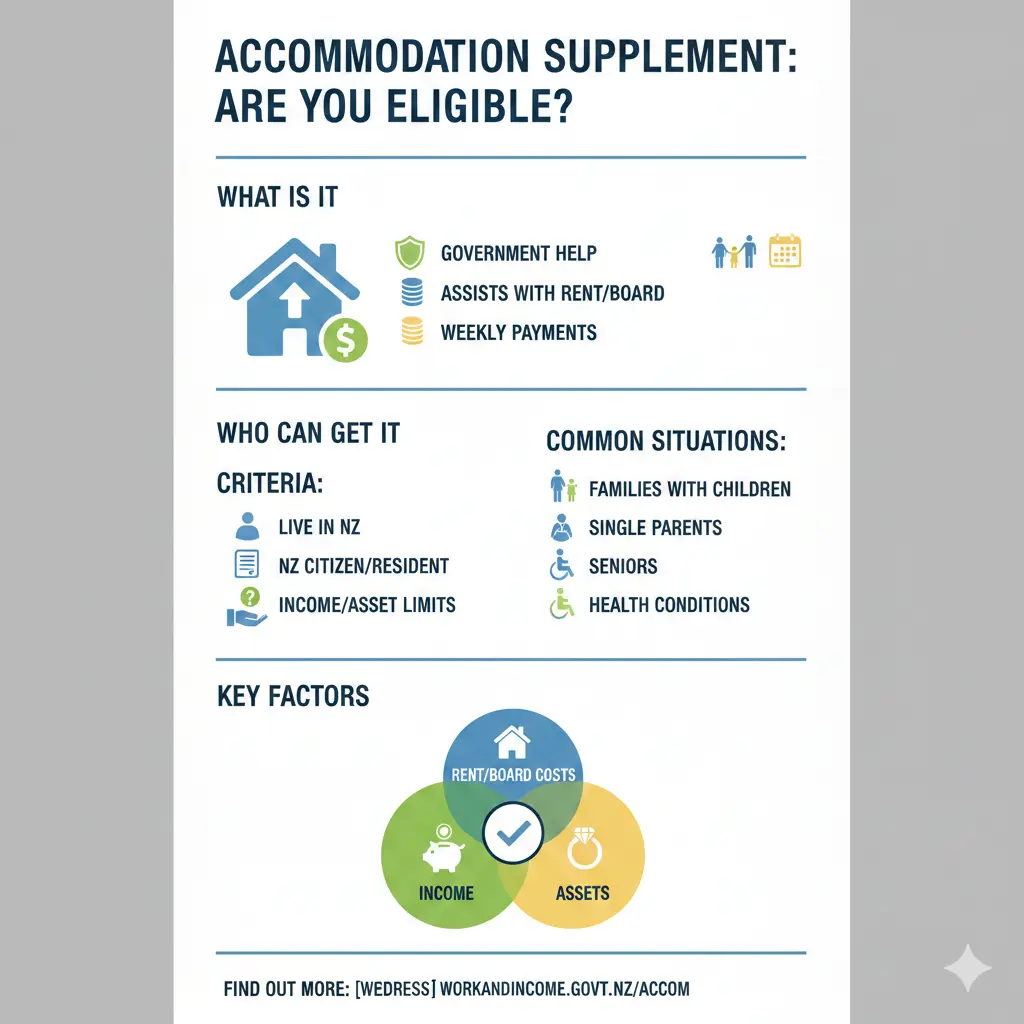
Are You Eligible for the Accommodation Supplement?
Eligibility hinges on several factors: your age, residency, housing costs, income, assets, and location. You must be 16 or older, a New Zealand citizen or permanent resident, normally live here, and intend to stay. Crucially, you can't receive it if you're in public housing from Kāinga Ora or approved community providers, as those rents are already subsidised.
Basic Requirements
You need to be paying a minimum weekly accommodation cost, known as the entry threshold. This is currently around 30% of your benefit rate (rising to 40% for some from April 2027—more on changes below). For non-beneficiaries, income limits apply: for instance, a single person in Auckland can't exceed about $69,524 annually.
Asset Limits
Your cash assets must stay under these thresholds:
| If you are: | Your assets are no more than: |
|---|---|
| Single | $8,100 |
| Couple (with or without children) or sole parent | $16,200 |
These limits can increase for certain lump sum payments from ACC or past accident insurance. Equity in rental properties often pushes assets over the limit, so they're typically ineligible.
Income Rules
If you're on a main benefit, income testing is lenient—even part-time work won't usually cut you off. Non-beneficiaries face stricter abatement: payments reduce as income rises above thresholds, like $120,016 for couples with children in high-cost areas.
Pro Tip: Use Work and Income's free 'Check what you might get' tool to assess your eligibility instantly—it factors in your income, assets, family, and location.
Payment Rates by Area: How Much Can You Get?
New Zealand is divided into four accommodation areas based on average housing costs, using 2016 rental data (updates coming in 2027). Rates are higher in expensive zones like central Auckland (Area 1). Here's the 2026 maximum weekly payment:
| Your situation | Area 1 | Area 2 | Area 3 | Area 4 |
|---|---|---|---|---|
| Single, 16+ years | $165 | $105 | $80 | $70 |
| Partner, no children | $235 | $155 | $105 | $80 |
| Partner, 1+ children | $305 | $220 | $160 | $120 |
| Sole parent, 1 child | $235 | $155 | $105 | $80 |
| Sole parent, 2+ children | $305 | $220 | $160 | $120 |
To find your area, check Work and Income's postcode tool or call them—it's not always intuitive, especially in growing spots like Queenstown.
"The amount you can receive is partly affected by where you live. Work and Income define four specific areas in New Zealand, and the maximum rates of payment vary between areas."
Real Kiwi Examples
- Auckland single renter (Area 1): Paying $600/week rent? Eligible for up to $165/week if income/assets qualify.
- Wellington couple with kids (Area 2): Mortgage $550/week could net $220/week supplement.
- Rural sole parent (Area 4): Board $300/week might get $80/week max.
Upcoming Changes in 2027: What Kiwis Need to Know
Budget 2025 brings tweaks effective 1 April 2027. The entry threshold rises from 30% to 40% of base benefit rates for most (excluding NZ Super, Veteran's Pension, and Supported Living Payment recipients). This means higher personal contributions before supplement kicks in, potentially disqualifying some low-cost homeowners.
Area boundaries will update using fresh data, boosting payments in high-growth areas (e.g., parts of Queenstown shifting to Area 1) and aiding more working households. About 1,300 may lose eligibility, but others could gain. No changes yet in 2026—apply now under current rules.
How to Apply for Accommodation Supplement
Applying is straightforward and often backdated. Here's how:
If You're on a Main Benefit
- Apply online via MyMSD or call 0800 559 009 for an appointment.
- Provide proof of ID, accommodation costs (e.g., tenancy agreement, rates notice), and assets.
- It's usually backdated to your first contact date.
If You're Not on a Benefit (Non-Beneficiary)
- Complete the Accommodation Supplement form on workandincome.govt.nz.
- Attend a Work and Income appointment with ID, cost proofs, income details, and asset info.
- Backdated to contact date if approved.
For Students
Apply through StudyLink alongside your student allowance—same eligibility rules apply, excluding social housing.
Practical Tip: Gather docs upfront: bank statements for costs, valuations for assets. Even 18-19-year-olds living at home qualify if paying board to parents.
Common Mistakes to Avoid
- Forgetting to declare all income or assets—could lead to overpayments and repayment demands.
- Assuming public housing qualifies—nope, it's excluded.
- Not checking your area—use the tool to confirm.
- Ignoring non-beneficiary options if you're working but struggling.
Next Steps: Secure Your Accommodation Supplement Today
Don't let high housing costs overwhelm you—thousands of Kiwis receive this support weekly. Start by using the Work and Income eligibility checker, gather your proofs, and apply online or via phone. If unsure, call 0800 559 009 for free advice tailored to your situation. Small steps now could mean hundreds extra in your pocket each year. Check today, apply tomorrow, and breathe easier.
Frequently Asked Questions
Sources & References
-
1
Accommodation Supplement - Work and Income — www.workandincome.govt.nz
-
2
Accommodation Supplement 2025 & 2026: Rates & Eligibility — www.moneyhub.co.nz
-
3
Accommodation Supplement: Ongoing help with your rent — communitylaw.org.nz
-
4
Changes to the Accommodation Supplement through Budget 2025 (PDF) — www.msd.govt.nz
-
5
Accommodation Supplement - StudyLink — www.studylink.govt.nz
-
6
Government Confirms Changes to Benefits for 18–19 Year-Olds — lamartinierelawsoc.org
Related Articles

Working for Families: Are You Eligible for Government Support?
Struggling to make ends meet with kids at home? You're not alone—many Kiwi families are turning to Working for Families for that extra financial boost. This government support package could put hundre...
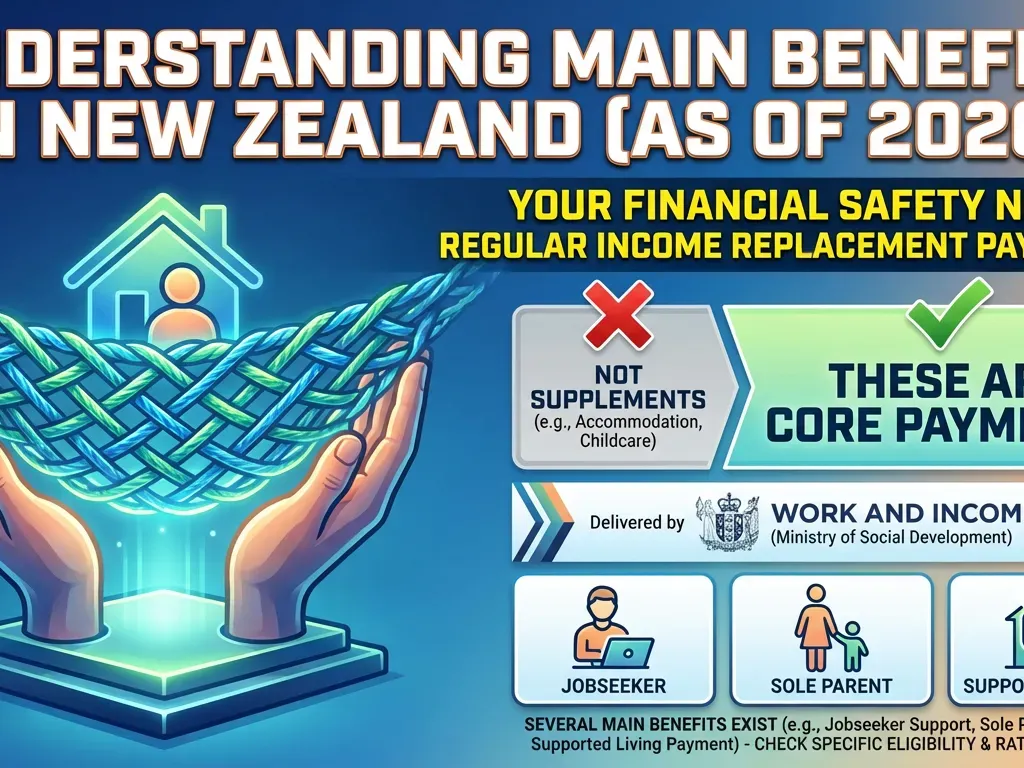
Main Benefits Overview: What Support Is Available
If you're facing financial hardship in Aotearoa, you're not alone—and there's genuine support available. The New Zealand Government offers several main benefits designed to help people through tough t...