Current Mortgage Interest Rates NZ (Updated Monthly)

If you're a homeowner, first-time buyer, or investor keeping an eye on the property market, you'll know that mortgage interest rates can make or break your financial plans. Right now in early 2026, Ne...
James writes about the New Zealand property market, renting, home ownership, and housing costs. He breaks down complex property topics into practical advice for renters and buyers.
If you're a homeowner, first-time buyer, or investor keeping an eye on the property market, you'll know that mortgage interest rates can make or break your financial plans. Right now in early 2026, New Zealand's mortgage landscape is shifting—and understanding what's happening could save you thousands of dollars. Let's break down where rates are headed, what's driving them, and what you should be doing about your mortgage.
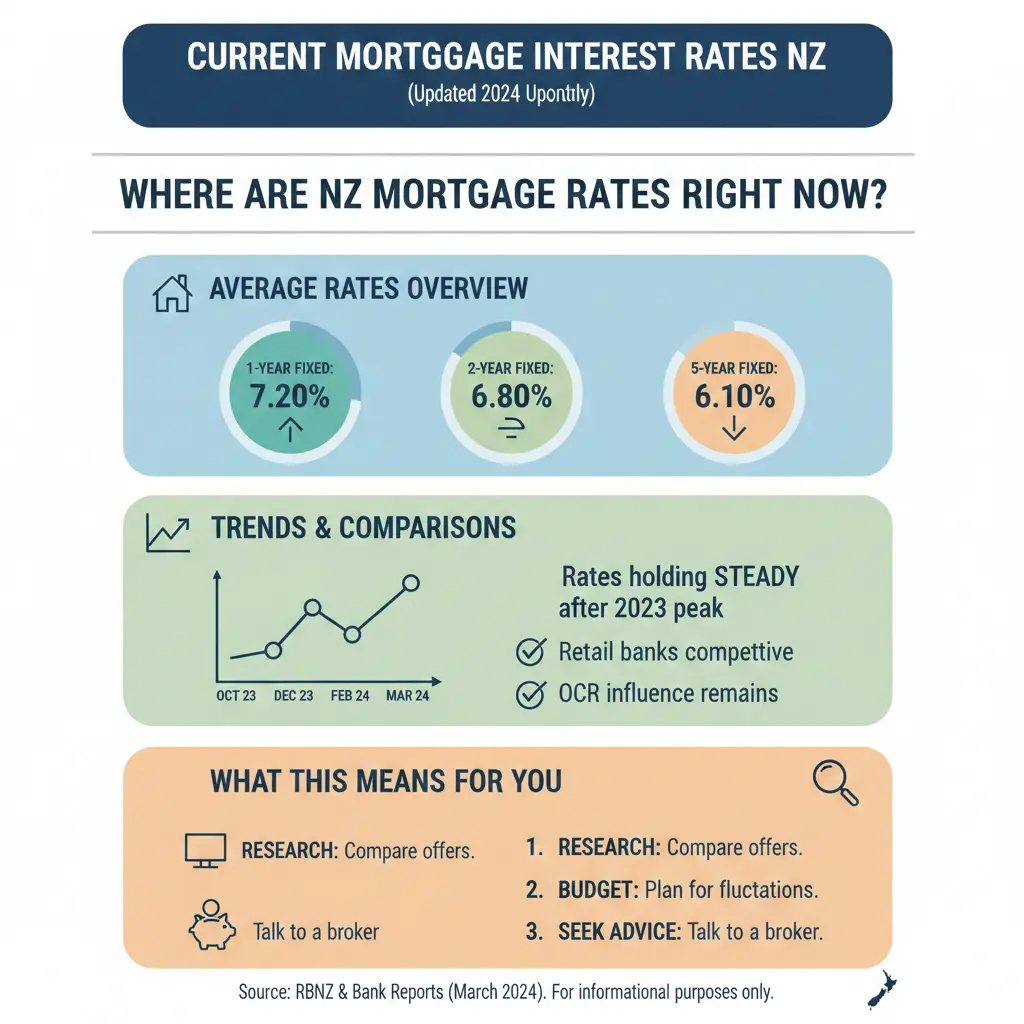
Where Are NZ Mortgage Rates Right Now?
The Reserve Bank of New Zealand (RBNZ) currently has the Official Cash Rate (OCR) set at 2.25 percent. This is the lowest level we've seen since mid-2022, following the RBNZ's decision to cut rates in November 2025 as inflation pressures eased and the economy slowed.
Based on current forecasts from major banks and analysts, fixed mortgage rates from the big banks are ranging from approximately 3.50% to around 6.00%, depending on the term length you choose. Here's what that typically looks like:
- Shorter fixed terms (1-2 years): Generally at the lower end of the range
- Medium fixed terms (3-5 years): Mid-range rates
- Longer fixed terms (beyond 5 years): Typically higher rates
More New Zealanders are choosing shorter fixed terms at the moment—typically 1-2 years—as uncertainty in the market makes longer commitments feel riskier.
What's Driving Mortgage Rates in 2026?
The OCR and How It Affects Your Mortgage
When the RBNZ adjusts the OCR, it creates a ripple effect through the entire mortgage market. Here's how it works: a lower OCR reduces banks' borrowing costs, which they typically pass on to customers. However, the timing matters.
Floating rate mortgages respond quickly—usually within days—when the OCR changes. If you're on a floating rate and the OCR drops, your repayment amount gets recalculated almost immediately, potentially saving you money each month.
Fixed rate mortgages adjust more gradually. The market moves within about a week as banks adjust their rates to stay competitive. But here's the catch: if you're locked into a fixed rate, you won't see any benefit until that term expires and you refinance.
Inflation Expectations and Long-Term Rates
While the OCR is at 2.25%, longer-term mortgage rates are actually under upward pressure. The RBNZ expects inflation to return to around 2 percent by mid-2026, but wholesale interest rates—which influence term mortgage rates for one-year terms and beyond—have risen in response to the November OCR cut.
This means that longer-term fixed rates of more than two years could increase more over 2026. In fact, early 2026 forecasts suggest that wholesale interest rates are past their lows for this easing cycle, which puts upward pressure on both longer-term mortgage rates and term deposit rates.
Looking Ahead: Interest Rate Predictions
Experts expect the OCR to remain at 2.25% until at least November 2026, with long-term projections suggesting it could rise to around 3.50 percent in 2027 and 3.75 percent in 2028. This gradual increase reflects expectations that the economy will recover and inflation pressures may persist.
What This Means for Different Types of Borrowers
Homeowners with Floating Rate Mortgages
If you're on a floating rate, you've benefited from the recent OCR cuts, but you're also exposed to future increases. With rates expected to potentially rise later in 2026 and into 2027, your monthly repayments could increase significantly. Many financial advisors are now recommending that borrowers on floating rates consider fixing at least part of their mortgage while rates remain relatively low.
Homeowners with Fixed Rate Mortgages
If you've locked in a fixed rate, you're protected from any OCR increases until your term expires. However, you won't benefit from any further OCR cuts. When your fixed term ends, pay attention to market conditions—if rates have risen, you might want to fix again rather than switch to floating.
First-Time Home Buyers
The current environment is mixed for first-time buyers. Lower mortgage rates make homes more affordable in terms of repayment costs, but this can also mean entering a competitive market where property prices are higher. Bank economists are forecasting modest house price growth of around 2-4 percent in 2026, which suggests we're not in a rapid appreciation phase—potentially good news for buyers looking to enter the market without overpaying.
At current rates, if you qualify for a $700,000 loan at a mortgage rate of 6.00%, your monthly repayment would be approximately $4,200. It's worth getting pre-approved to understand your borrowing capacity before you start house hunting.
Property Investors and Landlords
Lower OCR rates reduce mortgage costs for landlords because interest rates drop. However, this can also push rents higher as housing demand increases. Conversely, if the OCR rises and mortgage costs increase, landlords may pass those costs on to tenants through rent increases when reviews come up.
What Should You Do About Your Mortgage?
Should You Fix or Float?
This depends on your personal circumstances, but here are some general guidelines:
- Consider fixing if: You prefer payment certainty, you're concerned about future rate rises, or you're currently on a floating rate and rates are relatively low
- Consider floating if: You can afford potential payment increases, you expect rates to fall further, or you want flexibility to make extra payments
- Consider a split strategy: Fix part of your mortgage (say 50-70%) and float the rest to balance certainty with flexibility
Refinancing Opportunities
If your fixed term is coming up for renewal, now is a good time to shop around. Banks compete for refinancing customers, and you may be able to negotiate a better rate than what you're currently paying. Even a 0.25% reduction on a $500,000 mortgage can save you hundreds of dollars per year.
Making Extra Payments
If you're in a position to do so, making extra payments towards your mortgage principal can significantly reduce the total interest you'll pay over the life of your loan. This is particularly valuable if rates are expected to rise.
Understanding How Rate Changes Affect Your Budget
Let's look at a practical example. If the OCR is cut by 0.50% and you refinance your $500,000 mortgage 12 months later for three years at a new fixed rate of 6.00% (down from 6.50%), your monthly repayment would decrease. Over a 25-year term, this could save you $130-150 per month.
Conversely, if the OCR increases by 0.50% and you refinance to a fixed rate of 7.00%, your monthly repayment would increase, potentially squeezing your household budget.
Key Takeaways for New Zealand Borrowers
The mortgage landscape in early 2026 is one of stability at the OCR level, but with longer-term rates under upward pressure. Whether you're a homeowner, first-time buyer, or investor, understanding these dynamics helps you make informed decisions about fixing versus floating, refinancing opportunities, and overall budget planning.
The best mortgage strategy is the one that fits your personal circumstances, risk tolerance, and financial goals. If you're uncertain, it's worth speaking with a mortgage broker or financial advisor who can review your specific situation and provide tailored recommendations.
Keep an eye on RBNZ announcements and economic data throughout 2026—these will shape the direction of mortgage rates over the coming months. And remember, rates aren't everything: comparing fees, customer service, and flexibility across lenders will help you find the best overall deal for your needs.
Frequently Asked Questions
Sources & References
-
1
Interest Rate Predictions 2026 & 2027 - MoneyHub NZ — www.moneyhub.co.nz
-
2
2026 in Focus: What's Happening In The Mortgage Market - Threefold — threefold.co.nz
-
3
New Zealand Interest Rate - Trading Economics — tradingeconomics.com
- 4