How Budget 2025 KiwiSaver Changes Affect You (With Calculator)
If you're a Kiwi with a KiwiSaver account, the Government's Budget 2025 changes are already reshaping how your retirement savings work. Starting from 1 April 2026, your contributions are about to incr...
Sarah covers personal finance, tax, and KiwiSaver topics for Lifetimes NZ. She focuses on making money management straightforward and practical for everyday Kiwis.
If you're a Kiwi with a KiwiSaver account, the Government's Budget 2025 changes are already reshaping how your retirement savings work. Starting from 1 April 2026, your contributions are about to increase—and so is your employer's match. But here's the catch: the government's contribution is being cut in half. Whether these changes leave you better or worse off depends on your income, age, and employment situation. Let's break down what's actually happening and what it means for your financial future.
The Big Picture: What's Changing and When
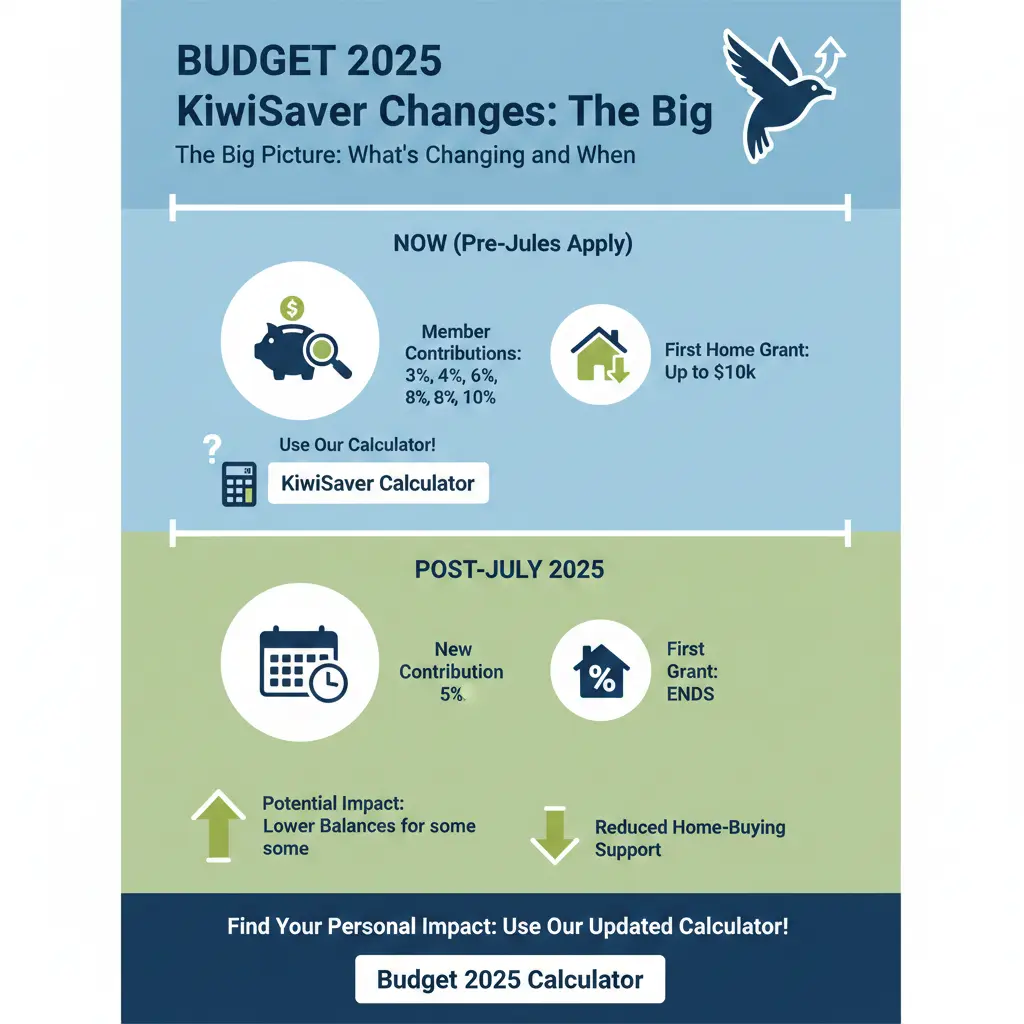
Budget 2025 introduces four major changes to KiwiSaver, phased in over the next couple of years. The most significant shift happens on 1 April 2026, when contribution rates start climbing. Here's the timeline you need to know:
- 1 July 2025: Government contribution halved from 50 cents to 25 cents per dollar (already happened)
- 1 April 2026: Employee and employer contributions increase to 3.5%
- 1 April 2028: Employee and employer contributions increase to 4%
The Government's reasoning? Making KiwiSaver more sustainable while encouraging higher personal savings. But as the Retirement Commissioner noted, not everyone benefits equally from these changes. Low-income earners, Māori, women, and the self-employed are hit hardest by the reduced government contribution.
How the Government Contribution Is Changing
The Reduction: What You're Losing
From 1 July 2025, the government's annual contribution dropped from a maximum of $521.43 to just $260.72. To put this in perspective, if you're currently contributing the minimum $1,042.86 per year to receive the full government match, you're now getting half the government support you used to.
This change affects most KiwiSaver members, but there are two important exceptions:
- High earners (over $180,000 annually): You no longer qualify for any government contribution from 1 July 2025.
- 16 and 17-year-olds: You're now eligible for the government contribution for the first time, which is genuinely good news for young savers starting their KiwiSaver journey.
The Math: What You Actually Need to Contribute
To receive the maximum government contribution of $260.72 in the current year, you'll need to contribute at least $1,042.86 between 1 July 2025 and 30 June 2026. That works out to about $87 per month or roughly 2% of an average NZ salary. If you're earning $60,000 annually, you're probably already hitting this threshold through your regular KiwiSaver contributions.
The Increase: Higher Contribution Rates Coming
How Much More You'll Contribute
If you're currently in KiwiSaver at the default 3% contribution rate, here's what's changing:
| Date | Employee Contribution | Employer Match |
|---|---|---|
| Now until 31 March 2026 | 3% | 3% |
| 1 April 2026 – 31 March 2028 | 3.5% | 3.5% |
| From 1 April 2028 onwards | 4% | 4% |
For someone earning $60,000 annually, this means:
- Current: You contribute $1,800 per year; your employer adds $1,800
- From April 2026: You contribute $2,100 per year; your employer adds $2,100
- From April 2028: You contribute $2,400 per year; your employer adds $2,400
That's an extra $300 per year coming out of your pay from April 2026, and another $300 from April 2028. For many Kiwis, this is noticeable but manageable.
What If You Can't Afford the Increase?
The Government recognizes that higher contributions aren't feasible for everyone. From 1 February 2026, you can apply to Inland Revenue for a temporary contribution rate reduction. This allows you to stay at 3% for up to 12 months, with your employer matching at that rate too.
Here's the clever part: you can reapply every 12 months, and there's no limit on how many times you can take a temporary reduction. So if you're facing financial hardship or want to redirect money elsewhere, you've got flexibility built in. Just remember—you'll need to reapply each year, and you'll default back to the higher rate unless you take action.
Who Benefits Most (And Who Doesn't)
The Winners
These changes are genuinely positive for:
- Salary and wage earners with employer matching: You're getting more money flowing into your account, accelerating your retirement savings growth
- Young people (16–17 years old): You're now eligible for both government contributions and employer matching for the first time, giving you a massive head start on retirement savings
- People planning to buy their first home: Your KiwiSaver balance will grow faster, potentially giving you more cash for a deposit
The Losers
Unfortunately, these changes disproportionately hurt:
- Low-income earners: The halved government contribution means less free money from the Government
- The self-employed: You don't get employer matching at all, so you're only seeing the reduced government contribution
- Women: Research shows women have 25% lower KiwiSaver balances on average than men, and the reduced government contribution widens this gap
- Māori: Lower average incomes mean the government contribution cut hits this community harder
- High earners (over $180,000): You've lost the government contribution entirely
The Retirement Commissioner has flagged these equity concerns, and the Government is reviewing retirement income policies to address them.
What Hasn't Changed
It's worth noting what the Budget didn't touch:
- First home withdrawal rules: You can still use your KiwiSaver to buy your first home
- Retirement withdrawal age: Still 65
- Investment options: No changes to how you can invest your KiwiSaver funds
- Contribution holidays: You can still take a break from contributions if needed
The only real difference is that with higher contribution rates, your balance will grow faster—giving you more cash when you need it for a first home or retirement.
Practical Steps to Take Now
Before 1 April 2026
Check your current contribution rate. Log into your KiwiSaver provider's website (AMP, Westpac, Fisher Funds, etc.) and confirm you're on the 3% default rate. If you've manually set it to something else, you'll need to update it when the changes take effect.
Top up your government contribution before 30 June 2025. If you haven't already, contribute $1,042.86 before the end of June 2025 to get the old, higher government match of $521.43. After 1 July 2025, you'll only get $260.72 for the same contribution.
Budget for the increase. Calculate what the 3.5% contribution will mean for your take-home pay from April 2026. If it's going to be tight, start exploring whether a temporary rate reduction makes sense for you.
From 1 April 2026 Onwards
Decide on your contribution strategy. Will you stick with the new 3.5% rate, or apply for a temporary reduction? There's no right answer—it depends on your financial situation.
Monitor your balance growth. With higher contributions flowing in, your KiwiSaver balance should accelerate. Keep an eye on your annual statements to see the impact.
Review your investment choice. With more money going into your account, it's a good time to check that your investment fund (conservative, balanced, growth, etc.) still matches your risk tolerance and time horizon.
The Bottom Line
Budget 2025's KiwiSaver changes represent a significant shift in how New Zealand supports retirement savings. Higher contribution rates mean faster balance growth for most Kiwis, but the halved government contribution is a real loss—especially for those who can least afford it.
If you're a salaried employee, these changes likely work in your favour. If you're self-employed, low-income, or earning over $180,000, you'll want to carefully consider how this affects your retirement planning. Either way, the key is to stay informed, plan ahead, and use the tools available to you—like the temporary contribution reduction—to manage the changes.
Start by checking your current KiwiSaver balance and contribution rate. Then, decide whether the higher contributions work for your budget. If not, remember that you can apply for a temporary reduction. Finally, keep an eye on your balance growth over the next couple of years—you might be pleasantly surprised by how much faster it accumulates.
For more information, visit retirement.govt.nz or check with your KiwiSaver provider directly. They can answer specific questions about your account and help you make the right choice for your situation.