KiwiSaver Member Tax Credit: How to Maximise Your $521

Imagine unlocking free money from the government to supercharge your retirement savings—up to $260.72 in 2026, simply by contributing enough to your KiwiSaver. While the maximum KiwiSaver Member Tax C...
Sarah covers personal finance, tax, and KiwiSaver topics for Lifetimes NZ. She focuses on making money management straightforward and practical for everyday Kiwis.
Imagine unlocking free money from the government to supercharge your retirement savings—up to $260.72 in 2026, simply by contributing enough to your KiwiSaver. While the maximum KiwiSaver Member Tax Credit has halved from previous years, savvy Kiwis can still maximise every cent of this government top-up alongside the upcoming contribution rate changes. With KiwiSaver defaults rising to 3.5% from April 2026, now's the time to review your strategy and ensure you're not leaving money on the table.
What is the KiwiSaver Member Tax Credit?
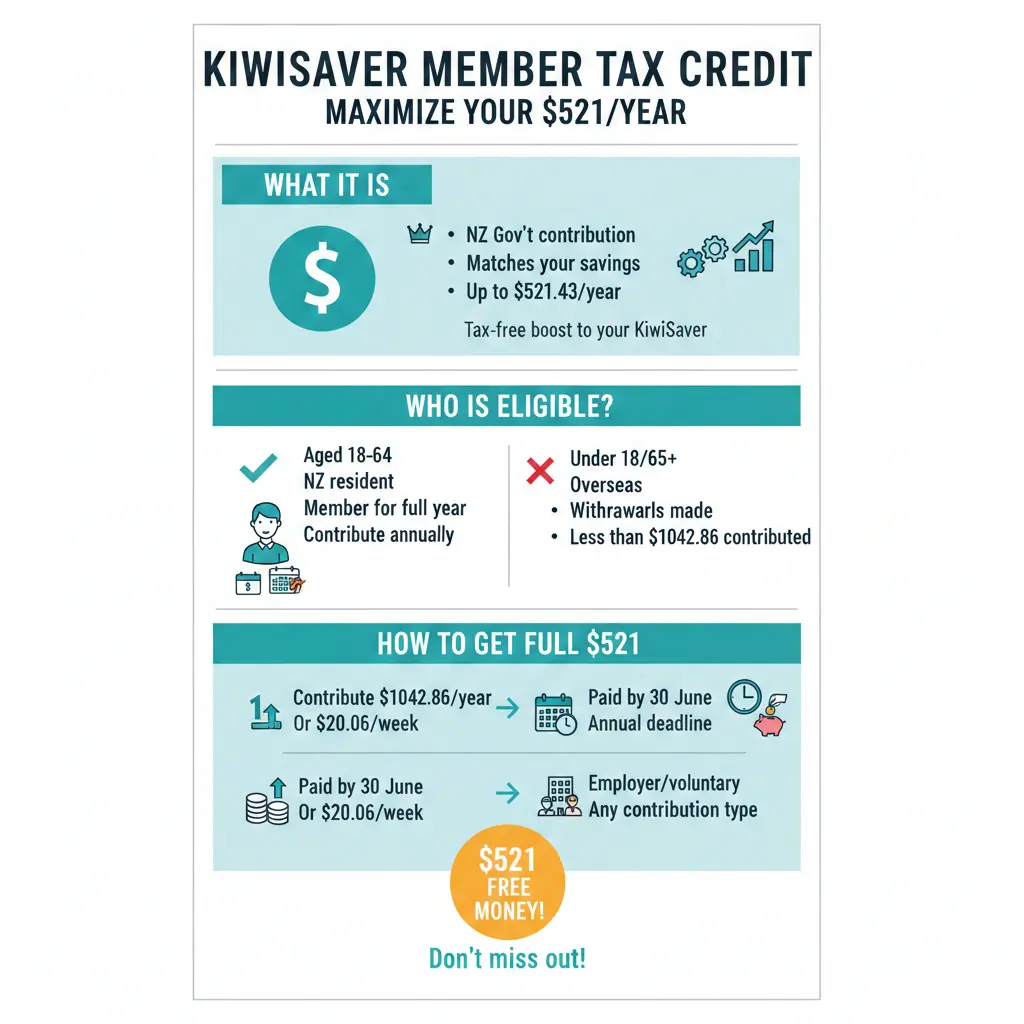
The KiwiSaver Member Tax Credit, often called the government contribution, is a dollar-for-dollar match from Inland Revenue (IRD) on your personal KiwiSaver contributions. It's designed to boost your retirement nest egg, but recent budget changes mean it's no longer the $521 windfall it once was.
From 1 July 2025, the rate dropped from 50 cents to 25 cents per dollar you contribute, capping the annual maximum at $260.72. This requires you to personally contribute at least $1,042.86 over the contribution year (1 July to 30 June) to claim the full amount.
Key Eligibility Rules for 2026
- You must be aged 16 or over—a positive change, as 16- and 17-year-olds are now eligible from 1 July 2025.
- Your taxable income must be $180,000 or under annually; high earners above this threshold get nothing.
- You need to be a New Zealand tax resident.
- No active KiwiSaver savings suspension during the year.
Contributions from your employer or the government don't count toward your personal total—only what comes directly from your pay or after-tax deposits.
How the 2026 Changes Affect Your Member Tax Credit
The 2025 Budget reshaped KiwiSaver incentives, halving the Member Tax Credit to curb costs while introducing phased contribution increases. These shifts make strategic planning essential if you want to maximise your $260.72.
Contribution Rate Hike to 3.5%
From 1 April 2026, the default minimum contribution rate jumps from 3% to 3.5% for both employees and employers. This means more automatic savings flowing into your account, helping you hit that $1,042.86 threshold faster—especially if you're on the median Kiwi wage of around $70,000.
For example:
- On a $70,000 salary at 3.5%, you'd contribute about $42 weekly (pre-tax), totalling roughly $2,184 annually—well over the required $1,042.86.
- Your employer matches at 3.5%, adding another $2,184, but remember, only your share counts for the tax credit.
Temporary Rate Reduction Option
Can't afford the jump? From 1 February 2026, apply via myIR for a temporary reduction to stay at 3% for 3-12 months (renewable). Show your employer the IRD certificate—your rate drops from your first pay on or after 1 April 2026.
Employers can match your reduced 3% rate during this period, but must revert to 3.5% when it ends unless you reapply. This flexibility helps if cashflow is tight, but sticking at 3% might mean slower progress toward the tax credit maximum.
Extension to Younger Workers
16- and 17-year-olds gain compulsory employer contributions from 1 April 2026, plus eligibility for the Member Tax Credit. If you're a parent or young worker, opt into KiwiSaver early to start claiming.
Step-by-Step Guide: How to Maximise Your $260.72
Reaching the full KiwiSaver Member Tax Credit isn't automatic—here's your actionable plan tailored for 2026.
Step 1: Check Your Current Contribution Rate
Log into your KiwiSaver provider's portal or myIR to confirm your rate. If below 3%, bump it up now via a KS2 form to your employer. Aim for at least 3.5% from April to hit the threshold effortlessly.
Step 2: Calculate Your Personal Contributions
Use IRD's KiwiSaver calculator or this simple formula: To get $260.72, contribute $1,042.86 personally from 1 July 2025 to 30 June 2026. Track via payslips—after-tax lump sums count too.
| Salary | 3.5% Annual Personal Contribution | Qualifies for Full Credit? |
|---|---|---|
| $50,000 | $1,750 | Yes |
| $70,000 | $2,450 | Yes |
| $30,000 (part-time) | $1,050 | Yes (just) |
| $25,000 | $875 | No—increase rate or add lump sum |
Step 3: Make Lump Sum Contributions if Needed
Short on salary contributions? Deposit after-tax cash directly (up to $1,042.86). For instance, a $500 top-up in June 2026 could unlock an extra $125 credit. Providers like ANZ or ASB make this easy online.
Step 4: Apply for the Credit Automatically
IRD pays it automatically into your KiwiSaver by late September 2026 if eligible—no separate claim needed. Check your IRD account post-30 June to confirm contributions logged correctly.
Step 5: Review Employer Matching
Ask your boss about contributions above 3.5%—many Kiwi employers offer 4-6% voluntarily, accelerating growth without affecting your tax credit eligibility.
Practical Tips to Stretch Your KiwiSaver Further
- Automate everything: Set-and-forget 4-8% rates to exceed the minimum and build compound interest magic.
- Tax advantages: Employer contributions are tax-free; your contributions get PIE tax credits at your PIR (10.5-39%).
- First Home Withdrawal: If saving for a house, the tax credit stays in your account unless withdrawn under KiwiSaver rules.
- Multiple Jobs: Consolidate contributions across providers to one account for easier tracking.
- Hardship? Pause Wisely: Suspensions halt credits—use temporary reductions instead.
"The extra half-percent from April 2026 adds up over time, making the Member Tax Credit even more valuable as a boost."
Common Mistakes to Avoid
- Assuming employer contributions count toward your $1,042.86—they don't.
- Forgetting the 30 June deadline—late contributions miss the year.
- Ignoring high-income cuts—if over $180k, focus on personal contributions instead.
- Not applying for rate reductions early—beat the 1 February rush.
Next Steps to Maximise Your KiwiSaver Today
Don't wait for April's changes—log into myIR now to check your rate, calculate contributions, and apply for reductions if needed from 1 February 2026. Chat with your KiwiSaver provider or a financial adviser for personalised tweaks. Small adjustments today compound into serious retirement security tomorrow.
Disclaimer: This is general information only. Tax and KiwiSaver rules are complex—consult a licensed financial adviser or IRD for advice specific to your situation. Rates and rules current as of 2026.
Frequently Asked Questions
Sources & References
-
1
Key KiwiSaver changes you need to know for 2026 — www.generatewealth.co.nz
-
2
KiwiSaver 1 April 2026 Changes - NZQBA — www.nzqba.co.nz
-
3
KiwiSaver updates affecting employees & employers - Citation Group — citationgroup.co.nz
-
4
Upcoming KiwiSaver changes - Business.govt.nz — www.business.govt.nz
-
5
Changes to the KiwiSaver contribution rate - Inland Revenue — www.ird.govt.nz
-
6
New year, new KiwiSaver rules, same you | Deloitte New Zealand — www.deloitte.com
-
7
KiwiSaver benefits - Inland Revenue — www.ird.govt.nz
Related Articles

Industry Bodies and Professional Associations NZ
Whether you're launching a business, advancing your career, or navigating financial regulations, industry bodies and professional associations in New Zealand offer invaluable support. These organisati...

Emergency Benefit NZ: When You Have No Other Options
When you're struggling financially and don't qualify for other benefits, the Emergency Benefit might be your lifeline. It's a discretionary payment designed for Kiwis in genuine hardship who've exhaus...

Unpaid Internships NZ: Are They Legal?
Unpaid internships are a common pathway for students and graduates to gain work experience in New Zealand, but there's often confusion about whether they're actually legal. The short answer is: unpaid...

Estate Administration NZ: Managing Someone's Affairs After Death
Losing a loved one is one of life's toughest challenges, and stepping in to manage their estate can feel overwhelming. In New Zealand, estate administration—the process of handling someone's affairs a...