Working for Families: Complete Eligibility & Payment Guide

Struggling to make ends meet while raising kids in Aotearoa? You're not alone—many Kiwi families rely on Working for Families NZ to ease the financial pinch of childcare, school costs, and everyday es...
The Lifetimes NZ editorial team curates, fact-checks, and updates guides on personal finance, property, health, immigration, legal, business, and lifestyle topics relevant to Lifetimes NZ readers. Articles are produced with AI assistance and reviewed by the editorial team before publication.
Struggling to make ends meet while raising kids in Aotearoa? You're not alone—many Kiwi families rely on Working for Families NZ to ease the financial pinch of childcare, school costs, and everyday essentials. This government scheme delivers tax credits straight into your pocket, helping you balance work and whānau life without the stress.
In 2026, with living costs climbing, Working for Families remains a lifeline for eligible parents and caregivers. Whether you're a solo mum in Auckland juggling two jobs or a couple in Christchurch supporting three tamariki, understanding eligibility and payments can unlock hundreds or even thousands of dollars yearly. Let's break it down step by step, so you can check if you qualify and get your application sorted today.
What is Working for Families NZ?
Working for Families is a package of tax credits and payments from Inland Revenue (IRD) designed to support families with the rising costs of raising children. It helps make work pay by topping up your income, especially if you're earning modest wages.
Administered jointly by IRD and Work and Income, the scheme ensures families don't fall through the cracks. You won't get it if you're on a main benefit from Work and Income, but it's perfect for working whānau or those with mixed income sources.
Payments are usually made weekly or fortnightly through your pay, or as a lump sum at tax time—your choice. In 2026, expect rates adjusted for inflation, with key thresholds like family income limits updated annually.
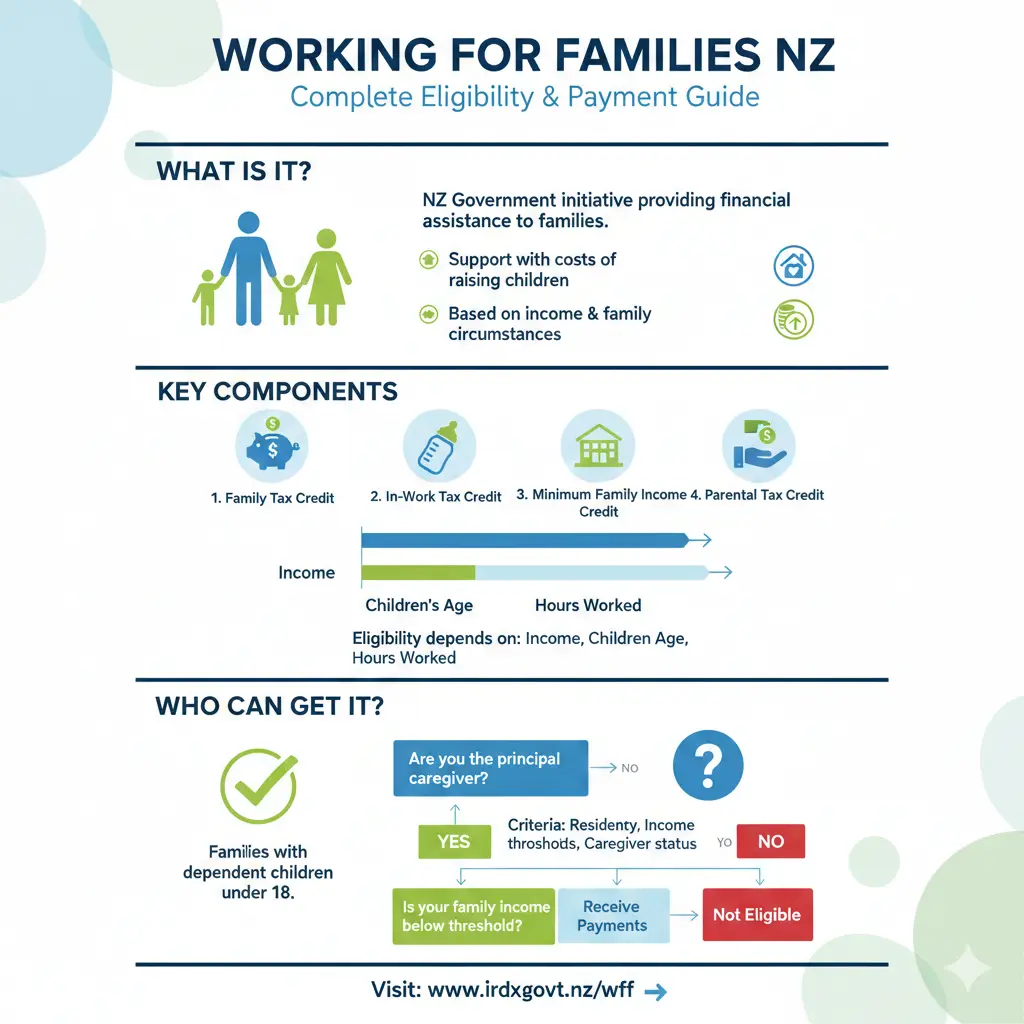
Who Qualifies for Working for Families?
To access Working for Families NZ, you must tick these boxes:
- Be aged 16 years or older.
- Be the principal caregiver for at least one dependent child.
- Meet NZ residency requirements—typically a New Zealand tax resident living here, or caring for NZ citizen/resident kids.
- Care for the child more than temporarily (at least one-third of a four-month period if sharing care).
- Not receive a main benefit from Work and Income.
What's a Dependent Child?
A dependent child is:
- Aged 15 or under, or
- Aged 16-17 and financially dependent on you, or
- Aged 18, financially dependent, and in school or tertiary study (not married or in a relationship).
Separated parents: If you have your kids for at least 84 days (one-third) in a 126-day period, you may qualify.
Income and Work Rules
Eligibility hinges on your annual family income (combined before-tax earnings from you and your partner). Higher earners get less or nothing, but there's no hard cutoff—payments phase out gradually.
- Best Start: No income limit in year one.
- Other credits: Reduce above $42,700-$120,500 depending on kids and credit type.
Solo parents on benefits? You might get some components alongside income-tested support—check with IRD.
Types of Working for Families Payments
Working for Families NZ includes four main tax credits, each with unique rules. Here's the 2026 breakdown:
Family Tax Credit (FTC)
Base payment for every dependent child, regardless if you're working. Weekly rates (approximate, based on income):
| Family Income (before tax) | 1 Child | 2 Children | 3+ Children |
|---|---|---|---|
| Up to $42,700 | $144/wk | $288/wk | $432+/wk |
| Over $120,500 | Phases to $0 | Phases to $0 | Phases to $0 |
Paid weekly; abates 27c per $1 over thresholds.
In-Work Tax Credit (IWTC)
For working families only. Requires minimum hours: solo parent 20/wk, couple 30/wk combined.
- $72/wk base + $15/child over first (max $125/wk for 3+ kids).
- Abates above $42,700 family income.
Minimum Family Tax Credit (MFTC)
Guarantees minimum after-tax income for low-wage workers: $679/wk ($35,316/yr after tax) from 31 July 2024 rates (2026 similar, indexed).
- Single: 20+ hrs/wk.
- Couple: 30+ hrs/wk combined.
- Income under $41,483 before tax.
Best Start Tax Credit (BSTC)
For newborns:
- Year 1: $73/wk per child (no income limit).
- Years 2-3: $147/wk if income under $79,000; abates after.
- Need IRD number for child; principal caregiver.
Pro tip: Use IRD's calculator for your exact entitlement—it's free and quick.
How to Apply for Working for Families
- Get your IRD numbers sorted for you and each child.
- Log into myIR or use the Working for Families application form.
- Enter income details, family size, and care arrangements.
- Choose payment method: weekly via PAYE, lump sum, or direct credit.
- Update changes (new baby, job loss, separation) within a month to avoid over/underpayments.
Applying takes 20 minutes online. Retro payments available for past years if eligible. Struggling? Free advice from IRD (0800 227 773) or community law centres.
Practical Tips to Maximise Your Working for Families
- Track family income accurately—include partner's earnings, even if separated.
- Combine with other support: Childcare subsidies via Work and Income if under minimum wage thresholds.
- Watch abatement rates: Small pay rises can reduce payments—use the IRD chart.
- Reapply if circumstances change, like a child turning 16 but staying in school.
- Accountant help: For complex situations (shared care, high income), pros can spot extras worth thousands.
Example: Sarah, a Hamilton solo parent earning $50,000 with two kids (5 and 8), gets ~$5,000/yr FTC + IWTC. A small side hustle pushed her over, but recalculating saved her claim.
Next Steps to Secure Your Working for Families Support
Don't leave money on the table—head to ird.govt.nz/working-for-families now. Use the entitlement calculator, apply via myIR, and set reminders for updates. If self-employed or with variable income, chat to an accountant for tailored advice. Your whānau deserves this boost—kiwi families have claimed over $2 billion annually in recent years. Get started today and breathe easier tomorrow.
Frequently Asked Questions
Sources & References
- 1
-
2
Can you get Working for Families? - Inland Revenue — www.ird.govt.nz
- 3
-
4
Working for Families - Inland Revenue — www.ird.govt.nz
-
5
Working for Families - Bountiful NZ — bountifulpacks.co.nz
-
6
Working for Families Tax Credits - National Accountants — www.nationalaccountants.co.nz
-
7
Working for Families weekly payments [PDF] - Inland Revenue — www.ird.govt.nz
-
8
Working for Families - Work and Income — www.workandincome.govt.nz