Studying Part-Time While Working: A Kiwi's Guide

Balancing a full-time job with part-time study is a smart move for many Kiwis looking to boost their career without hitting pause on life. Whether you're eyeing a promotion, switching fields, or just...
The Lifetimes NZ editorial team curates, fact-checks, and updates guides on personal finance, property, health, immigration, legal, business, and lifestyle topics relevant to Lifetimes NZ readers. Articles are produced with AI assistance and reviewed by the editorial team before publication.
Balancing a full-time job with part-time study is a smart move for many Kiwis looking to boost their career without hitting pause on life. Whether you're eyeing a promotion, switching fields, or just keen to learn something new, part-time tertiary education in New Zealand offers flexible paths tailored to working professionals.
With rising living costs and the job market demanding upskilling, more Kiwis are turning to part-time study. In 2026, options abound from universities to polytechnics and online providers, all designed to fit around your 9-to-5. This guide breaks down everything you need to know, from choosing courses to managing your time and money.
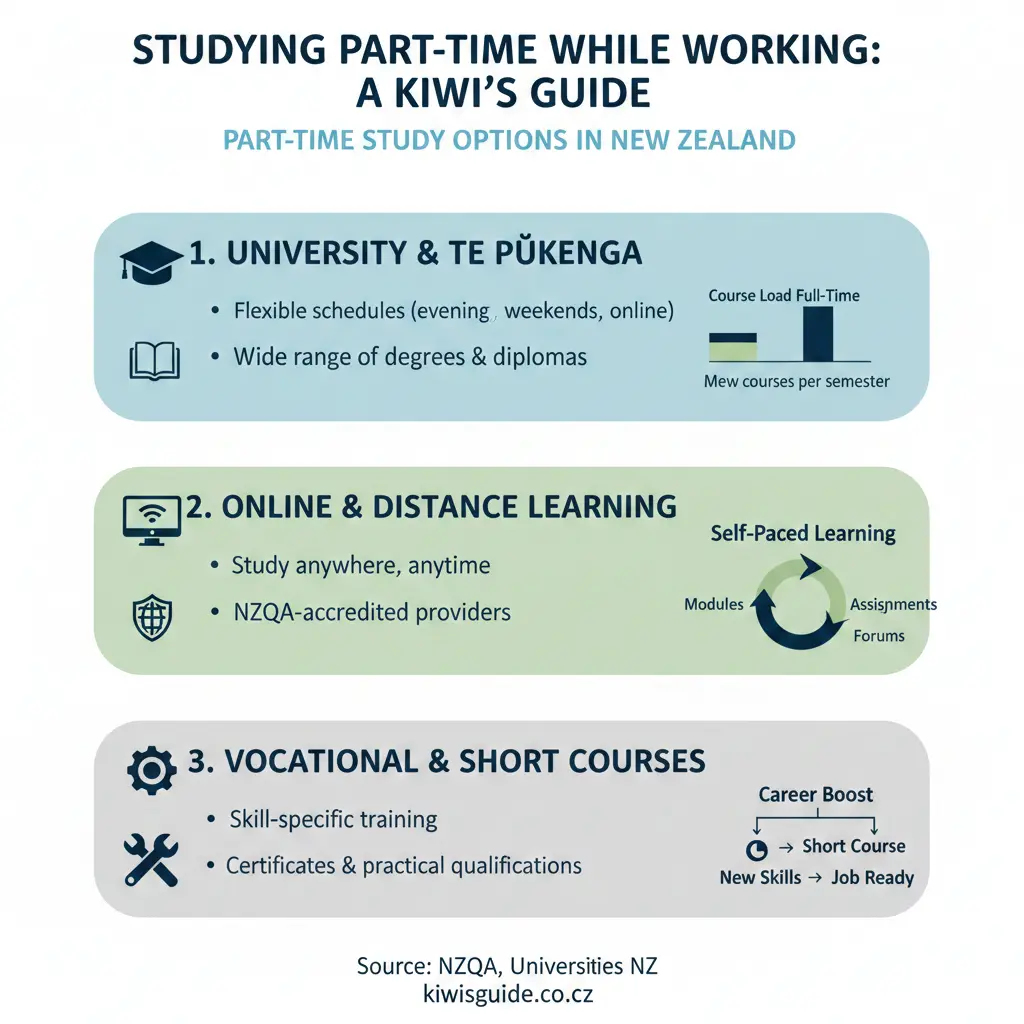
Part-Time Study Options in New Zealand
New Zealand's tertiary sector is packed with flexible programmes perfect for workers. You can study at Level 4 or higher on the New Zealand Qualifications Framework (NZQF), from certificates to degrees, all while keeping your job.
Universities and Universities of Technology
Institutions like the University of Auckland, Massey University, and AUT offer part-time bachelor's and postgraduate degrees. For example, Massey's online Bachelor of Business fits around shift work, with modules delivered via their Stream platform. Many unis now provide micro-credentials—short, stackable courses worth credits towards full qualifications.
Polytechnics such as Ara Institute of Canterbury and WelTec specialise in practical, vocational training. Ara's part-time Diploma in Construction Management lets you study one course at a time, ideal for tradespeople.
Private Training Establishments (PTEs) and Online Providers
PTEs like Yoobee Colleges and Open Polytechnic deliver niche courses in IT, design, and health. Open Polytechnic is a standout for distance learning, with no on-campus requirements—perfect if you're in rural NZ or juggling family.
In 2026, expect more hybrid models blending online lectures with occasional workshops. Fees for part-time enrolment typically range from $5,000–$8,000 per year for domestic students, depending on the level.
Time Management: Juggling Work, Study, and Life
Mastering your schedule is key to thriving, not just surviving. Here's how Kiwis make it work.
Creating a Realistic Schedule
- Assess your commitments: Track a week's routine using apps like Google Calendar or Notion to spot study slots.
- Block time wisely: Dedicate evenings or weekends to readings and assignments—aim for 10–15 hours weekly for a standard part-time load.
- Use the 52/17 rule: Study in 52-minute bursts followed by 17-minute breaks to stay sharp.
Tools and Techniques for Busy Kiwis
Leverage Kiwi-friendly apps: StudyLink's student portal for deadlines, or Forest app to curb distractions. Join study groups via university forums or Facebook groups like "Part-Time Students NZ" for motivation.
Pro tip: Align study with work rhythms. If you're in retail, tackle heavy assignments during quieter winter months.
Getting Employer Support
Many Kiwi employers encourage upskilling, especially with skills shortages in IT, healthcare, and engineering. Here's how to secure backing.
Discussing Study with Your Boss
Approach conversations positively: "This qualification will help me contribute more to the team." Highlight benefits like improved productivity—stats show trained staff boost output by 20%.
Study Leave and Fees Assistance
Under the Holidays Act 2003, you're entitled to paid study leave if your employment agreement includes it. Larger firms like Fonterra or Spark offer KiwiSaver-matched study grants up to $2,000 annually.
Check your contract for professional development clauses. Unions like E tū can negotiate study support in collective agreements.
| Employer Perk | Example Companies | Typical Support |
|---|---|---|
| Fee reimbursement | Spark, Air NZ | Up to 100% for job-related courses |
| Flexible hours | Fisher & Paykel, KiwiBank | ROTW (results-oriented time work) |
| Study leave | Public sector (IRD, MBIE) | 5–10 days paid annually |
Financial Considerations: Funding Your Part-Time Study
Don't let costs hold you back—plenty of support exists for domestic Kiwis studying part-time.
Fees-Free and Student Loans
The Fees-Free policy covers your first year of tertiary study if eligible—worth up to $12,000 in 2026. Apply via feesfree.govt.nz before enrolment.
StudyLink offers interest-free loans for fees and living costs, repayable via payroll once earning over $24,128 (2026 threshold). Part-time students qualify if enrolled in 0.25 EFTS (equivalent full-time student) or more.
KiwiSaver Withdrawals and Scholarships
Withdraw from KiwiSaver for first-home buyers or study under strict rules—up to $10,000 for fees if you're over 18 and in approved programmes.
Scholarships abound: Universities NZ awards $5–10 million yearly, plus employer-specific ones. WINZ's Training Incentive Allowance supports sole parents on benefits.
- Part-time loan example: A Level 6 diploma at $6,500/year—borrow fees, repay $50 fortnightly post-graduation.
Work Rights for International Students Studying Part-Time
If you're an international Kiwi-in-the-making on a student visa, 2026 rules allow up to 25 hours per week during term time for Level 4+ courses—a jump from 20 hours since November 2025. Full-time work remains during holidays. Apply for visa variations via Immigration NZ if needed (NZD 325 fee). Secondary students (Years 12–13) need parental/school approval.
This flexibility helps cover costs while gaining NZ work experience, but prioritise studies to maintain visa compliance.
Health and Wellbeing: Avoiding Burnout
Part-time study amps up stress—protect your wellbeing.
- Exercise: 30 minutes daily walks in our beautiful parks.
- Sleep: Aim for 7 hours; use ACC's mental health resources if needed.
- Support: Free counselling via Student Services or Lifeline (0800 543 354).
Next Steps to Get Started
- Identify your goals: Career switch or upskill? Browse studywithnewzealand.govt.nz.
- Research providers: Contact 2–3 for info sessions.
- Check funding: Apply for Fees-Free or StudyLink loan early.
- Talk to your employer: Pitch the benefits.
- Enrol: Deadlines for Semester 1 (Feb 2026) approaching—act now!
Part-time study is your ticket to a brighter future without sacrificing today. Thousands of Kiwis do it successfully every year—now it's your turn.
Frequently Asked Questions
Sources & References
-
1
New Zealand raises student work limit to 25 hours a week — indiatoday.in — www.indiatoday.in
-
2
StudyLink Official Website — studylink.govt.nz — www.studylink.govt.nz
-
3
IRD KiwiSaver Withdrawals — ird.govt.nz — www.ird.govt.nz
-
4
Upcoming changes to student visa work rights — immigration.govt.nz — www.immigration.govt.nz
-
5
New Zealand Extends International Student Work Hours — y-axis.com — www.y-axis.com
- 6
- 7
-
8
Stats NZ Tertiary Education Statistics — stats.govt.nz — www.stats.govt.nz
Useful Tools
Related Articles

The 2026 Student Loan Guide: Repayments; Interest; and Strategies
Heading into 2026, many Kiwis are navigating their student loans with repayments kicking in at just $24,128 a year and interest at 4.9%—but smart strategies can make all the difference in paying it of...

The Ultimate Word Counter for NZ Students and Writers
Ever stared at your screen at 2am, racing to finish that uni essay, only to realise you've smashed past the word limit by 500 words? Or worse, come up short and need to pad it out without sounding flu...

Scholarships & Financial Aid for Tertiary Study in NZ
Pursuing tertiary education in New Zealand doesn't have to drain your bank account. Whether you're a school leaver, career changer, or postgraduate student, there's a surprising range of scholarships...

Student Loans Explained: How the NZ System Works
If you're heading to university, polytechnic, or another tertiary education provider in Aotearoa, you've probably heard about student loans. They're one of the main ways Kiwis fund their studies, but...