Post-Study Work Rights in New Zealand

If you're an international graduate looking to stay and work in New Zealand, you've got genuine opportunities to build your career here. The Post-Study Work Visa (PSWV) is your main pathway, offering...
Priya writes about immigration pathways, job searching, and building a career in New Zealand. She covers visa options, CV writing, interview preparation, and workplace culture for newcomers and locals alike.
If you're an international graduate looking to stay and work in New Zealand, you've got genuine opportunities to build your career here. The Post-Study Work Visa (PSWV) is your main pathway, offering up to three years of work rights depending on your qualification. Whether you've just finished your degree or you're planning your study abroad adventure, understanding how these visas work—and how they can lead to permanent residence—is crucial for your future in Aotearoa.
What is the Post-Study Work Visa?
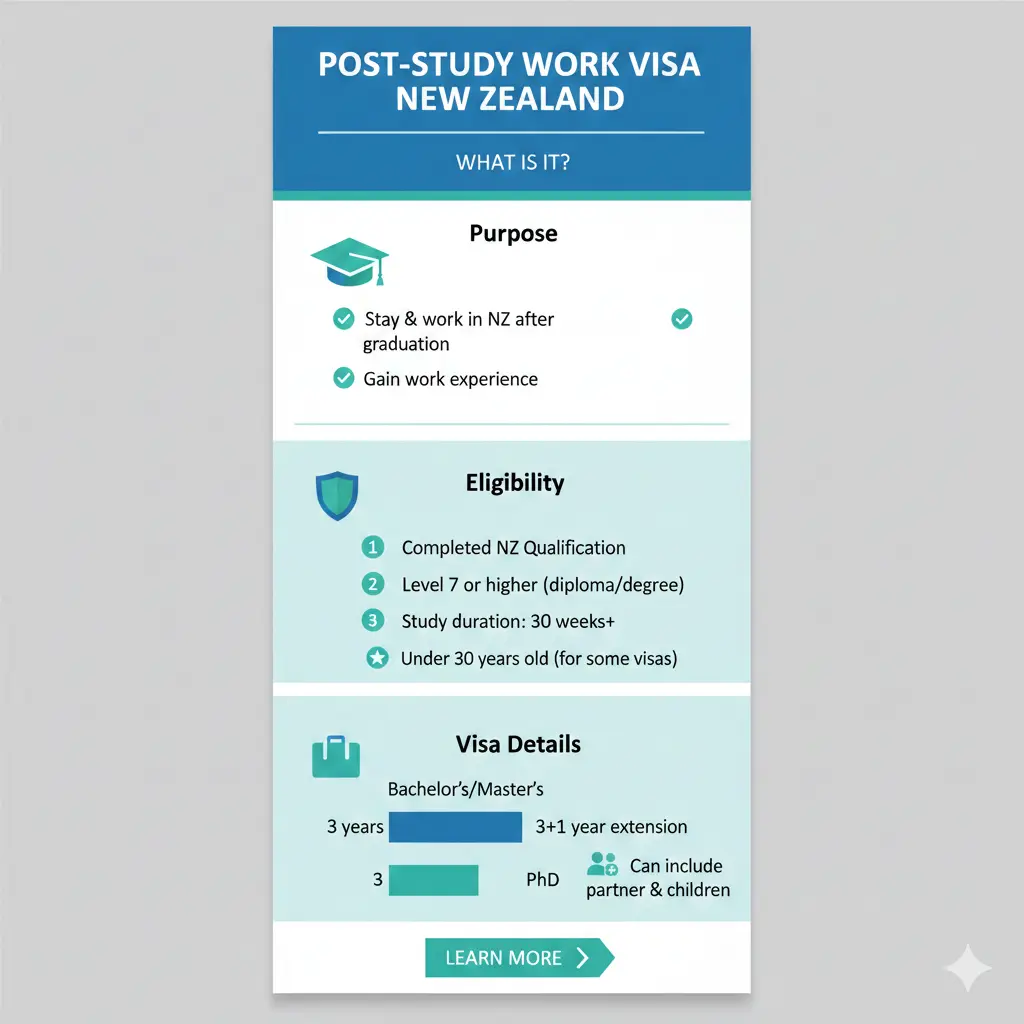
The Post-Study Work Visa allows international graduates to stay and work in New Zealand after completing their studies. It's designed to give you practical experience in the Kiwi job market and help bridge the gap between student life and permanent residence. The visa is administered by Immigration New Zealand and offers genuine flexibility for those who've invested time studying here.
The key appeal? If you've completed a Bachelor's degree or higher qualification, you can work for any employer and do almost any sort of work—there are no field restrictions or sector requirements. This open-ended approach is one of the reasons New Zealand stands out as an attractive destination for international students.
Eligibility Requirements for the Post-Study Work Visa
For Bachelor's Degrees and Higher
To qualify for a Post-Study Work Visa with full work rights, you'll need to meet these requirements:
- Complete a qualification at degree level 7 or above (Bachelor's, Master's, or PhD)
- Study for at least 30 weeks of full-time study in New Zealand
- Complete your qualification at a New Zealand institution on Immigration New Zealand's approved list
- Have physically studied in the country (online-only study doesn't count)
Meeting these requirements gives you the golden ticket: you can work for any employer in any role, with no restrictions tied to your field of study.
For Non-Bachelor Qualifications
If you've completed a qualification below degree level (like diplomas or certificates), the rules are stricter:
- You must complete the whole qualification in New Zealand
- Your qualification must be listed on Immigration New Zealand's eligible qualifications list
- You'll only be able to work in a role directly linked to your qualification
- Your visa length equals the time you spent studying (confirmed by your education provider)
This means if you've studied for a one-year diploma, you'd get one year of work rights—but only in roles related to that qualification.
Special Circumstances
There's a helpful provision if you've stacked qualifications: if you complete an eligible qualification and then immediately achieve a higher-level qualification in less than 30 weeks, you can apply for the PSWV based on your first qualification. You'll need to do this within 12 months of your student visa expiring for that first qualification.
How Long Can You Stay and Work?
The length of your Post-Study Work Visa depends entirely on what you've studied:
- Master's or PhD graduates: Up to 3 years of work rights
- Bachelor's degree graduates: Up to 3 years of work rights
- Qualifications at level 8 or below: A visa period equal to the time you spent studying
This means a Master's graduate could theoretically work in New Zealand for three years after finishing their studies, giving them genuine time to establish themselves professionally and explore whether they want to pursue permanent residence.
Student Work Rights While You're Still Studying
Before you even graduate, New Zealand's updated student visa rules (effective from November 3, 2025) give you more flexibility to work and earn:
- You can now work up to 25 hours per week during the academic semester (increased from 20 hours)
- You can work full-time during scheduled breaks
- These rights apply to all tertiary students and secondary students in years 12 and 13
- For secondary school students, parental and school permission is still required
For secondary school students in years 12 and 13, the 25-hour limit requires parental and school permission, but the expanded hours give you genuine opportunity to support yourself while studying. If you're on an approved exchange or study abroad programme, you're now eligible for these in-study work rights even if you're only doing a one-semester course.
Transitioning to Permanent Residence
The Post-Study Work Visa is often a stepping stone to permanent residence, but there's an important strategic consideration. If you're working in a Green-List occupation (roles in high demand like nursing, engineering, or skilled trades), you should think carefully about which visa pathway to take.
Here's the catch: if you hold a Post-Study Work Visa while working in a Green-List role, the time you spend in that role won't count towards a Work to Residence Visa application. This means you might be better off skipping the PSWV and going straight to an Accredited Employer Work Visa if your employer is willing to sponsor you.
Why? Because time worked on an Accredited Employer Work Visa does count towards residence eligibility, giving you a clearer pathway to becoming a permanent resident. If your employer is accredited under the new scheme, working for them on an employer-sponsored visa gives you a direct route to residence rather than a three-year detour on a PSWV.
What About Your Family?
If you're bringing dependants to New Zealand while you study or work, there are options available. Dependent child visitor visa holders now have expanded work rights—they can work up to 25 hours per week if their visa allows part-time employment. Partners and dependent children can be included in your visa application, though their specific rights depend on their visa type.
The Bigger Picture: New Zealand's International Education Strategy
New Zealand is actively working to make itself more attractive to international students and graduates. The increased student work hours and expanded Post-Study Work Visa options are part of the government's International Education Growth Plan. Further changes are being explored, including a short-term work visa specifically for vocational graduates, which could open new pathways for technical qualifications.
Currently, New Zealand has around 40,987 student visa holders with in-study work rights, and nearly 30,000 of those visas will expire by March 2026. This suggests a significant cohort of graduates will be transitioning to post-study work visas in the coming months.
How to Apply for Your Post-Study Work Visa
The application process is straightforward:
- Check you meet the eligibility requirements on the Immigration New Zealand website
- Gather your documentation (qualification certificate, proof of study duration, passport)
- Apply online through Immigration New Zealand
- Pay the application fee (costs vary depending on your circumstances)
- Wait for processing (timeframes are published on the immigration website)
You can apply for your Post-Study Work Visa while you're still studying or after you've finished—just make sure you apply before your student visa expires.
Your Next Steps
If you're currently studying in New Zealand, start thinking now about your post-study plans. Check whether your qualification meets the eligibility requirements, and consider your long-term goals—do you want to stay for three years and then move on, or are you interested in building a permanent life here?
If permanent residence is your goal, have a conversation with your employer (or potential employers) about visa sponsorship options. The strategic choice between a Post-Study Work Visa and an Accredited Employer Work Visa could significantly impact your pathway to residence.
Head to Immigration New Zealand's website for the most current information, and don't hesitate to contact an immigration adviser if you need personalised guidance. Your qualification is your ticket to staying and working in Aotearoa—make sure you use it strategically.
Frequently Asked Questions
Sources & References
-
1
Post-Study Work Rights 2026: Best Countries for International Graduates — www.openvisa.org
- 2
-
3
Changes to Post-Study Work Visa — www.tompkinswake.com
-
4
Staying to work after finishing your study — www.immigration.govt.nz
- 5
-
6
Post Study Work Visa — immigration.govt.nz
Related Articles

Points Calculator for Skilled Migration to NZ
Ever wondered if your skills could earn you a spot in Aotearoa? The Points Calculator for Skilled Migration to NZ is your first step towards turning that dream into reality, helping skilled workers li...

Culture Shock: 10 Things Nobody Tells You About Moving to NZ
Imagine stepping off the plane at Auckland Airport, buzzing with excitement about your new life in Aotearoa—only to be blindsided by a gale-force wind that nearly sweeps you off your feet. Or discover...

The Skilled Migrant Category: How to Score Enough Points in 2026
Imagine landing a job in New Zealand that not only matches your skills but fast-tracks you to residency. That's the promise of the Skilled Migrant Category (SMC) Resident Visa in 2026, where scoring a...

Moving to NZ in 2026: The Complete Relocation Guide
Planning your move to New Zealand in 2026? Whether you're chasing career opportunities, a lifestyle upgrade, or simply the chance to call Aotearoa home, this guide covers everything you need to know f...