Moving to NZ in 2026: The Complete Relocation Guide

Planning your move to New Zealand in 2026? Whether you're chasing career opportunities, a lifestyle upgrade, or simply the chance to call Aotearoa home, this guide covers everything you need to know f...
Priya writes about immigration pathways, job searching, and building a career in New Zealand. She covers visa options, CV writing, interview preparation, and workplace culture for newcomers and locals alike.
Planning your move to New Zealand in 2026? Whether you're chasing career opportunities, a lifestyle upgrade, or simply the chance to call Aotearoa home, this guide covers everything you need to know for a smooth relocation. With major visa updates, wage changes, and streamlined processes on the horizon, 2026 is an exciting time to make the move—we've got the latest details to help you succeed.
Understanding New Zealand's Immigration Landscape in 2026
New Zealand's immigration system is evolving to attract skilled workers who can fill key roles in our economy. Immigration New Zealand (INZ) has introduced significant changes, including expansions to the National Occupation List (NOL) and updates to median wage requirements, making it easier for qualified migrants to settle here.
Key Visa Changes Effective in 2026
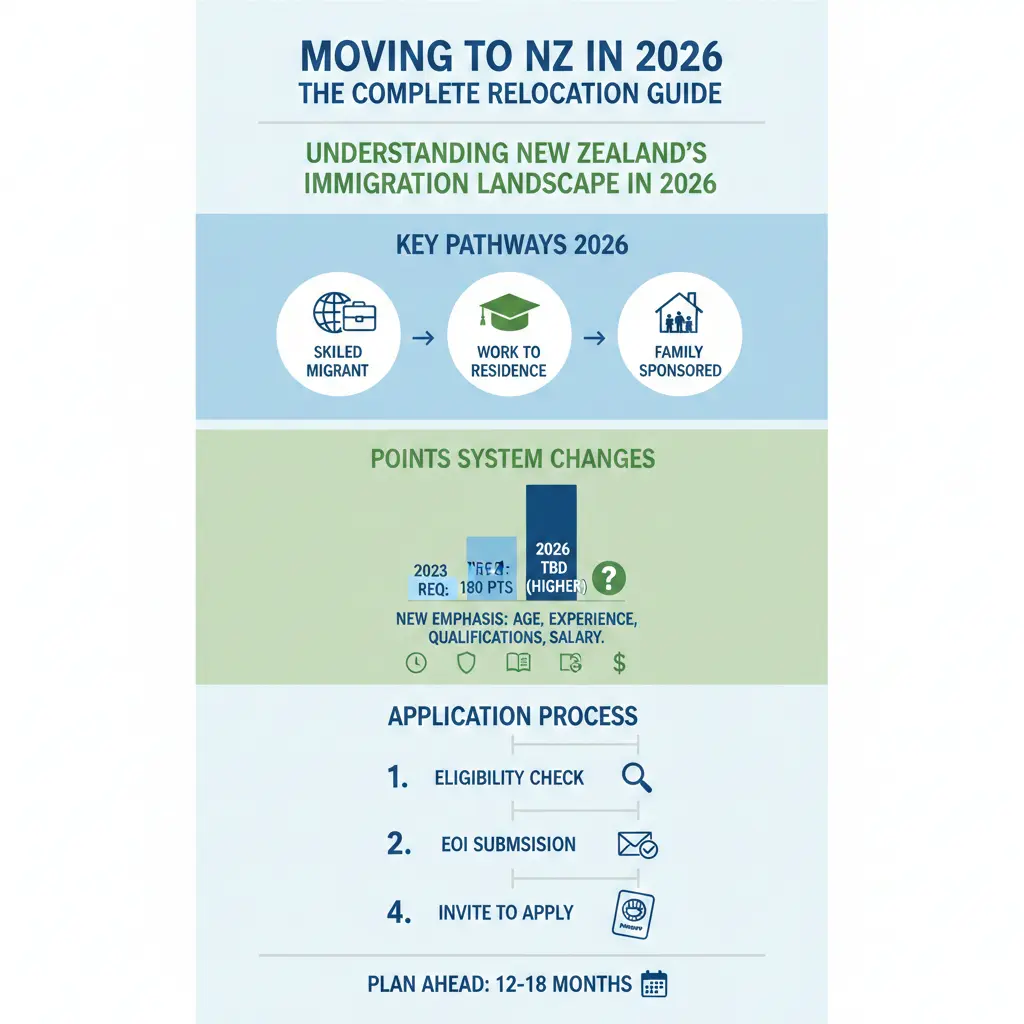
From March 9, 2026, the NOL replaces the old ANZSCO system, adding 47 new skill level 1–3 occupations for Accredited Employer Work Visas (AEWV). This better matches our modern job market, covering roles from tech specialists to healthcare pros. The immigration median wage rises to NZD $35.00 per hour on the same date, affecting visa eligibility, family support, and residency paths. Roles like pet groomers, nannies, and kennel hands shift to skill level 4, requiring stronger English skills and MSD checks for new applicants.
By August 2026, the Skilled Migrant Category Resident Visa gets a revamp with two new pathways: Skilled Work Experience (for ANZSCO levels 1–3, needing 5 years' experience including 2 in NZ at 1.1x median wage) and Trades & Technician (level 4+ quals, 4+ years post-qual experience including 18 months in NZ at median wage). Points now favour NZ qualifications, and wage proof simplifies—no need for hikes at application time.
Popular Visa Options for Moving to NZ in 2026
Choosing the right visa depends on your skills, experience, and goals. Here's a breakdown of the main pathways.
Accredited Employer Work Visa (AEWV)
The AEWV is your entry point if you have a job offer from an accredited employer. They must prove no Kiwi or resident fits the role, often via Work and Income engagement—INZ checks this rigorously, with 15% of employers recently falling short. Minimum wage hits NZD $23.95/hour from April 1, 2026. For longer stays (up to 5 years in lower-skilled roles), aim for 1.5x median ($52.50/hr); twice median ($70/hr) skips advertising.
- Requirements: Job offer, health/character checks, English proficiency for some roles.
- Processing: Faster in 2026 thanks to INZ upgrades.
- Tip: Ensure your employer is accredited—check via INZ tools.
Skilled Migrant Category Resident Visa
For permanent settlement, this points-based visa targets those 55 or under with skills NZ needs. Submit an Expression of Interest (EOI) for NZD $590; top scorers get an Invitation to Apply (ITA), then pay NZD $4,890 for the full app. Claim points from quals (e.g., PhD), income, or NZ work—new 6-point system simplifies it.
- Need a skilled job offer or current employment.
- English: IELTS 6.5 overall (no band <6), waivable for UK PhDs.
- Police clearance from passport office, medicals, good character.
Other Pathways: Green List and Straight to Residence
Green List roles offer fast-track residency; many now tie to the $35/hr median. Straight to Residence suits Tier 1 Green List jobs, leading to citizenship after 5 years. Working Holiday Visas remain for under-35s from eligible countries—perfect for testing the waters.
Step-by-Step Relocation Process
Here's your actionable roadmap to get settled by 2026.
Step 1: Assess Eligibility and Secure a Job
Use INZ's points calculator and NOL checker. Target in-demand roles via Seek.co.nz or Trade Me Jobs. Network on LinkedIn—many Kiwis help migrants connect.
Step 2: Gather Documents and Apply
- Passport, birth certs, quals, references.
- Police clearances (passport-issued, from countries lived 5+ years).
- Medicals via approved panels.
- English proof (or waiver).
- Proof of funds—enough to support yourself.
Submit EOI or work visa app online. Expect quicker processing, but double-check employer compliance.
Step 3: Plan Your Move Logistics
Book flights early— Auckland, Wellington, Christchurch are main hubs. Shipping? Use NZ Post or movers like Crown Relocations. Pets need MAF biosecurity approval. Budget NZD $5,000–10,000 for initial setup, including bond for rental (4 weeks' rent max in most cities).
Step 4: Settle In—Essentials on Arrival
- IRD Number: Get instantly online for tax—essential for work.
- Bank Account: ANZ, BNZ, or Kiwibank; bring ID.
- Phone/Internet: Spark or Vodafone SIMs from airport.
- Healthcare: Free GP visits first year? No—get medical insurance; ACC covers work injuries.
- KiwiSaver: Auto-enrol for retirement savings.
Rent via Trade Me Property—expect Auckland medians around $600/week for 2-bed. Buy a car? Check NZTA for imports/regs.
Costs and Financial Planning for 2026
Visa fees: EOI $590, residence app $4,890. Living costs: Auckland COL index high, but regional spots like Hamilton cheaper. Median wage $35/hr means full-time ~$72k/year pre-tax. Factor IRD tax (10.5–39%), GST 15%.
| Expense | Estimated Cost (NZD) |
|---|---|
| Visa Fees | $590–$4,890 |
| Flight (one-way) | $1,500–3,000 |
| First Month Rent + Bond | $4,000–6,000 |
| Setup (Furnishings, etc.) | $2,000–5,000 |
Tip: Use OFX for currency transfer—better rates than banks.
Life in New Zealand: What to Expect
From our stunning landscapes to work-life balance, NZ delivers. 2026 brings more efficient INZ processing, but prepare for job checks. Communities welcome skilled migrants—join expat groups on Facebook.
Next Steps to Start Your Move
Check your eligibility on immigration.govt.nz today, secure a job offer, and gather docs. Consult a licensed adviser for complex cases. With 2026 changes opening doors, now's the time—kia kaha, your Kiwi adventure awaits!
Frequently Asked Questions
Sources & References
-
1
New Zealand Major Visa Changes 2026 - YouTube — www.youtube.com
-
2
Complete Guide to New Zealand Visa Process in 2026 — business.times-online.com
-
3
NZ Immigration Update 2026: 47 New NOL Roles & Median Wage — www.newzealandshores.com
- 4
-
5
Immigration New Zealand Outlines Major 2026 Policy Shifts — newlandchase.com
-
6
New occupations recognised under the National Occupation List — www.immigration.govt.nz
-
7
Skilled Migrant Category Resident Visa - Immigration New Zealand — immigration.govt.nz
-
8
Immigration New Zealand — www.immigration.govt.nz
-
9
Complete Guide to the New Zealand Working Holiday Visa in 2026 — www.gooverseas.com
-
10
Straight to Residence Visa - Immigration New Zealand — immigration.govt.nz
Related Articles

Points Calculator for Skilled Migration to NZ
Ever wondered if your skills could earn you a spot in Aotearoa? The Points Calculator for Skilled Migration to NZ is your first step towards turning that dream into reality, helping skilled workers li...

Culture Shock: 10 Things Nobody Tells You About Moving to NZ
Imagine stepping off the plane at Auckland Airport, buzzing with excitement about your new life in Aotearoa—only to be blindsided by a gale-force wind that nearly sweeps you off your feet. Or discover...

The Skilled Migrant Category: How to Score Enough Points in 2026
Imagine landing a job in New Zealand that not only matches your skills but fast-tracks you to residency. That's the promise of the Skilled Migrant Category (SMC) Resident Visa in 2026, where scoring a...
Teaching or Nursing in NZ? A Guide to Professional Registration
Are you a Kiwi eyeing a career switch into teaching or nursing, or helping a family member navigate professional registration in Aotearoa? Whether you're trained locally or overseas, getting registere...