Teaching or Nursing in NZ? A Guide to Professional Registration
Are you a Kiwi eyeing a career switch into teaching or nursing, or helping a family member navigate professional registration in Aotearoa? Whether you're trained locally or overseas, getting registere...
Priya writes about immigration pathways, job searching, and building a career in New Zealand. She covers visa options, CV writing, interview preparation, and workplace culture for newcomers and locals alike.
Are you a Kiwi eyeing a career switch into teaching or nursing, or helping a family member navigate professional registration in Aotearoa? Whether you're trained locally or overseas, getting registered to teach or nurse in New Zealand is your gateway to these rewarding professions, backed by strict standards to ensure quality care and education for our communities.
With high demand for teachers—especially in early childhood and primary—and nurses across hospitals, clinics, and aged care, understanding the process is key. This guide breaks it down step-by-step, using 2026 updates like the new Ngā Paerewa | Standards 2026 for teachers, so you can hit the ground running.
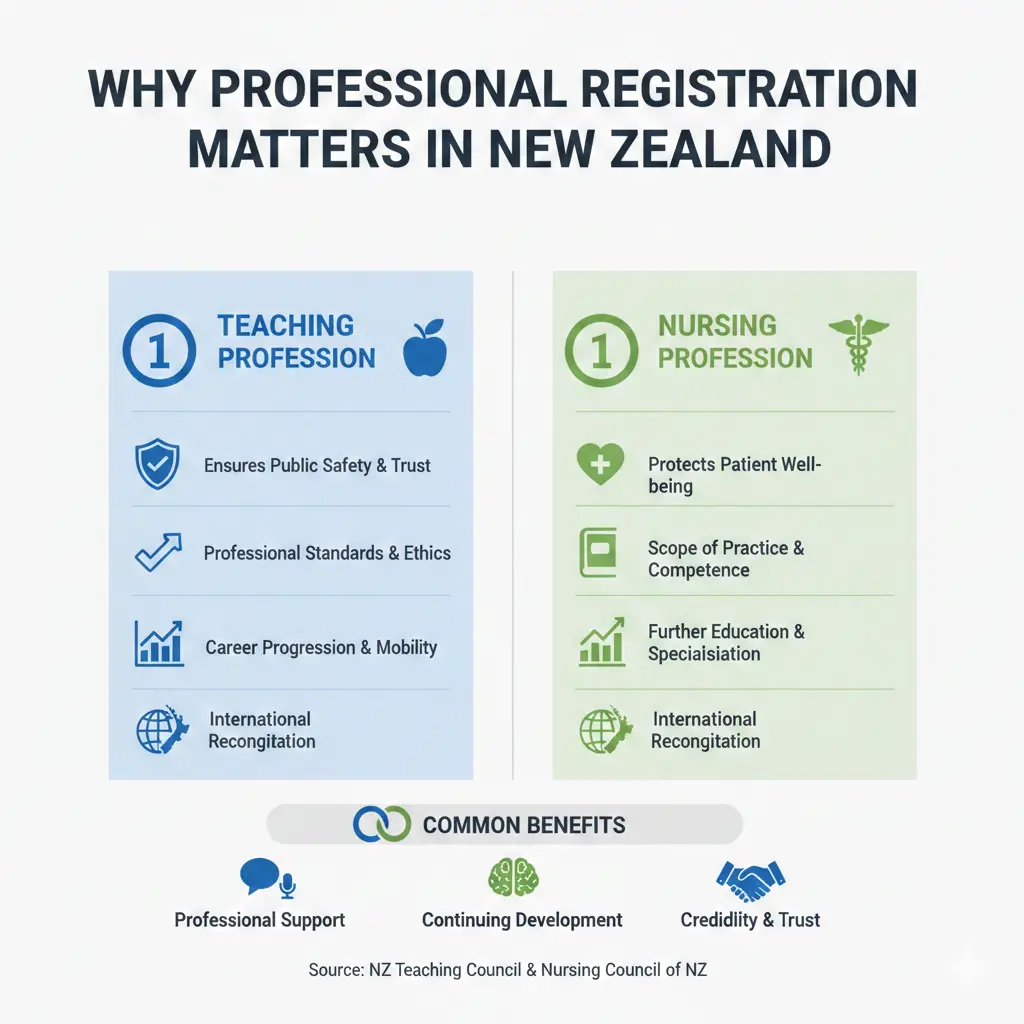
Why Professional Registration Matters in New Zealand
Registration isn't just paperwork—it's a legal must. Every teacher and nurse in Aotearoa must be registered and hold a current practising certificate to work. For teachers, registration confirms you meet professional and ethical standards, while the practising certificate lets you legally teach. Nurses follow suit under the Nursing Council, ensuring patient safety under the Health Practitioners Competence Assurance Act 2003.
In 2026, these systems protect our tamariki, whānau, and communities. Overseas-trained professionals often qualify for Green List pathways, leading to Work to Residence visas after two years' work—perfect for settling in NZ.
Teaching Registration: Overview
The Teaching Council of Aotearoa New Zealand oversees it all. You need both registration (lifelong, unless cancelled) and a practising certificate (renewed every 1-3 years). New Ngā Paerewa | Standards 2026 kicked in this year for professional growth, with full endorsements from 2027.
Nursing Registration: Overview
The Nursing Council of New Zealand (NCNZ) registers nurses. It's competence-based, focusing on safe practice. Overseas nurses need an IQA or CAP, plus competency assessments like CGFNS or OSCE exams. Like teaching, a current Annual Practising Certificate (APC) is essential.
Step-by-Step Guide to Teacher Registration
Ready to teach? Here's the practical path for locals and overseas Kiwis or migrants.
For Locally Trained Teachers
- Complete your Initial Teacher Education (ITE): Graduate from an approved programme—you can apply immediately.
- Gather documents: Certified ITE qualification (or eQuals link), police vetting, health declaration, and commitment to Te Reo me ngā tikanga Māori.
- Set up accounts: Create My Rawa and Educator Sector Login (ESL) on the Teaching Council site.
- Apply online: Submit via My Rawa for registration and first practising certificate. Processing takes 6-12 weeks.
- Renewal: Every 1-3 years, with principal endorsement based on Standards.
Tip: Download your digital practising certificate to Apple or Google Wallet for easy access.
For Overseas-Trained Teachers
The process takes about six months, so start early.
- Get a Teaching IQA: Apply to NZQA to check your qualification against NZ ITE standards (Level 7 equivalent).
- Additional docs: Proof of identity (Children's Act compliant), transcripts, practicum evidence, professional status, teaching service statements, English competency, and CV.
- Australian teachers: Use Trans-Tasman Mutual Recognition Act—provide current registration for verification.
- Apply via My Rawa: Same as locals, post-IQA. Police vetting follows.
- Secure job and visa: Need a job offer for Accredited Employer Work Visa or Straight to Residence (Green List).
If direct registration stalls, study a NZ ITE course at uni or polytech.
Step-by-Step Guide to Nursing Registration
Nursing Council handles this with a focus on competence. Demand is huge in aged care and mental health.
For Locally Trained Nurses
- Complete approved programme: Bachelor of Nursing (Level 7) from a NZ provider.
- State Final Exam: Pass the NCNZ exam.
- Apply for registration: Submit transcripts, ID, police check, and fitness declaration.
- Get APC: Pay fee and renew annually (around $160 in 2026).
For Overseas-Trained Nurses
- Credential Assessment: Use CGFNS or IQA via NZQA for qualification check.
- Competency Assessment Programme (CAP): Or OSCE exam if from designated countries (UK, Ireland, etc.).
- English test: IELTS 7.0+ or OET B across bands.
- Documents: Passport, qualification certificates, service statements, police clearance (NZ and home country).
- Apply online: Via NCNZ portal; processing 8-12 weeks. Then APC.
- Visa path: Green List for nurses—job offer leads to residence after two years.
Pro tip: Join the New Zealand Nurses Organisation (NZNO) for support and advocacy.
Key Differences: Teaching vs Nursing Registration
| Aspect | Teaching | Nursing |
|---|---|---|
| Governing Body | Teaching Council | Nursing Council |
| Qualification Check | NZQA Teaching IQA | CGFNS/IQA + CAP/OSCE |
| Practising Certificate | 1-3 years, Standards-based | Annual APC |
| Overseas Fast-Track | TTMRA for Aussies | Designated countries OSCE |
| Green List Visa | Yes, primary/ECE | Yes, all levels |
Costs, Timelines, and 2026 Updates
- Teacher fees: Registration ~$250, practising certificate ~$200 (2026 rates).
- Nursing fees: Application ~$400, APC ~$160.
- Timelines: Teachers 6-12 weeks; nurses 8-12 weeks post-documents.
- 2026 news: Teaching shifts to Ngā Paerewa 2026 for growth cycles; nursing emphasises digital health competencies.
Practical Tips for Success
- Start with police vetting—use 100% Employers for fast NZ checks.
- Tailor your CV to Kiwi norms: Focus on Māori responsiveness and inclusive practice.
- Network via Seek, Education Gazette, or District Health Boards for jobs.
- Budget for English tests if needed—book early.
- Check the public registers: Teaching at Hapori Matatū, nursing via NCNZ site.
Next Steps to Get Registered
Pick your path: Head to Teaching Council or Nursing Council portals today. Gather docs, apply for IQA if overseas-trained, and scout jobs on Trade Me or Education Counts. With NZ's teacher and nurse shortages, your skills are needed—register now and make a difference in our classrooms and clinics. Kia kaha!
Frequently Asked Questions
Sources & References
-
1
NZ Teacher Registration & Certification Guide | Prospero Teaching — www.prosperoteaching.co.nz
-
2
Register to teach - Teaching Council — teachingcouncil.nz
-
3
Registration and certification - PPTA — www.ppta.org.nz
-
4
Teaching in New Zealand | Teachers Registration NZ - IANZ — nzimmigration.info
-
5
Requirements to teach in Aotearoa New Zealand - Teaching Council — teachingcouncil.nz
-
6
International Qualification Assessment for teachers - NZQA — www2.nzqa.govt.nz
Related Articles

Points Calculator for Skilled Migration to NZ
Ever wondered if your skills could earn you a spot in Aotearoa? The Points Calculator for Skilled Migration to NZ is your first step towards turning that dream into reality, helping skilled workers li...

Culture Shock: 10 Things Nobody Tells You About Moving to NZ
Imagine stepping off the plane at Auckland Airport, buzzing with excitement about your new life in Aotearoa—only to be blindsided by a gale-force wind that nearly sweeps you off your feet. Or discover...

The Skilled Migrant Category: How to Score Enough Points in 2026
Imagine landing a job in New Zealand that not only matches your skills but fast-tracks you to residency. That's the promise of the Skilled Migrant Category (SMC) Resident Visa in 2026, where scoring a...

Moving to NZ in 2026: The Complete Relocation Guide
Planning your move to New Zealand in 2026? Whether you're chasing career opportunities, a lifestyle upgrade, or simply the chance to call Aotearoa home, this guide covers everything you need to know f...