The Skilled Migrant Category: How to Score Enough Points in 2026

Imagine landing a job in New Zealand that not only matches your skills but fast-tracks you to residency. That's the promise of the Skilled Migrant Category (SMC) Resident Visa in 2026, where scoring a...
The Lifetimes NZ editorial team curates, fact-checks, and updates guides on personal finance, property, health, immigration, legal, business, and lifestyle topics relevant to Lifetimes NZ readers. Articles are produced with AI assistance and reviewed by the editorial team before publication.
Imagine landing a job in New Zealand that not only matches your skills but fast-tracks you to residency. That's the promise of the Skilled Migrant Category (SMC) Resident Visa in 2026, where scoring at least 6 points can open doors to a new life here. With major updates rolling out from August 2026, understanding how to rack up those points is key for skilled workers eyeing permanent settlement in Aotearoa.
Whether you're a professional in an ANZSCO skill level 1-3 role or a tradesperson with hands-on experience, the simplified points system makes it clearer than ever to qualify. We'll break down the requirements, point pathways, and tips to boost your score, all tailored to the latest Immigration New Zealand rules.
What is the Skilled Migrant Category Resident Visa?
The SMC Resident Visa targets skilled migrants who can contribute to New Zealand's economy through high-demand jobs. You need an acceptable job or job offer from an accredited employer—either full-time permanent, a fixed-term contract of at least 12 months, or a services contract of 6 months or more.
Key eligibility basics include meeting health and character standards (like police clearances from countries where you've lived 5+ years), English language requirements (typically IELTS 6.5 overall, no band below 6), and being aged under 56. But the real game-changer is the points test: you must score at least 6 skilled resident points.
Big Changes Coming in August 2026
From August 2026, the system simplifies with two new pathways: the Skilled Work Experience Pathway (for ANZSCO levels 1-3) and the Trades and Technician Pathway (for level 4+ qualified trades). Work experience caps drop—max 2 years NZ experience for most—and wage thresholds ease to median wage maintenance over your employment period.
Additional incentives include bonus points for NZ university qualifications, and the National Occupation List (NOL) expands with 47 new skill level 1-3 roles from March 2026. Median wage updates to $35/hour further clarify thresholds.
How the Points System Works in 2026
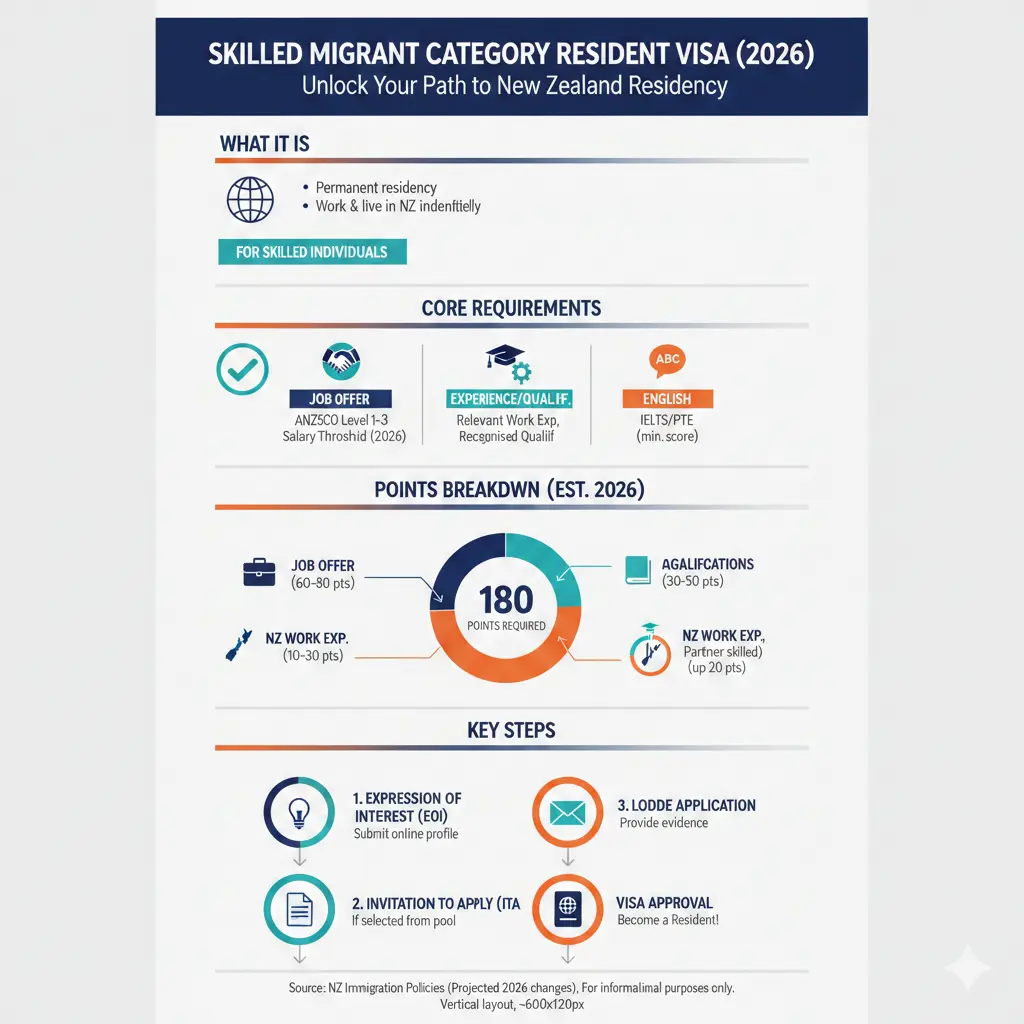
You need 6 points total, split between 'skill points' (3-6 from qualifications, registration, or income) and NZ work experience (1 point per year, max 3). Claim from the category giving the most points. ANZSCO levels classify your job: 1-3 for professionals (e.g., accountants, ICT specialists, chefs), 4-5 for some trades but with higher wage hurdles (1.5x median).
Earning Skill Points: Qualifications, Registration, and Income
Points come from your highest-scoring factor. Here's the 2026 breakdown:
- 6 points: Doctoral degree; NZ registration requiring 6+ years training; job paying 3x median wage.
- 5 points: Master's degree (NZ with bachelor's, or overseas with bachelor's); NZ honours/post-grad diploma/certificate (with bachelor's); registration requiring 5+ years.
- 4 points: Honours/post-grad diploma (NZ or overseas with bachelor's); bachelor's (NZ or overseas); registration requiring 4+ years; job at 2x median wage.
- 3 points: Bachelor's/post-grad certificate; registration requiring 3+ years (or 2+ for some).
For post-grad quals outside NZ, you often need an International Qualification Assessment (IQA). NZ master's holders get 5 points even without a bachelor's if it's a specific 5-point claim.
| Training/Experience for Registration | Points |
|---|---|
| 6+ years | 6 |
| 5+ years | 5 |
| 4+ years | 4 |
| 3+ years | 3 |
Boosting Points with New Zealand Work Experience
If you're short on skill points (e.g., 3-5), NZ work experience fills the gap: 1 point per year in a skilled job, up to 3 points. Under new rules, max drops to 2 years for most, but pathways specify:
- Skilled Work Experience Pathway: 5 years total experience (2 in NZ), at 1.1x median wage.
- Trades/Technician: Level 4+ qual, 4+ years post-qual (18 months NZ), at median wage.
AEWV holders nearing max stay get a 12-month extension to hit requirements if at median wage.
New Pathways: Skilled Work Experience and Trades/Technician
Skilled Work Experience Pathway (ANZSCO 1-3)
For professionals like business analysts, health pros, or salespeople. Need 5 years relevant experience (2 in NZ) and earnings at 1.1x median ($38.50/hour from 2026). Combine with 3+ skill points for faster residence.
Trades and Technician Pathway
Aimed at hands-on roles with level 4+ quals (diploma/certificate worldwide OK). Requires 4+ years post-qual experience (18 months NZ) at median wage ($35/hour). Ideal for electricians, mechanics, or technicians on the expanded NOL.
Practical Tips to Score 6+ Points
- Check ANZSCO and NOL: Use Immigration NZ's tools to confirm your job fits levels 1-3 or trades. New 47 occupations added March 2026 boost AEWV options.
- Get Qualified Right: Pursue NZ quals for bonus points—master's holders score big. Assess overseas creds via IQA early.
- Secure Accredited Employment: Target accredited employers; aim for median+ wage history.
- Build NZ Experience: Start on AEWV, rack up 1-2 years in skilled roles.
- Prep Documents: Police clearances, IELTS (or UK PhD waiver), medicals, and English proof.
- Use Licensed Advisers: Avoid points errors; advisers ensure quals/experience match.
Example: A chef (ANZSCO 1-3) with 5 years experience (2 NZ at 1.1x median) + bachelor's (3 points) hits 6 easily via Skilled Pathway.
Common Challenges and How to Overcome Them
Points miscalculations top the list—quals not matching jobs or ignoring IQA. Wage proof must show consistent median throughout NZ tenure. For level 4-5 roles, hit 1.5x median or pivot to pathways.
Kiwi employers: Support migrants via accreditation—it's a win for skills shortages.
Next Steps to Apply
Start with Immigration NZ's points calculator or self-assessment. Gather quals, job offer, and English proof. Consult a licensed adviser, apply via AEWV if needed, and track NOL updates. With 2026 changes, now's prime time to score residency—check immigration.govt.nz for forms. Your skilled future in New Zealand awaits!
Frequently Asked Questions
Sources & References
-
1
Changes to the Skilled Migrant Category Resident Visa announced — www.immigration.govt.nz
- 2
-
3
The Skilled Migrant Category Resident Visa — www.new-zealand-immigration.com
-
4
New Zealand Major Visa Changes 2026 - YouTube — www.youtube.com
-
5
Simplified points system in depth - MBIE — www.mbie.govt.nz
-
6
Skilled Migrant Category Resident Visa - Immigration New Zealand — www.immigration.govt.nz
-
7
New occupations recognised under the National Occupation List and annual median wage increase — www.immigration.govt.nz
-
8
Immigration New Zealand Outlines Major 2026 Policy Shifts — newlandchase.com
-
9
NZ Immigration Update 2026: 47 New NOL Roles & Median Wage Update — newzealandshores.com
Related Articles

Points Calculator for Skilled Migration to NZ
Ever wondered if your skills could earn you a spot in Aotearoa? The Points Calculator for Skilled Migration to NZ is your first step towards turning that dream into reality, helping skilled workers li...

Culture Shock: 10 Things Nobody Tells You About Moving to NZ
Imagine stepping off the plane at Auckland Airport, buzzing with excitement about your new life in Aotearoa—only to be blindsided by a gale-force wind that nearly sweeps you off your feet. Or discover...

Moving to NZ in 2026: The Complete Relocation Guide
Planning your move to New Zealand in 2026? Whether you're chasing career opportunities, a lifestyle upgrade, or simply the chance to call Aotearoa home, this guide covers everything you need to know f...
Teaching or Nursing in NZ? A Guide to Professional Registration
Are you a Kiwi eyeing a career switch into teaching or nursing, or helping a family member navigate professional registration in Aotearoa? Whether you're trained locally or overseas, getting registere...