Child Support (Child Maintenance) in New Zealand

Navigating separation or shared parenting in New Zealand often brings up questions about child support NZ – that essential financial help ensuring kids get what they need, no matter where they live. W...
Aroha writes about parenting, education, and family life in Aotearoa. She covers school choices, childcare, family benefits, and practical advice for raising a family in New Zealand.
Navigating separation or shared parenting in New Zealand often brings up questions about child support NZ – that essential financial help ensuring kids get what they need, no matter where they live. Whether you're the paying parent, receiving carer, or a non-parent caregiver, understanding the system can ease stress and keep things fair for your tamariki.
Run by Inland Revenue (IRD), our child support scheme balances parents' incomes and care time to work out payments. It's designed to cover kids' everyday costs like food, clothes, and school stuff, without one parent footing the full bill. In this guide, we'll break it down step by step with practical tips tailored for Kiwis, using the latest 2026 info.
Who Qualifies for Child Support in New Zealand?
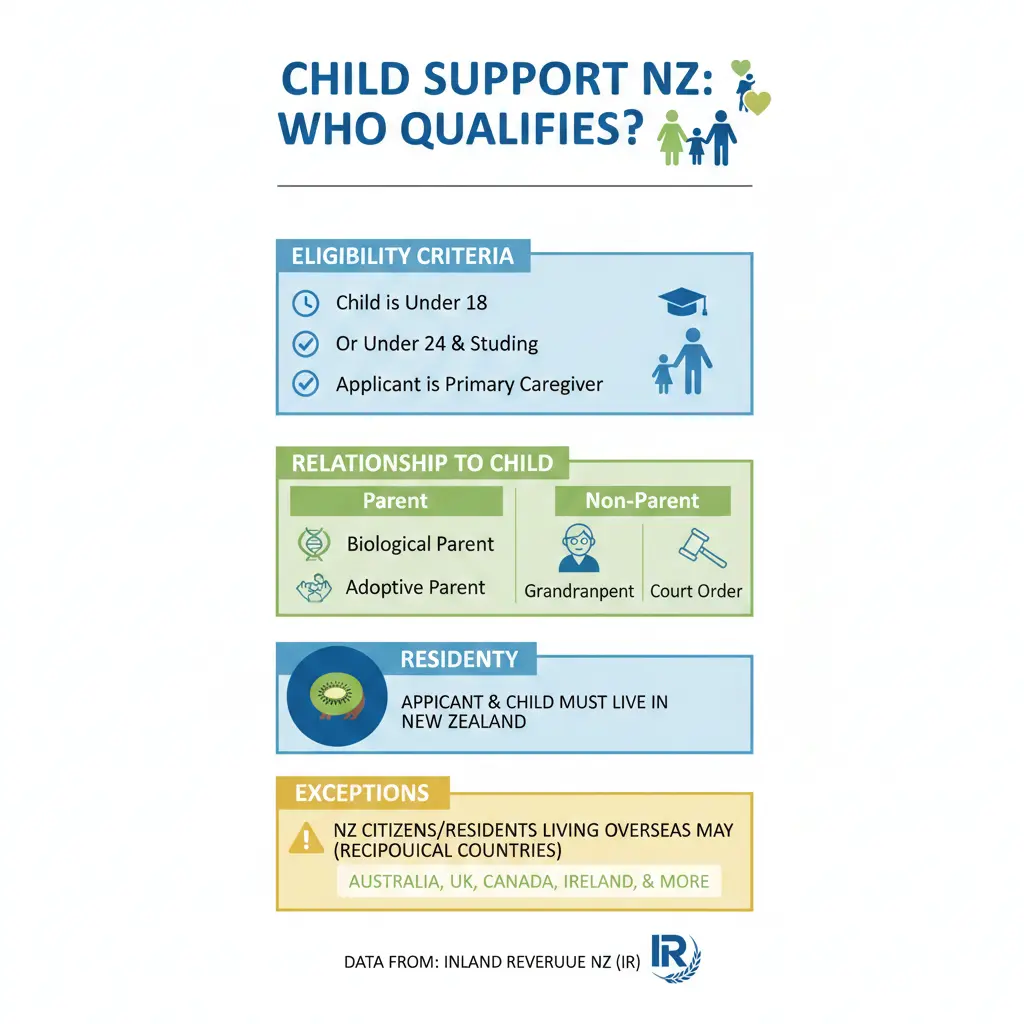
Not every child automatically gets child support – there are clear rules under the Child Support Act. A qualifying child must meet these criteria:
- Under 18 years old, or 18 and still at school full-time (like NCEA or equivalent).
- New Zealand citizen or ordinarily resident here.
- Not financially independent – meaning not working full-time (more than 30 hours a week on average) or getting a benefit/student allowance as their main income.
- Not married, in a civil union, or de facto relationship.
The child needs to live with a carer for at least 35% of the time – that's more than 2.5 nights a week. This applies to parents and non-parent caregivers alike, such as grandparents or aunties raising mokopuna.
Who Pays and Who Receives?
The liable parent is the one who pays – usually the higher earner or the one with less care time. The receiving carer gets the payments for the child's everyday needs. Both parents must be NZ citizens/residents, or from a country with a reciprocal agreement (like Australia or the UK) for enforcement.
For example, if you share 50/50 care but one of you earns twice as much, IRD's formula might have the higher earner pay a bit to even things out.
How Child Support is Calculated: The Formula Assessment
IRD uses a formula based on the child support year (1 April to 31 March), pulling income from the latest full year. Payments get re-assessed regularly, so they adjust if your job or care setup changes.
Key Factors in the Calculation
The formula looks at:
- Combined child support income of both parents (taxable income minus living allowances).
- Care percentage – how many nights each parent cares for the kids.
- Income cap – for 2025 it was $195,296, reviewed yearly based on average wages (expect a bump for 2026).
- Number of qualifying kids and their ages.
Each parent gets a 'living allowance' updated yearly, plus extras for kids without support. You can estimate your amount using IRD's online calculator before applying.
Private, Voluntary, or Formula Agreements?
- Private agreement: Sort it yourselves, no paperwork. But anyone can ask IRD for a formula assessment anytime.
- Voluntary agreement: Write it down, minimum $10/week. IRD collects and pays out – receiving carer can cancel anytime.
- Formula assessment: If you can't agree, apply to IRD. Send ID, birth certs, and kids' IRD numbers. They'll notify both sides and issue a notice with amounts and due dates.
Pro tip: Update IRD straight away if care changes – like more overnights – to avoid unfair delays. Assessments aren't instant, so keep records of shared care.
Payment Dates and How It Works in 2026
If IRD manages your child support, payments hit your bank by 3pm on issue day, usually the 20th (or 21st if weekend). For 2026, watch these adjusted dates:
| Month | Payment Issue Date |
|---|---|
| February | 23 February 2026 |
| March | 23 March 2026 |
| June | 23 June 2026 |
| September | 22 September 2026 |
| November | 23 November 2026 |
| December | 22 December 2026 |
Liable parents pay via wages deductions, direct debit, or payment plans for arrears. At March 2025, total debt was $930 million (down 10% year-on-year).
Enforcement, Departures, and Common Challenges
IRD enforces via wage deductions, bank levies, or even passport restrictions for big debts. If the formula feels off – say, due to high rent or special needs – apply for a departure. Start with IRD review, escalate to court if needed. Prove 'special circumstances' like disability costs.
Challenges include slow updates for care changes and shocks at calculated amounts. Some call for a system shakeup to make it fairer.
Non-Parent Caregivers
Grandparents or others caring 35%+ time can get support, but calculations differ – contact IRD for details.
Links to Other Family Support
Child support pairs with Working for Families tax credits via IRD, and benefits from Work and Income. Note 2026 changes: 18-19-year-olds need a Parental Assistance Test for Jobseeker (unless they have kids), with income limits around $65,529 (adjusting April 2026).
Practical Tips for Managing Child Support NZ
- Log into myIR to check payments, update details, or set plans.
- Keep care diaries – apps like OurFamilyWizard help prove sharing.
- Estimate first: Use IRD's tool at ird.govt.nz/child-support.
- Seek free advice: Community Law Centres or Citizens Advice Bureau.
- If struggling: Talk to IRD early – plans avoid penalties.
Next Steps for You
Ready to sort your child support NZ? Head to ird.govt.nz/child-support to apply, estimate, or check status. Chat with IRD at 0800 221 221 for personalised help. If tensions run high, a family mediator via Family Justice can smooth agreements. Prioritising your kids' stability pays off for everyone – you've got this, whānau.
Frequently Asked Questions
Sources & References
-
1
2026 Child support payments - receiving carers — www.ird.govt.nz
-
2
Child Support in New Zealand: A Comprehensive Guide — disputeresolution.nz
-
3
Changes in 2026 to Jobseeker Support for 18- and 19-year-olds — www.workandincome.govt.nz
-
4
'The system needs a shakeup': Call for child support changes — www.rnz.co.nz
-
5
Child support scheme: The formula assessment — communitylaw.org.nz
-
6
Child support | New Zealand Government — www.govt.nz
-
7
Child support - Inland Revenue — www.ird.govt.nz
Related Articles

Childcare Options and Costs in NZ 2026
Finding the right childcare for your tamariki (children) is one of the biggest decisions you'll make as a parent, and it's often one of the biggest expenses too. Whether you're returning to work after...

Childcare Subsidies & Financial Support in NZ
Raising tamariki in Aotearoa comes with its joys and challenges, especially when balancing work, study, or training with the costs of quality childcare. If you're searching for childcare subsidies NZ...
Best Start Tax Credit: What It Is & Who Qualifies
If you've just had a baby or are planning to start a family, you might be wondering how to make ends meet during those early years. The Best Start tax credit is one of New Zealand's most valuable fami...

Parental Leave Rights: What Kiwi Parents Need to Know
Bringing a new baby into the world is one of life's biggest adventures, but for Kiwi parents, navigating parental leave NZ entitlements can feel like a maze. Whether you're expecting, adopting, or bec...