New Zealand English Has Unique Vowel Sounds

Introduction to New Zealand English New Zealand English, also known as NZE or Kiwi English, is a unique and fascinating dialect that has evolved over time.
Aroha writes about parenting, education, and family life in Aotearoa. She covers school choices, childcare, family benefits, and practical advice for raising a family in New Zealand.
Introduction to New Zealand English
New Zealand English, also known as NZE or Kiwi English, is a unique and fascinating dialect that has evolved over time. As a New Zealander, you may not even realise the distinct characteristics of your native language, but they are certainly noticeable to visitors and language learners. One of the most interesting aspects of New Zealand English is its vowel sounds, which can be quite different from other English dialects. In this article, we'll delve into the world of NZE vowel sounds, exploring what makes them unique and how you can improve your pronunciation.
New Zealand English has developed a distinct flavour, shaped by the country's history, cultural diversity, and geographical isolation. The language has been influenced by the indigenous Māori language, as well as by the languages of early European settlers, such as English, Scottish, and Irish. As a result, NZE has a distinct accent, vocabulary, and grammar that sets it apart from other English dialects. If you're interested in learning more about the history and evolution of New Zealand English, there are many excellent resources available, including books, documentaries, and online courses.
Whether you're a native New Zealander or a language learner, understanding the vowel sounds of NZE can be helpful in improving your communication skills and connecting with others. In this article, we'll provide you with practical information and actionable advice on how to pronounce NZE vowel sounds correctly. We'll also explore some common challenges faced by language learners and provide tips on how to overcome them. So, let's get started on this journey into the world of New Zealand English vowel sounds!
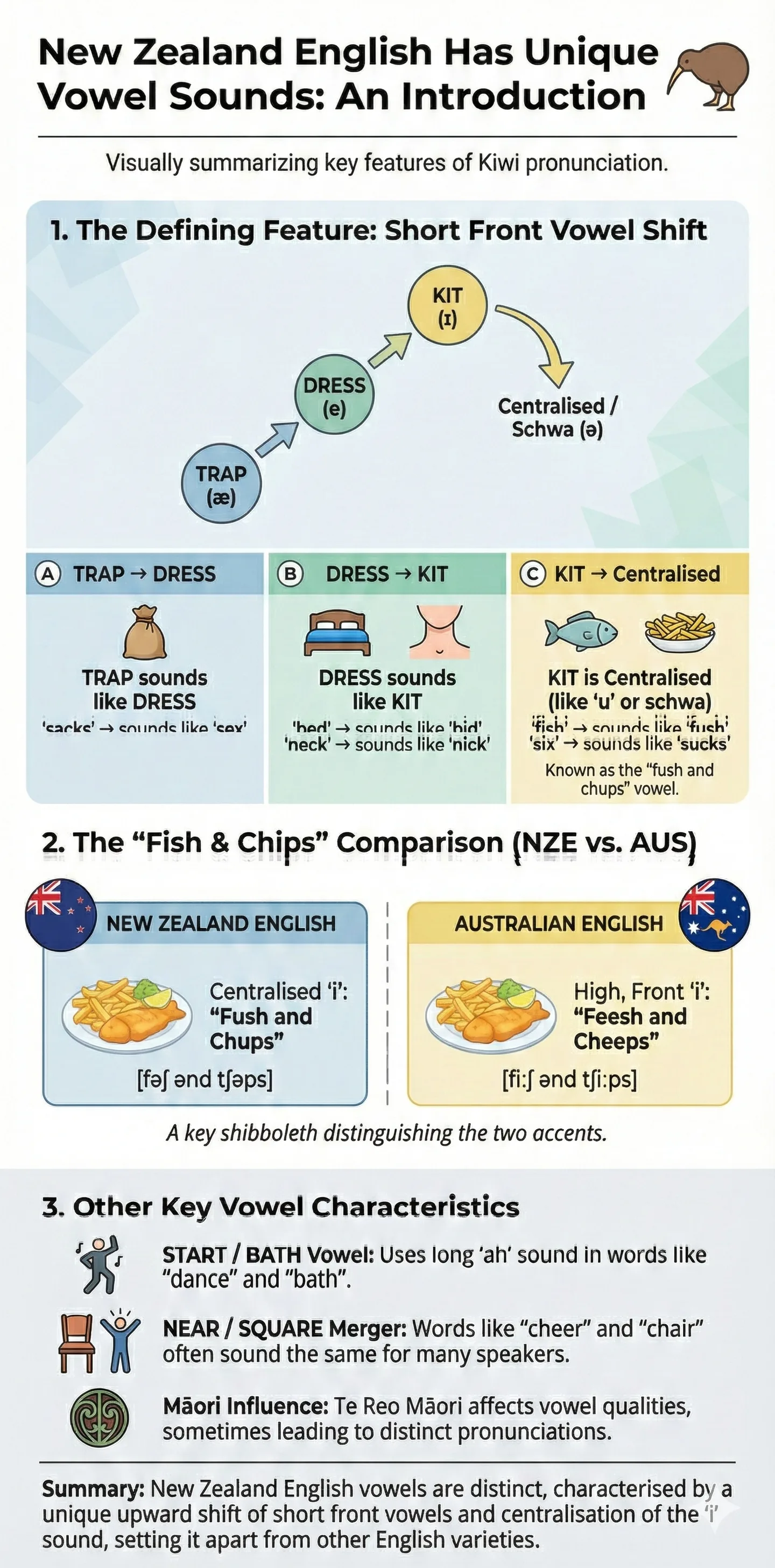
The Basics of Vowel Sounds
To understand the unique vowel sounds of New Zealand English, it's essential to start with the basics. In English, there are 12 basic vowel sounds, which can be classified into two main categories: monophthongs and diphthongs. Monophthongs are single, pure vowel sounds, while diphthongs are combinations of two vowel sounds pronounced in a single syllable. New Zealand English has a distinct set of vowel sounds, which can be different from other English dialects.
Some of the key features of NZE vowel sounds include:
- Short vowels: In NZE, short vowels are often pronounced more centrally, with a more neutral tongue position. For example, the word "bit" is pronounced more like "buh" than "beat".
- Long vowels: Long vowels in NZE are often pronounced with a more open, relaxed quality. For example, the word "price" is pronounced more like "praahs" than "prays".
- Diphthongs: NZE diphthongs are often pronounced with a more gradual, smooth transition between the two vowel sounds. For example, the word "buy" is pronounced more like "bah-ee" than "boo-ee".
Common Challenges for Language Learners
If you're a language learner trying to master New Zealand English, you may encounter some common challenges when it comes to pronunciation. One of the biggest hurdles is the difference in vowel sounds between NZE and your native language. For example, if you're from a country with a more pronounced distinction between short and long vowels, you may struggle to adapt to the more neutral vowel sounds of NZE.
Some other common challenges faced by language learners include:
- Accent and intonation: NZE has a unique accent and intonation pattern, which can be difficult to replicate for non-native speakers.
- Vowel sound shifts: NZE has a number of vowel sound shifts, where a word's pronunciation changes depending on its grammatical function or the surrounding words.
- Colloquialisms and slang: NZE is full of colloquialisms and slang expressions, which can be confusing for language learners.
To overcome these challenges, it's essential to practice regularly and immerse yourself in the language. Here are some tips:
- Listen to native speakers: Listen to native New Zealanders speaking, either in person or through recordings, to get a feel for the rhythm and pronunciation of the language.
- Practice with a language exchange partner: Find a language exchange partner, either in person or online, to practice your pronunciation and get feedback.
- Watch New Zealand TV shows and movies: Watching New Zealand TV shows and movies can help you get used to the sound and rhythm of the language.
Regional Variations in NZE
While New Zealand English is a distinct dialect, there are also regional variations within the country. These variations can be influenced by factors such as geography, culture, and history. For example, the South Island has a distinct accent and vocabulary, which is different from the North Island.
Some of the key regional variations in NZE include:
- South Island: The South Island has a more pronounced rural accent, with a stronger emphasis on the "r" sound and a more drawling intonation pattern.
- North Island: The North Island has a more urban accent, with a greater influence from Māori and Pacific Island languages.
- Māori language influence: The Māori language has had a significant influence on NZE, particularly in terms of vocabulary and pronunciation. Many Māori words have been incorporated into NZE, and the language has also borrowed pronunciation patterns and intonation from Māori.
Tips for Improving Your Pronunciation
If you want to improve your pronunciation of New Zealand English, here are some tips:
- Practice regularly: Practice your pronunciation regularly, either by speaking with a language exchange partner or by recording yourself and listening to the playback.
- Focus on individual sounds: Focus on individual sounds, such as the "i" sound in "fish" or the "e" sound in "pet".
- Listen to native speakers: Listen to native New Zealanders speaking, either in person or through recordings, to get a feel for the rhythm and pronunciation of the language.
- Use online resources: Use online resources, such as pronunciation guides and language learning apps, to help you improve your pronunciation.
Some recommended online resources include:
- Forvo: A pronunciation guide that provides audio recordings of words and phrases in different languages, including New Zealand English.
- YouTube: A video-sharing platform that has many channels dedicated to language learning and pronunciation practice.
- Language learning apps: Apps such as Duolingo and Babbel that provide interactive language lessons and pronunciation practice.
Conclusion and Key Takeaways
In conclusion, New Zealand English has a unique set of vowel sounds that can be different from other English dialects. By understanding these vowel sounds and practicing your pronunciation, you can improve your communication skills and connect with others more effectively. Whether you're a native New Zealander or a language learner, there are many resources available to help you master the pronunciation of NZE.
Here are the key takeaways from this article:
- NZE has a distinct set of vowel sounds: NZE has a unique set of vowel sounds, which can be different from other English dialects.
- Practice regularly: Practice your pronunciation regularly to improve your communication skills and connect with others more effectively.
- Focus on individual sounds: Focus on individual sounds, such as the "i" sound in "fish" or the "e" sound in "pet", to improve your pronunciation.
- Use online resources: Use online resources, such as pronunciation guides and language learning apps, to help you improve your pronunciation.
By following these tips and practicing regularly, you can master the pronunciation of New Zealand English and improve your communication skills. Remember, the key to improving your pronunciation is to practice regularly and immerse yourself in the language. With time and effort, you can become a confident and fluent speaker of New Zealand English.
Related Articles

The Longest Place Name in the World Is in New Zealand (85 Letters)
Introduction to the Longest Place Name New Zealand is renowned for its stunning landscapes, diverse culture, and unique features that set it apart from the

Many Māori Words Have Been Adopted into NZ English
Introduction to Te Reo in NZ English As a New Zealander, you're likely familiar with the unique flavour that Māori words bring to our everyday language. F