Council Rates Explained: What Are You Really Paying?

Ever stared at your council rates bill and wondered where all that money's going? You're not alone—many Kiwis feel the pinch as rates climb faster than our wages, funding everything from pothole fixes...
The Lifetimes NZ editorial team curates, fact-checks, and updates guides on personal finance, property, health, immigration, legal, business, and lifestyle topics relevant to Lifetimes NZ readers. Articles are produced with AI assistance and reviewed by the editorial team before publication.
Ever stared at your council rates bill and wondered where all that money's going? You're not alone—many Kiwis feel the pinch as rates climb faster than our wages, funding everything from pothole fixes to park benches. With a proposed government cap on the horizon, it's time to unpack what council rates NZ really mean for your wallet.
In this guide, we'll break down how council rates work, what's driving the increases, and practical steps you can take to understand—and maybe even challenge—your bill. Whether you're in Auckland facing a 5.8% hike this year or elsewhere watching rates soar 88% over the past decade, we've got the facts tailored for New Zealanders.
What Are Council Rates in New Zealand?
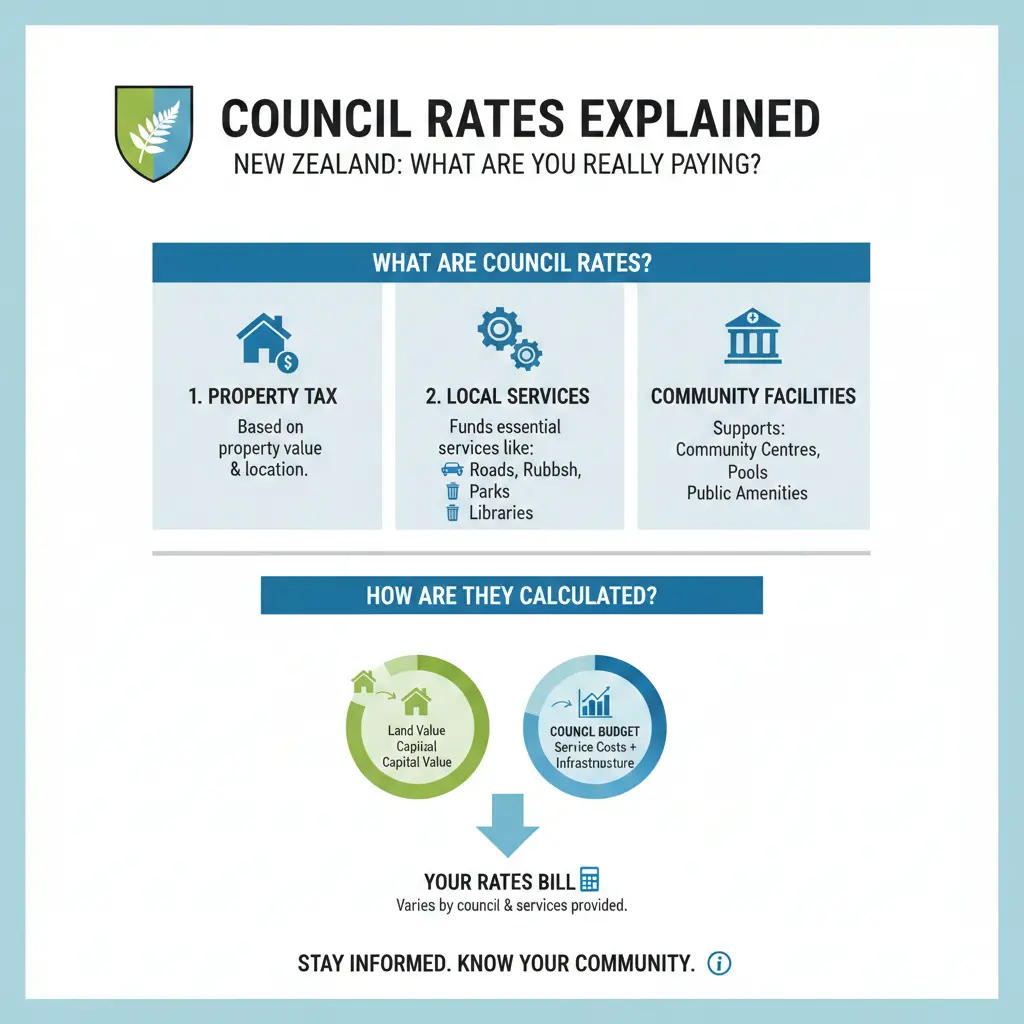
Council rates are the primary way local governments fund essential services across our cities and towns. Think rubbish collection, road maintenance, libraries, parks, and water infrastructure—these aren't free, and rates cover about 60-70% of council budgets nationwide.
Unlike income tax collected by IRD, rates are property-based taxes set annually by your local council. They're calculated on your property's capital value (CV), land value (LV), or improvement value (LV), depending on what your council uses. Most Kiwi councils—55 out of 78—base rates on capital value, which includes land and buildings.
How Are Rates Calculated?
Your rates bill typically includes:
- General rates: The biggest chunk, funding day-to-day operations like parks and pools.
- Targeted rates: For specific projects, e.g., Auckland's Natural Environment Targeted Rate (NETR) up 3.5% for 2025/26.
- Uniform Annual General Charge (UAGC): A flat fee per property, often $300-500, to spread costs fairly.
The formula's simple: Rates = (Rate in the dollar x Property Value) + Fixed Charges. For example, if your home's CV is $1 million and the general rate is 0.25 cents per dollar, that's $2,500 base general rates. Add targeted rates for sewage or stormwater, and your total bill grows.
Councils review property valuations every three years via Quotable Value NZ (QV). If your rates jump post-revaluation, it's often because property values have risen—great for selling, tough on rates.
Why Have Council Rates Skyrocketed?
Over the past decade, the average Kiwi rates bill has surged 88%, outpacing wage growth by double—hourly earnings up just 50%. Pre-2020, annual increases averaged 4%; since then, they've hit 8% yearly, with peaks of 12% in some areas.
Blame it on:
- Infrastructure catch-up: Decades of underinvestment mean councils are pouring cash into pipes, roads, and three waters projects. Debt has doubled since 2017, with interest costs eating into budgets.
- Population growth and inflation: More homes in fast-growing spots like Auckland and Queenstown demand more services. CPI jumped 0.6% last quarter, partly from rates and power bills.
- Rising costs: Wages, fuel, and compliance (think climate action) have spiked. Auckland's 2025/26 plan cites a 6.54% general rates rise plus targeted hikes totalling 5.8% or $223/year extra.
For fixed-income households—like retirees on super— this squeezes housing affordability hardest. No wonder rates are now a top inflation driver.
The Government's Proposed Rates Cap: What It Means for You
Good news on the horizon: In December 2025, the government announced plans to cap council rates NZ increases at 2-4% per capita annually. This targets total rates revenue growth, allowing extra for population booms but curbing hikes on existing ratepayers.
Key Details of the Proposal
- Scope: Covers general, targeted rates, and UAGC—but excludes water charges and fees.
- Timeline: Legislation in 2026, transition from 1 January 2027, full effect 2029. Councils must report metrics like rates as % of house prices.
- Exemptions: Rare, for disasters or infrastructure deficits—needs regulator approval from the Department of Internal Affairs (DIA).
- Council response: Some worry it'll force service cuts or more user-pays, but it aims to keep rates affordable.
"The lower end ensures essential services like rubbish collection and roads; the upper balances growth with affordability." — Local Government Minister Simeon Brown
Consultation runs to February 2026—your chance to have a say via govt.nz submissions.
Your Rates Bill Breakdown: Auckland vs. Smaller Councils
Rates vary wildly by location. Here's a snapshot:
| Council | Avg Residential Bill (2025/26) | Annual Increase | Key Driver |
|---|---|---|---|
| Auckland | $3,847 | 5.8% ($223) | General + targeted (NETR/CATTR up 3.5%) |
| Christchurch | ~$3,200 | ~7% | Infrastructure debt |
| Wellington | ~$4,100 | 9% | Earthquake recovery |
| Small rural (e.g., Mackenzie) | ~$2,000 | 10-12% | Roads, low ratepayer base |
(Note: Figures approximate based on recent trends; check your council's Annual Plan.)
Practical Tips: How to Manage and Challenge Your Council Rates
Don't just pay and grumble—take control:
- Check your valuation: Request a free QV notice from your council. If it's off (e.g., post-flood), object within 1-4 months via QV.co.nz.
- Review your bill: Spot errors? Contact your council's rates team. Remissions available for hardship—e.g., Auckland's policy covers low-income via Work and Income proof.
- Seek rates rebates: If over 65 or on low income, apply for the national Rates Rebate—up to $790 in 2026, income-tested at $31,510 single/$49,304 couple. Apply at ird.govt.nz.
- Engage locally: Attend Long-Term Plan hearings (every 3 years). Vote in council elections—your voice shapes budgets.
- Budget smart: Use tools like Sorted.org.nz's rates calculator. Factor 4-6% annual rises into home buying.
- Go green for savings: Solar panels or rainwater tanks can qualify for targeted rate discounts in eco-focused councils.
Next Steps: Take Charge of Your Rates Today
Grab your latest bill, log into your council's portal (e.g., aucklandcouncil.govt.nz for Aucklanders), and verify every line. With rates caps incoming, 2026 is prime time to engage—submit feedback on the proposal via beehive.govt.nz, apply for rebates at ird.govt.nz, and join local meetings. Knowledge is power; understanding council rates NZ means less stress and smarter finances for your whānau.
Stay informed—council finances affect us all. Questions? Drop your council a line or chat in the comments.
Frequently Asked Questions
Sources & References
-
1
A look at New Zealand's proposed local council rate cap — Westpac IQ — www.westpaciq.com.au
-
2
A look at New Zealand's proposed local council rate cap (PDF) — Westpac NZ — assets.dam.westpac.co.nz
-
3
Getting rates under control for ratepayers — Beehive.govt.nz — www.beehive.govt.nz
- 4
-
5
Changes to your property rates for the 2025/2026 rating year — Auckland Council — www.aucklandcouncil.govt.nz
Useful Tools
Related Articles

Registering to Vote in New Zealand
Ever wondered if your voice is truly heard in shaping New Zealand's future? With the 2026 general election set for 7 November, now's the perfect time to ensure you're registered and ready to vote[7][2...

Public Transport Options by City in NZ
Whether you're dodging Auckland's peak-hour traffic or exploring Wellington's windy streets, public transport in our cities makes getting around easier, greener, and often cheaper. With the City Rail...

Grocery Shopping on a Budget in New Zealand
With grocery prices in New Zealand still climbing—up 4% annually to December 2025—stretching your grocery budget NZ has never felt more urgent.[7] Whether you're feeding a family in Auckland or keepin...

Best Internet & Phone Plans in NZ (2025 Comparison)
Finding the right internet and phone plan in New Zealand doesn't have to be complicated. Whether you're after blazing-fast fibre speeds, budget-friendly wireless options, or bundled deals that save yo...