Small Claims: Disputes Tribunal Guide NZ

If you've got a dispute with a business, neighbour, or another person and you're not sure how to resolve it, New Zealand's Disputes Tribunal might be your answer. It's a quick, affordable way to settl...
The Lifetimes NZ editorial team curates, fact-checks, and updates guides on personal finance, property, health, immigration, legal, business, and lifestyle topics relevant to Lifetimes NZ readers. Articles are produced with AI assistance and reviewed by the editorial team before publication.
If you've got a dispute with a business, neighbour, or another person and you're not sure how to resolve it, New Zealand's Disputes Tribunal might be your answer. It's a quick, affordable way to settle civil disputes without the cost and complexity of going to court. Whether you're chasing money for poor workmanship, a damaged item, or a contract gone wrong, the Tribunal can help—and from January 2026, you can now claim up to $60,000, double the previous limit.
What is the Disputes Tribunal?
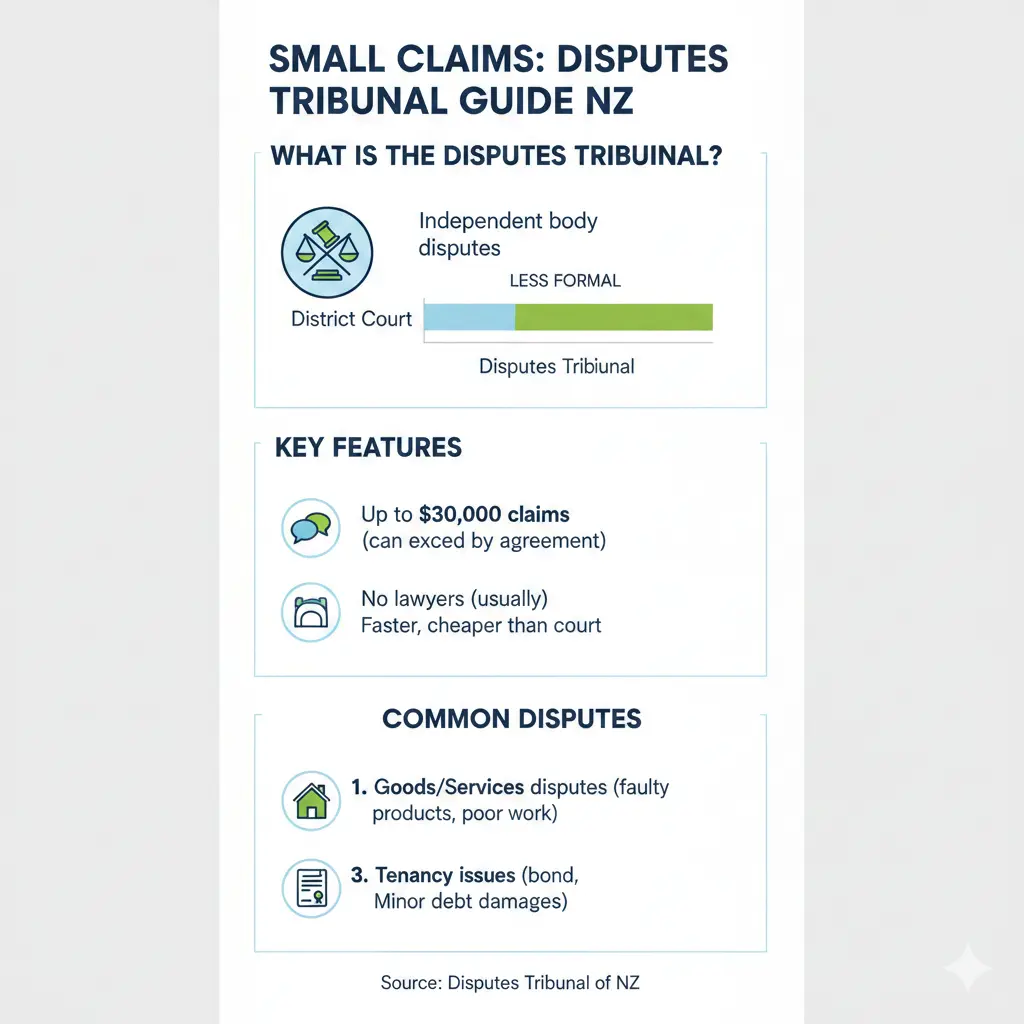
The Disputes Tribunal is a formal but accessible forum for resolving civil disputes in New Zealand. It's designed to be faster, cheaper, and less formal than the District Court, making it ideal for everyday disputes between individuals, businesses, and organisations. The Tribunal takes an inquisitorial approach, meaning it actively investigates the evidence and applies the law to determine what's fair and just in your circumstances.
You don't need a lawyer to use the Tribunal—many Kiwis represent themselves successfully. This keeps costs down and makes the process less intimidating than traditional court proceedings.
What Types of Disputes Can the Tribunal Handle?
The Disputes Tribunal covers a wide range of civil disputes. Here's what you can take to the Tribunal:
- Consumer disputes: faulty goods, poor quality work, overcharging, misleading advertising
- Service complaints: work not completed as expected, tradesperson standards
- Contract disputes: disagreements over business agreements and contracts
- Property damage: damage from car accidents or other incidents
- Neighbour disputes: boundary issues, nuisance complaints, and similar matters
- Flatmate issues: disputes over rent, bonds, or shared living arrangements
- Insurance claims: disputes about coverage or claim denials
- Hire purchase and credit agreements: disputes over credit sales and payment terms
- Debt disputes: disagreements over whether money is actually owed
The key requirement is that there must be a genuine dispute—the other party needs to disagree with your claim. If they simply owe you money and admit it, you might need to pursue other options like small claims in the District Court.
Claim Limits: What's Changed in 2026
One of the biggest changes for the Disputes Tribunal came into effect on 24 January 2026. The maximum claim limit increased from $30,000 to $60,000. This is a significant change for Kiwis with mid-range disputes.
Previously, if your claim was between $30,000 and $60,000, you faced an awkward choice: abandon part of your claim to fit within the Tribunal's limit, or take the expensive route through the District Court. Now, you can pursue the full amount through the more affordable Tribunal process.
Keep in mind that the Tribunal's decision cannot exceed the amount you claim, and any settlement agreement between you and the other party must be reached through agreement—the Tribunal's order is binding up to $60,000.
Filing Fees for Your Claim
Filing fees are tiered based on the amount you're claiming:
- Less than $2,000: $61
- $2,000 to $4,999: $121
- $5,000 to $30,000: $243
- $30,001 to $60,000: $468
These fees are significantly lower than District Court costs, which is one reason the Tribunal is so popular for resolving disputes affordably.
How to Make a Claim: Step-by-Step
Step 1: Gather Your Information
Before you lodge a claim, you'll need to collect specific information. The Tribunal won't follow up if you don't provide what's needed, so it's up to you to have everything ready:
- Your full name, address, and phone number
- The respondent's (the other party's) full name, address, and phone number
- Details of any other parties involved
- Your insurance company's details if your insurance might cover the claim
- Clear details of the dispute and the amount you're claiming
- Evidence of what you've done to try to settle the dispute
If the respondent is a company or organisation, you'll need their legal name (not just their trading name). You can find this on the Companies Office website or by checking the New Zealand Business Number (NZBN) register at nzbn.govt.nz.
Step 2: Document Your Dispute
You need to provide clear details of what happened. Cover these points:
- What happened (the facts of the dispute)
- When it happened
- Where it happened
- Who was involved
- What damage or loss you suffered
- What you want done to settle it
- The amount you're claiming
Be specific and factual. Vague complaints won't help your case. For example, instead of "The plumber did bad work," say "The plumber installed the new bathroom on 15 November 2025. The shower leaked from day one. I've had water damage in the ceiling below, costing $3,500 to repair. I'm claiming $3,500 for the repair costs plus $500 for inconvenience."
Step 3: Gather Supporting Documents
Attach any documents that support your claim. This might include:
- Invoices and quotes
- Photographs of damage or defects
- Email correspondence with the other party
- Repair quotes or invoices
- Contracts or agreements
- Receipts and payment records
- Expert reports or assessments
If you're applying online, each attachment must be under 5MB. If you're submitting a paper form, you'll need to provide 3 copies of the form and all supporting documents.
Step 4: Complete the Application Form
You can apply either online or by paper form. The Disputes Tribunal provides a claim form and a guide to help you complete it. You can find these on the Disputes Tribunal website or at your local District Court.
If you apply online, you won't need to provide multiple copies. If you're submitting a paper application, you must give 3 copies of the form and any other documents to your nearest District Court.
Step 5: Find Your Local District Court
Whether you apply online or in person, you'll need to know your nearest District Court. You can find your local court on the Disputes Tribunal website. If you're applying by paper form, you'll need to deliver it in person to this court.
Step 6: Pay Your Filing Fee
Pay the appropriate filing fee based on your claim amount. Fees are listed above. This is usually done when you submit your application.
What Happens After You File
Once you've lodged your claim, the Tribunal will serve it on the respondent. They'll have an opportunity to respond. The Tribunal will then schedule a hearing, which is usually held within a reasonable timeframe—typically faster than District Court cases.
At the hearing, both parties present their evidence and arguments. The Tribunal referee listens to both sides and makes a decision based on the law and the facts. The process is less formal than court but still follows proper procedures.
Why Choose the Disputes Tribunal Over Court?
There are several advantages to using the Tribunal instead of the District Court:
- Cost: Filing fees and proceedings are significantly cheaper than court litigation
- Speed: Hearings are typically scheduled sooner, reducing delays
- Accessibility: You don't need a lawyer and the process is less formal
- Fairness: The Tribunal takes an inquisitorial approach, actively investigating the facts rather than just refereeing arguments
- Finality: Decisions are final and binding, providing certainty
When You Might Need the District Court Instead
The Disputes Tribunal isn't right for every situation. You'll need to go to the District Court if:
- Your claim exceeds $60,000
- You need to enforce a Disputes Tribunal decision and the other party isn't complying
- Your dispute involves technical or complex legal issues beyond the Tribunal's scope
- You need an injunction (a court order to stop someone doing something)
If you're considering District Court action, it's worth getting legal advice first.
Getting Started: Your Next Steps
If you've got a dispute that fits the Tribunal's jurisdiction, here's what to do:
- Visit the Disputes Tribunal website (disputestribunal.govt.nz) to find your local court and download the claim form
- Gather all the information and documents you'll need
- Complete the claim form carefully, providing clear details of your dispute
- Calculate your filing fee based on the amount you're claiming
- Submit your application online or in person at your local District Court
- Keep copies of everything you submit for your records
The Disputes Tribunal is designed for everyday Kiwis like you. It's an affordable, accessible way to resolve disputes without the time, cost, and complexity of court proceedings. With the increased $60,000 limit now in place, more disputes can be resolved fairly and quickly. If you've got a legitimate dispute, don't let it fester—the Tribunal is there to help.
Frequently Asked Questions
Sources & References
-
1
Disputes Tribunal jurisdiction — Ministry of Justice — www.justice.govt.nz
-
2
Disputes Tribunal and courts — Building and Housing — www.building.govt.nz
-
3
Making a claim through the Disputes Tribunal — Consumer Protection — www.consumerprotection.govt.nz
-
4
Big Changes Coming to the Disputes Tribunal in 2026 — Cooneys Lee Morgan — cooneyleesmorgan.co.nz
-
5
What the new $60,000 Disputes Tribunal limit means for you — McVeagh Fleming — www.mcveaghfleming.co.nz
-
6
What you'll need to make a claim — Disputes Tribunal of New Zealand — disputestribunal.govt.nz
- 7
-
8
Forms & fees — Disputes Tribunal of New Zealand — disputestribunal.govt.nz
-
9
The Disputes Tribunal: what it is, what it covers — Community Law — communitylaw.org.nz
Related Articles

Scam Alert: How to Stay Safe on NZ Online Marketplaces
Picture this: you're scrolling Facebook Marketplace for a bargain on a second-hand lawnmower, spot a deal too good to pass up, and before you know it, your bank's alerting you to suspicious activity....

5 NZ Laws Changing in 2026 That You Haven’t Heard Of
Ever scrolled through your news feed and wondered if you're missing out on the quiet legal shifts that could change how you work, shop, or even camp in Aotearoa? In 2026, five under-the-radar law chan...

Inheritance & Wills: A Practical Guide to Protecting Your NZ Estate
Imagine this: you've spent decades building a life in Aotearoa—your family home in Auckland, a KiwiSaver nest egg, maybe a bach on the Coromandel. But without a solid will or estate plan, it could all...

Tenancy Disputes and Legal Aid: Getting Help
Imagine coming home to a leaky roof after a heavy Auckland downpour, only to have your landlord brush off your urgent repair request. Or as a landlord, discovering unexplained damage to your property...