Alternative Qualifications: Cambridge and IB in NZ
Considering the NCEA pathway but wondering if there's more out there? For Kiwi families seeking alternative qualifications like Cambridge and IB in NZ, these globally recognised programmes offer rigor...
The Lifetimes NZ editorial team curates, fact-checks, and updates guides on personal finance, property, health, immigration, legal, business, and lifestyle topics relevant to Lifetimes NZ readers. Articles are produced with AI assistance and reviewed by the editorial team before publication.
Considering the NCEA pathway but wondering if there's more out there? For Kiwi families seeking alternative qualifications like Cambridge and IB in NZ, these globally recognised programmes offer rigorous alternatives that can open doors to top universities here and overseas.
While NCEA remains the cornerstone of secondary education in New Zealand, Cambridge International (CIE) and International Baccalaureate (IB) are gaining traction in schools across Auckland, Wellington, and beyond. These options suit students who thrive in exam-focused environments or crave a broader, international perspective. In this guide, we'll compare them head-to-head with NCEA on content, assessment, university recognition, and student fit—armed with the latest 2026 entry requirements.
What Are Alternative Qualifications in New Zealand Secondary Schools?
New Zealand's education system offers flexibility beyond NCEA. Under the Education and Training Act 2020, schools can deliver approved qualifications that meet University Entrance (UE) standards set by Universities New Zealand – Te Pōkai Tara. Cambridge International Education (CIE) and the IB Diploma Programme are two popular choices, available at over 100 Cambridge schools nationwide and a growing number of IB World Schools.
These programmes cater to diverse learners: expat families, those eyeing overseas unis, or Kiwi students wanting deeper subject specialisation. In 2026, with global competition heating up, more parents are exploring them early—from Year 9 IGCSEs at schools like Avondale College to full IB at Wellington's Queen Margaret College.
Cambridge International (CIE) in NZ
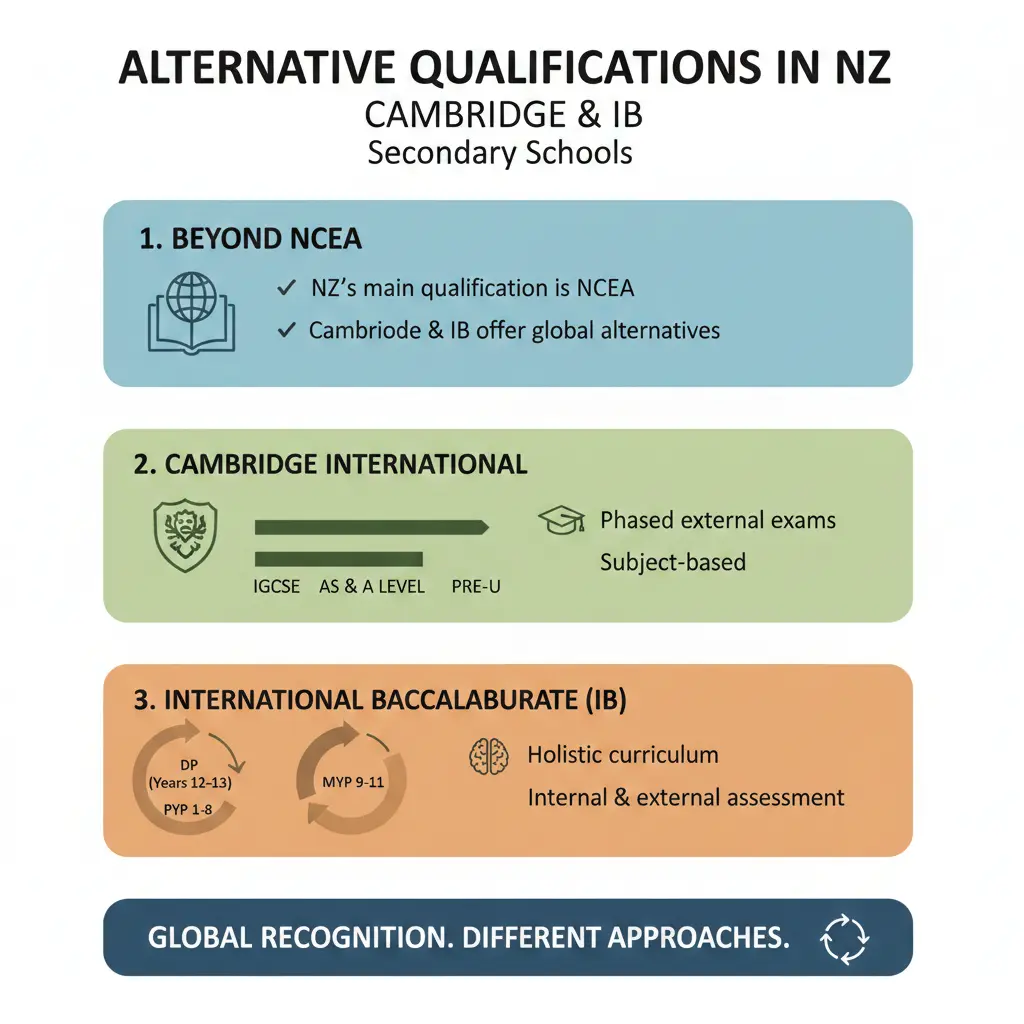
Offered by Cambridge Assessment International Education, CIE spans IGCSE (Years 10-11), AS Levels (Year 12), and A Levels (Year 13). It's linear and subject-based, emphasising depth in chosen areas like Maths, Sciences, or Humanities. Schools such as Huanui College in Northland run both June and November exam series, with tailored exam plans for each student.
Private candidates can sit exams too—ideal for homeschoolers or those switching pathways—as long as they're accepted at a registered centre. Fees for international students at places like Avondale College hit around NZD19,500 for Year 11 IGCSE in 2026.
International Baccalaureate (IB) Diploma in NZ
The IB Diploma, for Years 12-13, requires six subjects across language, maths, science, arts/humanities, plus core elements: Theory of Knowledge (TOK), Creativity, Activity, Service (CAS), and a 4,000-word Extended Essay. It's holistic, fostering global thinkers. NZ has about 20 IB Diploma schools, including ACG Senior College and St Kentigern College, with entry often competitive based on prior grades.
How Do Cambridge, IB, and NCEA Compare?
Choosing between these depends on your child's learning style. NCEA is modular and internal-assessment heavy; Cambridge is exam-intensive; IB balances breadth with inquiry-based learning. Here's a breakdown:
| Aspect | NCEA | Cambridge (CIE) | IB Diploma |
|---|---|---|---|
| Content | Standards-based across levels 1-3; flexible subjects and electives. | IGCSE/AS/A Levels; deep dive into 5-6 subjects with global syllabuses. | 6 subjects + core; interdisciplinary, international mindset. |
| Assessment | 60-80% internal (coursework), 20-40% external exams; credits accumulated. | Mostly final exams (80-100%); grades A*-G or U. | Mix: exams (70-80%), internals like essays/orals; total points 45 max. |
| University Recognition | Standard UE: 14 credits each in approved subjects, literacy/numeracy. | Full UE with 120 points from 3+ syllabus groups; rank score up to 420. | UE via 24 points + literacy/numeracy; rank score conversion (e.g., 38 IB pts = 280). |
| Best For | Practical learners, vocational paths, resits possible. | Exam pros, specialists (e.g., Cambridge Maths). | Broad thinkers, uni-bound globally. |
Content and Curriculum Depth
NCEA lets students mix levels and standards, suiting varied paces. Cambridge builds progressively: IGCSE foundations lead to AS/A Levels with advanced topics like multi-step calculus or research projects. IB mandates breadth—no dropping maths or a second language—plus TOK challenges assumptions, unlike NCEA's subject silos.
For Kiwi context, Cambridge aligns with NZ's approved subjects list, while IB's global focus suits immigrants or OE aspirants.
Assessment Styles
NCEA's internals allow teacher moderation via the NZQA, but externals test endurance. Cambridge is high-stakes: two exam series yearly, no resits mid-year except privates. Students get marks and grades (A*-E for AS/A, A*-G for IGCSE). IB blends predicted grades with finals, reducing single-exam pressure but demanding consistent effort.
Pro tip: If your teen shines in timed conditions, Cambridge's rigour preps them for uni exams worldwide.
University Entrance and Rank Scores in 2026
All three grant UE for NZ unis. For Cambridge: Part A needs 120 tariff points from 3+ syllabus groups (e.g., A* A Level = 140 pts), plus literacy (E+ in AS English) and numeracy (D+ IGCSE Maths). Rank score uses best 6 units: max 420 (e.g., 3 A* A Levels).
IB converts to rank scores—e.g., 38/45 points equals ~280, competitive for Auckland's MBChB (rank 250+). All NZ unis accept both, per Universities NZ. Overseas? Cambridge/IB edge out NCEA for UK/Ivy League due to familiarity.
Check programme specifics: e.g., Otago Medicine wants Cambridge A*/A in Sciences; some offer equity pathways for Māori/Pasifika with 130+ rank.
Costs and Accessibility in NZ
- NCEA: Free at state schools; exam fees ~NZD100/subject.
- Cambridge: School fees vary; privates ~NZD500-1,000/exam entry. Find schools via Cambridge's directory.
- IB: Often NZD15,000-25,000/year at private/integrated schools; scholarships via MOE for high achievers.
Private Cambridge entry at Huanui? Northland residents welcome, prior sitters for June series.
Which Qualification Suits Your Kiwi Student?
No one-size-fits-all. NCEA fits most—85% of Year 13s take it—but alternatives shine for:
- Cambridge: Independent studiers, maths/science whizzes, or global uni hopefuls. Builds resilience via tough exams.
- IB: Well-rounded kids loving debate/projects; ideal for humanities/arts.
- Stick with NCEA: If hands-on learning or trades appeal—pair with Gateway for work experience.
Assess via school decile, your whānau goals, and trials. Visit open days at Cambridge hubs like Pinehurst School.
Pros and Cons at a Glance
- Cambridge Pros: Portable worldwide, specialist depth, clear progression.
- Cons: Exam stress, less breadth.
- IB Pros: Holistic skills, uni prep.
- Cons: Heavy workload, fewer schools.
- NCEA Pros: Flexible, NZ-tailored.
- Cons: Variable standards perception overseas.
Real NZ Examples: Schools Leading the Way
Auckland's top Cambridge performers include King's College and St Cuthbert's, with 2025 results showcasing A* hauls. IB stars? Kristin School's cohorts snag Oxford offers. Check NZQA's directory or Cambridge's school finder for locals.
Frequently Asked Questions
Related Articles

Best Secondary Schools in Auckland: A 2026 Guide
Choosing the right secondary school in Auckland sets your tamariki up for success in NCEA, university entrance, and beyond. With Auckland's diverse mix of decile-rated state schools, elite privates, a...
School Zones Explained: How Your Address Affects Your Child’s Education
Ever wondered why your neighbour's kids go to a top-rated secondary school while yours might face a ballot? Your home address could be the key to unlocking the best educational opportunities for your...

University Entrance Requirements NZ 2025/2026
As Year 13 looms large for many Kiwi students, understanding University Entrance Requirements NZ 2025/2026 is your ticket to a smooth transition to uni life. Whether you're aiming for Auckland, Otago, or a...