University Entrance Requirements NZ 2025/2026

As Year 13 looms large for many Kiwi students, understanding University Entrance Requirements NZ 2025/2026 is your ticket to a smooth transition to uni life. Whether you're aiming for Auckland, Otago, or a...
The Lifetimes NZ editorial team curates, fact-checks, and updates guides on personal finance, property, health, immigration, legal, business, and lifestyle topics relevant to Lifetimes NZ readers. Articles are produced with AI assistance and reviewed by the editorial team before publication.
As Year 13 looms large for many Kiwi students, understanding University Entrance Requirements NZ 2025 is your ticket to a smooth transition to uni life. Whether you're aiming for Auckland, Otago, or anywhere in between, nailing these requirements means less stress and more focus on your future career.
What is University Entrance (UE) in New Zealand?
University Entrance, or UE, is the minimum standard all New Zealand universities use to admit domestic students into undergraduate programmes. Set by the New Zealand Qualifications Authority (NZQA), it ensures you're ready for the academic rigour of tertiary study. Achieving UE doesn't guarantee a spot in your dream course—many programmes have extra requirements like interviews or portfolios—but it's the essential first step.
For 2025 and 2026 intakes, these standards remain consistent, reflecting Universities New Zealand's guidelines amid any study disruptions. If you're a homeschooled student, international applicant, or coming via an alternative pathway, there are tailored options too.
NCEA Requirements for University Entrance
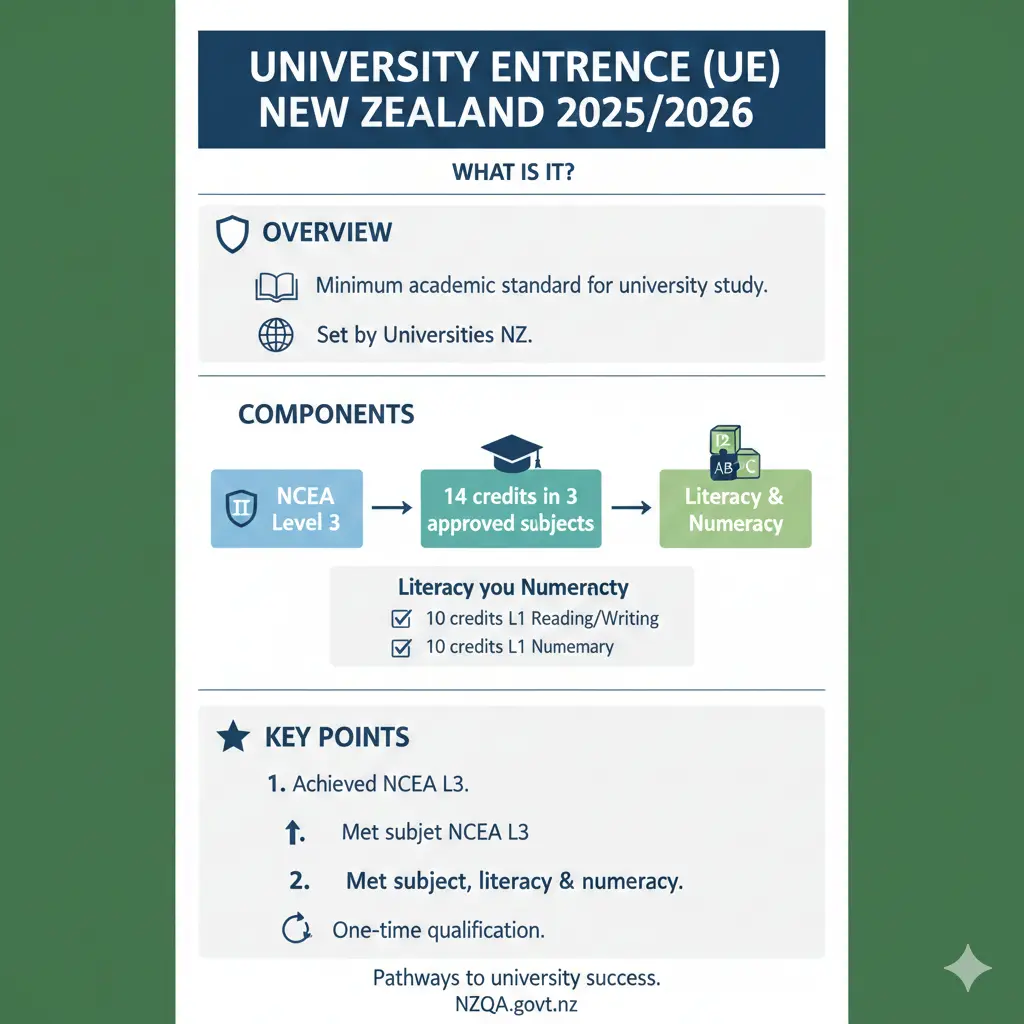
The most common route to UE is through the National Certificate of Educational Achievement (NCEA) at Level 3. Here's exactly what you need:
- NCEA Level 3 certificate, which requires 80 credits at Level 3 or above, with 60 at Level 3 or higher.
- 14 credits at Level 3 in each of three approved subjects. Approved subjects are those on NZQA's list, like English, maths, sciences, or te reo Māori—check the full roster on the NZQA site to plan your timetable wisely.
- 10 Literacy credits at Level 2 or above: at least 5 in reading and 5 in writing. These can come from English-rich subjects or specific unit standards.
- 10 Numeracy credits at Level 1 or above: via co-requisite standards like 32406 (Pāngarau) or 32412 (Te Pāngarau), or approved achievement standards in maths or related fields.
Approved Subjects List
NZQA maintains a dynamic list of approved subjects for UE. Classics include:
- English, Te Reo Māori, or Te Reo Rangatira
- Calculus, Statistics, or General Mathematics
- Biology, Chemistry, Physics
- History, Geography, Economics
- And many more—over 80 options to suit your strengths.
Pro tip: Pick subjects aligning with your intended degree. For engineering, prioritise calculus and physics; for health sciences, biology and chemistry are key.
Literacy and Numeracy Requirements Explained
Since 2025, literacy and numeracy are non-negotiable for UE, addressing foundational skills gaps. You need:
- Reading (5 credits): From standards like English 3.9 (reading-focused) or unit standard 32413.
- Writing (5 credits): English 3.4 or unit standard 32415.
- Numeracy (10 credits): Level 1 standards like 32406 ensure practical number skills for uni-level maths.
These credits are flexible—many subjects double up. Use NZQA's Literacy and Numeracy tool to track progress via the Learner Login.
"To be awarded UE, you need NCEA Level 3, 14 credits at Level 3 in each of 3 approved subjects, 10 Literacy credits... and 10 Numeracy credits."
Alternative Pathways to University Entrance
Not everyone follows the NCEA path. Here's how others gain UE:
International Qualifications
- CIE GCE A Levels: Minimum 120 UCAS points from three subjects (equivalent to approved NCEA ones), D grade or better in three, plus English and maths requirements.
- International Baccalaureate (IB): Full diploma with 24 points minimum, English at Language A1 (Higher or Standard), and maths.
- Other: Cambridge AS/A Levels, high school diplomas with specific GPA cut-offs (e.g., USA GPA 2.5), or country-specific equivalents like India's CSAT 250+.
Non-Standard New Zealand Pathways
- Steiner Education Level 3: 9 points in each of 3 approved subjects, 8 in literacy (4 reading/4 writing), 9 in numeracy.
- Christian Education NZ (CENZ) Level 3: Completed certificate with 4 Level 3 subjects, passes in Algebra 1 and English 1.
- Special Admission (Over 20s): For Kiwis/Aussies over 20, via foundation like New Start at University of Auckland—requires B+ GPA in specific courses.
- Foundation Programmes: Offered by unis or providers; complete one to bridge to UE.
Universities like Lincoln and Waikato assess case-by-case for others.
University-Specific Requirements Beyond UE
UE gets you in the door, but programmes demand more:
| University | Example Programme | Extra Requirements |
|---|---|---|
| University of Auckland | Bachelor of Arts | B+ in New Start NSGEN 47 (Special Admission) |
| Lincoln University | General Entry | Follows Universities NZ; disruptions considered |
| University of Waikato | Bachelor's | English proficiency (IELTS 6.0+ for internationals) |
Check each uni's site—e.g., health degrees often need UCAT or interviews.
Practical Tips to Meet UE in 2025/2026
- Plan Early: Year 12, secure literacy/numeracy. Year 13, lock in 3 approved Level 3 subjects.
- Track Progress: Use NZQA's Real-Time Results via schools or Learner Login.
- Seek Help: Talk to your dean or careers advisor. Gateway programmes or STAR courses can boost credits.
- Endorsements Matter: Aim for Merit/Excellent to stand out for scholarships like KiwiSaver boosts or uni-specific aid.
- Discretion for Disruptions: COVID or other issues? Unis follow Universities NZ flexibilities.
- International Kiwis: Prove residency with birth cert, passport, or IRD number.
Common Mistakes to Avoid
- Ignoring literacy/numeracy until it's too late—many fail here.
- Choosing unapproved subjects—double-check NZQA's list.
- Not applying for UE award—it's free via your school post-exams.
- Overlooking programme-specifics like limited-entry courses (e.g., Medicine via UCAT).
Next Steps for Your Uni Journey
Grab your NCEA record from NZQA, map your subjects, and chat with a careers advisor today. Apply via your uni's portal by key deadlines—July for February 2026 intake. Explore KiwiSaver for fees, StudyLink loans, and scholarships on universitiesnz.ac.nz. You've got this—kia kaha!
Frequently Asked Questions
Sources & References
-
1
University Entrance - NZQA — www2.nzqa.govt.nz
-
2
Entry requirements - Lincoln University — www.lincoln.ac.nz
-
3
2025 Entry Requirements to The University of Auckland (PDF) — www.auckland.ac.nz
-
4
Entry requirements for international students - University of Waikato — www.waikato.ac.nz
-
5
Study Intakes in New Zealand 2025 - Canam Consultants — www.canamgroup.com
-
6
Am I eligible? | Universities New Zealand - Te Pōkai Tara — www.universitiesnz.ac.nz
- 7
-
8
Entry requirements for international students - Massey University — www.massey.ac.nz
-
9
University Entrance requirements review - NZQA — www2.nzqa.govt.nz
Useful Tools
Related Articles

Best Secondary Schools in Auckland: A 2026 Guide
Choosing the right secondary school in Auckland sets your tamariki up for success in NCEA, university entrance, and beyond. With Auckland's diverse mix of decile-rated state schools, elite privates, a...

School Zones Explained: How Your Address Affects Your Child’s Education
Ever wondered why your neighbour's kids go to a top-rated secondary school while yours might face a ballot? Your home address could be the key to unlocking the best educational opportunities for your...
Alternative Qualifications: Cambridge and IB in NZ
Considering the NCEA pathway but wondering if there's more out there? For Kiwi families seeking alternative qualifications like Cambridge and IB in NZ, these globally recognised programmes offer rigor...