Beginner's Guide to Investing in New Zealand (2026)
Learn how to start investing in New Zealand with as little as $1. Compare platforms like Sharesies, InvestNow, Kernel and Hatch. Understand funds, shares, tax rules and build your first portfolio
The Lifetimes NZ editorial team curates, fact-checks, and updates guides on personal finance, property, health, immigration, legal, business, and lifestyle topics relevant to Lifetimes NZ readers. Articles are produced with AI assistance and reviewed by the editorial team before publication.
If you've been meaning to start investing but keep putting it off because it all seems too complicated, you're not alone. Many Kiwis feel the same way — and yet investing has never been more accessible in New Zealand than it is right now. You can open an account in minutes, start with as little as one cent on some platforms, and build a diversified portfolio without needing a finance degree.
This guide walks you through everything you need to know to get started, from understanding the basic types of investments available to choosing the right platform and navigating New Zealand's tax rules. Whether you're a student setting aside $20 a week or a working professional looking to grow your savings beyond KiwiSaver, this is your starting point.
What Does "Investing" Actually Mean?
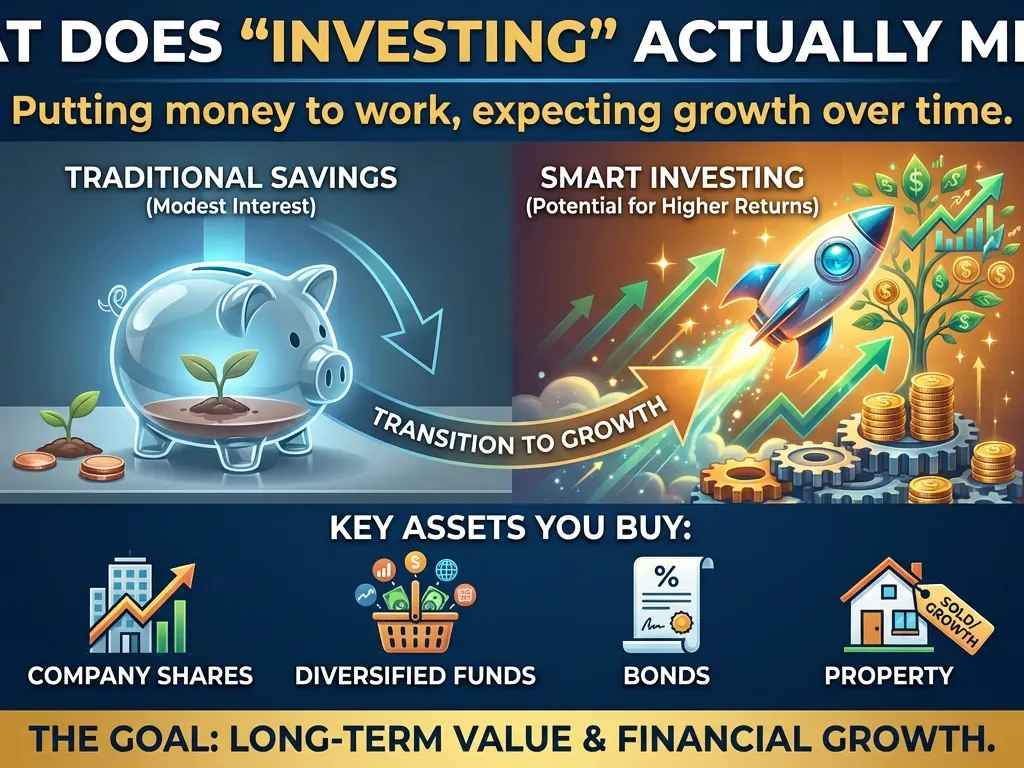
At its simplest, investing means putting your money into something with the expectation that it will grow in value over time. Instead of leaving your savings sitting in a bank account earning modest interest, you buy assets — shares in companies, funds that hold a basket of investments, bonds, or property — that have the potential to deliver higher returns over the long term.
The trade-off is risk. Unlike a term deposit where your return is guaranteed, investments can go up and down in value. A share you buy for $10 today might be worth $12 next year — or $8. The key to successful investing is understanding this relationship between risk and return, and making choices that suit your personal situation, goals and timeframe.
Why Should Kiwis Invest (Beyond KiwiSaver)?
If you already have KiwiSaver, you're technically already an investor. Your contributions are being invested in managed funds on your behalf. But KiwiSaver has limitations — your money is locked away until you turn 65 (with some exceptions for first-home buyers and financial hardship), and there's a cap on how much the government contributes each year.
Investing outside of KiwiSaver gives you flexibility. You can access your money when you need it, invest in specific companies or sectors you believe in, and build wealth that isn't tied to retirement. Many Kiwis use non-KiwiSaver investments to save for medium-term goals like a house deposit, a business venture, travel, or simply to build a financial safety net.
There's also the effect of compound growth to consider. When your investments earn returns, those returns get reinvested and start earning returns of their own. Over 10, 20 or 30 years, compounding can turn modest regular contributions into a substantial sum. The earlier you start, the more time compounding has to work in your favour.
Understanding the Main Types of Investments
Shares (Stocks)
When you buy shares in a company, you're buying a small ownership stake. If the company does well, the value of your shares tends to rise, and many companies also pay dividends — a share of their profits distributed to shareholders. New Zealand's share market (the NZX) lists companies like Fisher & Paykel Healthcare, Mainfreight, Auckland International Airport and Contact Energy.
You can also buy shares listed on overseas exchanges — the US market (NYSE, NASDAQ) is particularly popular with Kiwi investors, offering access to companies like Apple, Microsoft and Amazon.
Shares tend to deliver the highest long-term returns among common investment types, but they also carry the most short-term volatility. Individual share prices can swing dramatically based on company performance, industry trends, and broader economic conditions.
Funds (Managed Funds, Index Funds and ETFs)
Rather than picking individual companies, you can invest in a fund that holds a diversified basket of investments. This is the most popular approach for beginners because it spreads your risk across many companies and sectors.
There are several types of funds available in New Zealand:
Managed funds are actively managed by professional fund managers who decide which investments to buy and sell. They charge higher fees in exchange for their expertise. Examples include funds offered by Milford, ANZ and Fisher Funds.
Index funds track a specific market index — for example, the NZX 50 (New Zealand's top 50 companies) or the S&P 500 (America's 500 largest companies). Because they follow the index rather than making active decisions, they charge lower fees. Kernel, Simplicity and Smart (formerly Smartshares) are popular index fund providers in New Zealand.
Exchange-traded funds (ETFs) are similar to index funds but are listed on the stock exchange, meaning you can buy and sell them throughout the trading day like shares. Smart is the main provider of NZ-listed ETFs.
For most beginners, index funds or ETFs are the best starting point. Research consistently shows that low-cost index funds outperform the majority of actively managed funds over the long term, largely because their lower fees don't eat into your returns.
Bonds and Fixed-Interest Investments
Bonds are essentially loans you make to a government or company in exchange for regular interest payments. They're generally less risky than shares but also offer lower returns. In New Zealand, you can invest in government bonds, corporate bonds or bond funds through various platforms.
Term Deposits
While not technically "investing" in the traditional sense, term deposits are a low-risk way to earn a fixed return on your money over a set period. They're suitable for short-term savings goals or as the conservative portion of a broader portfolio.
How to Start Investing in New Zealand: Step by Step
Step 1: Get Your Finances in Order First
Before you invest a single dollar, make sure you've covered the basics. This means having a budget in place, paying off any high-interest debt (credit cards, personal loans), and building an emergency fund that can cover three to six months of essential expenses. There's no point earning 8% on investments if you're paying 20% interest on credit card debt.
You should also make sure you're getting the most out of KiwiSaver. If you're employed and contributing at least $20.12 per week (roughly $1,042.86 per year), you'll receive the full annual government contribution of $521.43 (at 50 cents per dollar contributed, effective from 1 July 2025). If you're not contributing enough to get this, top up your KiwiSaver first — it's essentially free money.
Step 2: Decide What You're Investing For
Your investment goals and timeframe will determine what you should invest in. Generally:
Short-term (1–3 years): If you'll need the money soon, stick with lower-risk options like term deposits, cash funds or conservative managed funds. You don't want the market to drop right when you need to withdraw.
Medium-term (3–7 years): A balanced mix of shares and bonds can work well. You have enough time to ride out some market ups and downs, but you still want some stability.
Long-term (7+ years): This is where growth-oriented investments like share funds and ETFs really shine. Over long periods, the share market has historically delivered returns of around 7–10% per year on average, despite short-term volatility.
Step 3: Understand Your Risk Tolerance
Risk tolerance is about how comfortable you are with your investment value going up and down. Be honest with yourself. If seeing your portfolio drop by 20% would keep you up at night and tempt you to sell everything, you should lean towards a more conservative investment mix.
Most investment platforms offer a risk profiler or investor questionnaire to help you figure out where you sit on the spectrum from conservative to aggressive.
Step 4: Choose an Investment Platform
This is where New Zealand really shines. Over the past several years, a wave of innovative platforms has made investing incredibly accessible and affordable for everyday Kiwis. Here are the main options:
For Funds and ETFs (Best for Most Beginners)
InvestNow is a fund platform offering access to over 150 funds from 27+ fund managers, including Smart, Milford, ANZ and Vanguard. There are no platform fees — you only pay the fund management fees. The minimum one-off investment is $250, or $50 for a regular investment plan. InvestNow is an excellent choice if you want access to a wide variety of funds from different managers in one place.
Kernel specialises in low-cost index funds with a New Zealand focus. They offer 23+ index funds, a high-interest savings account and a KiwiSaver scheme. The management fees are among the lowest in New Zealand at 0.25% per year for core funds, with a $5 monthly membership fee if your balance exceeds $25,000. Kernel is ideal if you want a simple, low-cost index fund approach.
Simplicity offers a small range of low-cost diversified funds (including a Growth Fund, Balanced Fund and Conservative Fund) with management fees of just 0.10% to 0.31% per year. The minimum investment is $1,000 per fund. Simplicity is a great no-frills option if you want a "set and forget" diversified fund.
For Shares and ETFs
Sharesies is New Zealand's most popular retail investment platform, with access to NZ, Australian and US share markets. There's no minimum investment — you can start with literally one cent thanks to fractional shares. Sharesies also offers funds and ETFs, auto-invest features and a KiwiSaver scheme. It charges brokerage fees on trades. Sharesies is the go-to for beginners who want an easy, app-based experience.
Hatch focuses on US-listed shares and ETFs, offering access to over 5,800 investments on the NYSE and NASDAQ. It charges a flat US$3 per trade (for up to 300 shares) plus a 0.50% foreign exchange fee. Hatch is Wellington-based and well-suited to investors who want straightforward access to the US market.
Stake is an Australian-based platform available to Kiwis, offering access to US shares with a 1% FX fee on deposits and withdrawals. It has a full-featured trading interface suited to more active investors.
For a Hands-Off Approach
If you'd rather not choose individual investments at all, consider a robo-advisor approach. Platforms like Simplicity and Kernel let you invest in pre-built diversified portfolios based on your risk profile. You just set up regular contributions and let the platform handle the rest.
Step 5: Make Your First Investment
Once you've chosen a platform and opened an account (which typically takes 5–10 minutes and requires your IRD number and a form of ID), it's time to invest. For most beginners, a sensible first investment is a diversified index fund — something like:
A New Zealand share fund (tracks the NZX 50) for local market exposure, combined with a global share fund (tracks international markets) for diversification. Many providers offer a single "total world" or "global" fund that gives you exposure to thousands of companies worldwide.
Don't overthink it. The most important step is simply starting. You can always adjust your investments later as you learn more.
Step 6: Set Up Regular Contributions
One of the most effective investing strategies is also the simplest: invest a fixed amount at regular intervals (weekly, fortnightly or monthly), regardless of what the market is doing. This is called dollar-cost averaging.
When prices are high, your regular contribution buys fewer units. When prices are low, it buys more. Over time, this smooths out the effect of market volatility and removes the temptation to "time the market" — something even professional investors struggle to do consistently.
Most platforms let you set up automatic investments, so the money leaves your bank account and gets invested without you having to think about it.
Understanding Tax on Investments in New Zealand
Tax is the part most beginners dread, but for the majority of Kiwi investors, it's actually quite straightforward — especially if you invest through the right structures.
PIE Funds (Portfolio Investment Entities)
Many funds available in New Zealand are structured as PIEs (Portfolio Investment Entities). This is good news for investors because PIE income is taxed at your prescribed investor rate (PIR), which maxes out at 28% — compared to the top personal income tax rate of 39%.
The three PIR rates are 10.5%, 17.5% and 28%, depending on your income level. Your fund provider handles the tax calculations and payments on your behalf, so you generally don't need to do anything extra in your tax return.
When you sign up for a PIE fund, make sure you set the correct PIR. If you set it too high, you may overpay tax (though you can now get a refund). If you set it too low, you could end up with a tax bill.
Tax on New Zealand and Australian Shares
For shares listed on the NZX and most shares listed on the Australian Stock Exchange (ASX), there's no capital gains tax in New Zealand. You only pay tax on dividends you receive, which are taxed at your marginal income tax rate. Most platforms deduct resident withholding tax (RWT) automatically.
Tax on Overseas Shares (FIF Rules)
This is where things get a bit more complex. If you hold overseas shares (other than most Australian shares) worth more than $50,000 in total cost, the Foreign Investment Fund (FIF) rules kick in.
Under the most common method — the Fair Dividend Rate (FDR) — you're taxed as if your overseas investments earned 5% per year, regardless of actual performance. This 5% is then taxed at your marginal income tax rate.
The good news for beginners is that if your total cost of overseas shares stays under $50,000, you're exempt from FIF rules altogether. And if you invest in overseas shares through a PIE fund (like a Smart Total World ETF held via InvestNow or Sharesies), the fund handles all the FIF tax calculations internally at the capped PIR of 28%.
Tip for beginners: Investing in overseas markets through NZ-domiciled PIE funds is the simplest approach from a tax perspective. The fund does all the FIF and tax work for you.
Recent Tax Changes to Know About
The government has been making changes to make investing more attractive. From 1 July 2025, the KiwiSaver government contribution dropped from 50 cents per dollar to 50 cents (calculated on $1,042.86), while employer minimum contributions are increasing to 3.5% in 2026 and 4% in 2028. There are also proposed changes to FIF rules (the Revenue Account Method) aimed at making New Zealand more attractive for migrants with overseas investments.
Common Beginner Mistakes to Avoid
Trying to time the market. Nobody — not even professional fund managers — can consistently predict when markets will rise or fall. Invest regularly and stay the course.
Checking your portfolio too often. Daily price movements are noise. If you're investing for the long term, checking once a month or even once a quarter is plenty.
Putting all your eggs in one basket. Don't invest everything in a single company or sector. Diversification is your best protection against risk.
Letting fees eat your returns. A 1% annual fee might not sound like much, but over 30 years it can cost you tens of thousands of dollars. Compare fees carefully and favour low-cost options where possible.
Investing money you'll need soon. Only invest money you won't need for at least three years (ideally longer). Markets can drop significantly in the short term.
Waiting for the "perfect time" to start. There's no perfect time. The best time to start investing was 10 years ago. The second-best time is today.
Building Your First Portfolio: A Simple Approach
If you want a straightforward starting portfolio, here's a common approach used by many Kiwi investors:
Allocate a percentage to a New Zealand share index fund (e.g. a fund tracking the NZX 50 or the S&P/NZX 50 Portfolio Index) to support local companies and benefit from favourable NZ tax treatment.
Allocate the majority to a global share index fund (e.g. a total world fund or an S&P 500 fund) for international diversification and access to the world's largest and most innovative companies.
If you're more conservative, add a portion in bonds or a conservative fund to reduce overall portfolio volatility.
A common split for a young investor with a long timeframe might be 80% shares (split between NZ and global) and 20% bonds or conservative funds. As you get older or closer to needing the money, you'd gradually shift more towards bonds and cash.
Many fund providers like Kernel and Simplicity offer pre-built diversified funds (Growth, Balanced, Conservative) that handle this allocation for you automatically.
How Much Do You Need to Start?
One of the best things about investing in New Zealand today is that the barriers to entry have virtually disappeared:
- Sharesies: No minimum investment (start with 1 cent)
- Kernel: $10 minimum per fund
- InvestNow: $250 one-off or $50 regular investment
- Simplicity: $1,000 per fund
- Hatch: No minimum investment for US shares
You don't need thousands of dollars to begin. Even $20 or $50 a week, invested consistently over many years, can build meaningful wealth.
Glossary of Key Terms
Brokerage: The fee charged by a platform when you buy or sell shares or ETFs.
Dividend: A payment made by a company to its shareholders, usually from profits.
Diversification: Spreading your investments across different assets to reduce risk.
ETF (Exchange-Traded Fund): A fund that is listed on the stock exchange and can be bought and sold like shares.
FIF (Foreign Investment Fund): The NZ tax rules that apply to overseas investments valued over $50,000.
Index fund: A fund that tracks a specific market index rather than being actively managed.
PIE (Portfolio Investment Entity): A tax-efficient fund structure in NZ where tax is capped at 28%.
PIR (Prescribed Investor Rate): Your tax rate for PIE investments — 10.5%, 17.5% or 28%.
Portfolio: Your complete collection of investments.
Volatility: How much the price of an investment fluctuates over time.
What to Do Next
Getting started is simpler than you might think. Here's a practical action plan:
- Review your finances — make sure your emergency fund is in place and high-interest debt is under control.
- Maximise your KiwiSaver — ensure you're contributing enough to get the full government contribution.
- Pick a platform — for most beginners, Sharesies, InvestNow or Kernel are excellent starting points.
- Open an account — you'll need your IRD number and a form of photo ID.
- Start small — invest an amount you're comfortable with in a diversified fund.
- Set up automatic contributions — consistency matters more than the amount.
- Keep learning — the more you understand, the more confident you'll become.
Investing is a marathon, not a sprint. The decisions you make today — even with small amounts — set the foundation for your financial future. The most important thing isn't picking the "perfect" investment. It's starting.
Disclaimer: This article is for general information purposes only and does not constitute financial advice. Investing involves risk, including the potential loss of principal. Past performance does not guarantee future results. Consider seeking advice from a licensed financial adviser before making investment decisions.
Related Articles on Lifetimes NZ:
- KiwiSaver Basics and Fund Selection
- Best Savings Accounts NZ 2025
- Tax Planning for Freelancers
- How to Budget in NZ
Useful External Resources:
Related Articles

Working Multiple Jobs NZ: Tax and Legal Considerations
Juggling multiple jobs can boost your income, but it's crucial to understand the tax implications and legal requirements that come with working more than one role in Aotearoa. Whether you're a contrac...

Name Changes NZ: Legal Process and Costs
Considering a fresh start with a new name? Whether it's after marriage, divorce, or simply embracing a personal transformation, changing your name in New Zealand is straightforward but requires follow...

Holiday Home Tax Rules NZ: Private Use and Rental
Own a bach in Coromandel or a holiday home in Queenstown? You're not alone—many Kiwis cherish these escapes, but renting them out while enjoying personal use can trip you up on tax rules. Getting the...

Industry Bodies and Professional Associations NZ
Whether you're launching a business, advancing your career, or navigating financial regulations, industry bodies and professional associations in New Zealand offer invaluable support. These organisati...