Changing Courses: Transferring Credit and Starting Over

Ever started a degree only to realise midway it's not the right fit? You're not alone—many Kiwis face this crossroads, weighing the cost of starting over against the potential of transferring credits...
The Lifetimes NZ editorial team curates, fact-checks, and updates guides on personal finance, property, health, immigration, legal, business, and lifestyle topics relevant to Lifetimes NZ readers. Articles are produced with AI assistance and reviewed by the editorial team before publication.
Ever started a degree only to realise midway it's not the right fit? You're not alone—many Kiwis face this crossroads, weighing the cost of starting over against the potential of transferring credits to save time and money.
In Aotearoa, changing courses doesn't have to mean wiping the slate clean. With tools like credit recognition and transfer (CRT), recognition of prior learning (RPL), and cross-crediting, you can carry forward your hard-earned progress. This guide breaks down the process for 2026, tailored for New Zealand students, so you can make informed decisions without unnecessary debt or delays.
Understanding Credit Transfer in New Zealand
Credit transfer allows you to apply credits earned at one tertiary provider towards a qualification at another. It's governed by NZQA rules and individual institution policies, ensuring your prior formal learning counts.
The New Zealand Qualifications and Credentials Framework (NZQCF) standardises levels, making transfers smoother across universities, polytechnics, and private training establishments (PTEs). For instance, a Level 6 business diploma from one provider might transfer to a similar programme elsewhere, though the amount depends on course similarity and evidence.
Key Types of Credit Recognition
- Credit Recognition and Transfer (CRT): Formal credits from a recognised provider. Ideal when switching institutions or qualifications.
- Cross-Credit: Using the same course credits towards two qualifications simultaneously or sequentially, often limited by points (e.g., max 120 points between two 360-point degrees).
- Recognition of Prior Learning (RPL): Credits for work experience, self-study, or informal learning, assessed against course outcomes. Max limits apply, like half an undergraduate qualification.
- Micro-Credentials: Short courses at NZQF Level 5+ (100-level equivalent) that can credit towards degrees, capped per qualification.
At the University of Canterbury, external credits can't exceed two-thirds of an undergraduate qualification or half for postgraduate, excluding theses. University of Auckland limits total transfer, cross, and internal credits to one-third of the programme value.
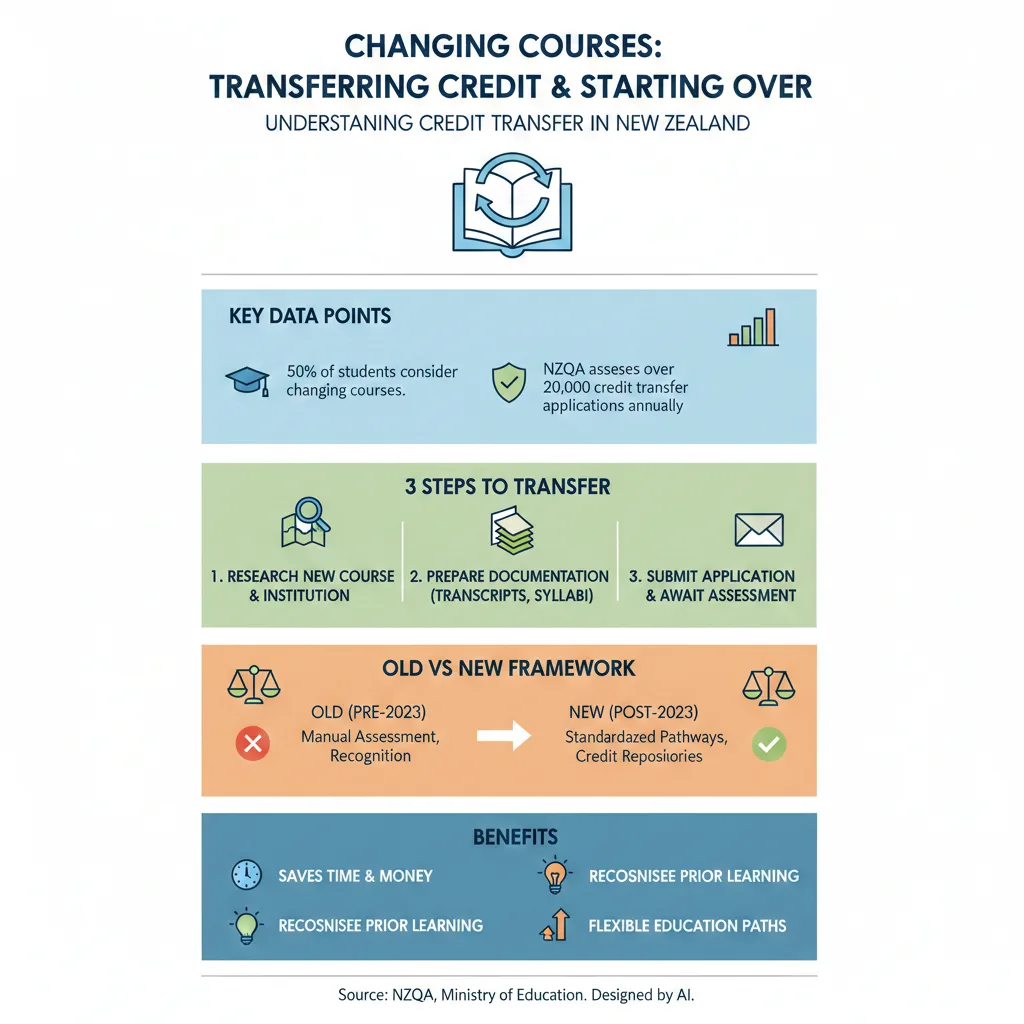
Steps to Transfer Credits When Changing Courses
Follow these practical steps to maximise your credits and minimise fees. Start early—processing can take weeks.
- Research Your New Programme: Check the receiving institution's credit policies on their website or via student services. Use NZQA's provider search for NZQCF alignment.
- Gather Evidence: Official transcripts, course outlines, NCEA results, or work portfolios for RPL. Courses over 10 years old often need RPL refreshers.
- Apply for Assessment: Submit to the new provider's faculty or admissions team. Fees may apply (e.g., $100–$300 for RPL).
- Get Approval: Deans or delegates decide based on level, relevance, and time limits (typically 10 years).
- Enrol and Confirm: Credits appear on your new academic record. Appeal if denied, providing more evidence.
Time Limits and Eligibility Rules
Most providers reject credits older than 10 years unless recent use is proven via RPL. University of Auckland requires transfer applications at admission for postgrad, within 5 semesters of completion. Open Polytechnic accepts NZDipBus courses within 10 years for cross-credit to their Bachelor of Business, needing at least a C pass.
Conferred qualifications usually can't transfer credits, avoiding double-dipping.
Financial Implications: Fees, Student Loans, and Savings
Changing courses impacts your finances, but smart transfers reduce costs. In 2026, tertiary fees for domestic students can rise up to 6% under AMFM regulations, with micro-credentials capped at $64 GST-inclusive per credit.
Student Loan Considerations: StudyLink allows loans for new enrolments, but transfers don't trigger repayments unless you exceed study limits. Track your entitlements via your StudyLink account—full-time undergrads get up to $15,244 in 2026 fees plus living costs. (Note: Rates indexed annually; check StudyLink.govt.nz.)
Cost-Saving Tips
- Transfer max credits to shorten study time, slashing fees and living costs.
- Opt for providers with generous cross-credit, like between diplomas and degrees.
- Combine RPL with part-time work to avoid full fees—e.g., Massey assesses capability via portfolios.
- Budget for assessment fees, but they're often offset by savings (e.g., 120 credits = ~$10,000 saved).
| Scenario | Without Transfer | With Max Transfer (e.g., 120 pts) | Savings |
|---|---|---|---|
| 360-pt Bachelor (3 yrs) | $45,000 fees | $30,000 (2 yrs) | $15,000 |
| Postgrad Dip (120 pts) | $12,000 | $6,000 (60 pts) | $6,000 |
Estimates based on 2026 avg fees; use TEC's fee finder for precision.
Disclaimer: This isn't personalised financial advice. Consult StudyLink, IRD, or a licensed adviser for your situation, especially KiwiSaver withdrawals or WINZ support.
Institution-Specific Policies for Kiwis
Policies vary, so compare before applying.
University of Canterbury
Executive Deans approve transfers meeting CUAP guidelines. Max external credit: 2/3 undergrad, 1/2 postgrad. Cross-credit limits: 120 pts between 360-pt degrees.
University of Auckland
One-third total credits cap. No cross-credits for Masters. 80 pts max from conjoint degrees.
Open Polytechnic and Others
NZDipBus cross-credits to business degrees if recent and C+ pass. Carey Baptist limits old credits; Massey excels in RPL.
NZQA oversees all via 2026 Programme Rules, ensuring fair accreditation.
Common Challenges and How to Overcome Them
Not all credits transfer seamlessly—dissimilar fields yield less (e.g., business to arts). Overcome by:
- Choosing aligned programmes.
- Appealing with detailed syllabi.
- Bridging courses for gaps.
- Seeking academic advice early.
For NCEA changers, note Level 2/3 reforms delay to 2028/2029, but uni entry uses current rules.
FAQ
1. How long does credit transfer take?
2–6 weeks, depending on provider. Apply before enrolment.
2. Can I transfer from a private provider?
Yes, if NZQA-approved and credits match NZQCF levels.
3. What's the max RPL credit?
Half undergrad, one-third postgrad at most unis.
4. Does transferring affect my student loan?
No repayments triggered, but check entitlements. Living costs require 0.3+ EFTS.
5. Can micro-credentials transfer?
Yes, Level 5+ to quals, with caps.
6. What if credits are denied?
Appeal with more evidence or try RPL.
Next Steps: Make Your Move
Ready to change courses? Log into your StudyLink account, contact your target uni's admissions (e.g., Canterbury's Amo Matua), and request a pre-assessment. Tools like NZQA's CRT guidelines and provider calendars empower you to graduate faster, debt-free(r).
Track 2026 fees via TEC updates, and remember: investing time now saves thousands later. Kia kaha—your best path awaits.
Related Articles

Industry Bodies and Professional Associations NZ
Whether you're launching a business, advancing your career, or navigating financial regulations, industry bodies and professional associations in New Zealand offer invaluable support. These organisati...

Emergency Benefit NZ: When You Have No Other Options
When you're struggling financially and don't qualify for other benefits, the Emergency Benefit might be your lifeline. It's a discretionary payment designed for Kiwis in genuine hardship who've exhaus...

Unpaid Internships NZ: Are They Legal?
Unpaid internships are a common pathway for students and graduates to gain work experience in New Zealand, but there's often confusion about whether they're actually legal. The short answer is: unpaid...

Estate Administration NZ: Managing Someone's Affairs After Death
Losing a loved one is one of life's toughest challenges, and stepping in to manage their estate can feel overwhelming. In New Zealand, estate administration—the process of handling someone's affairs a...